

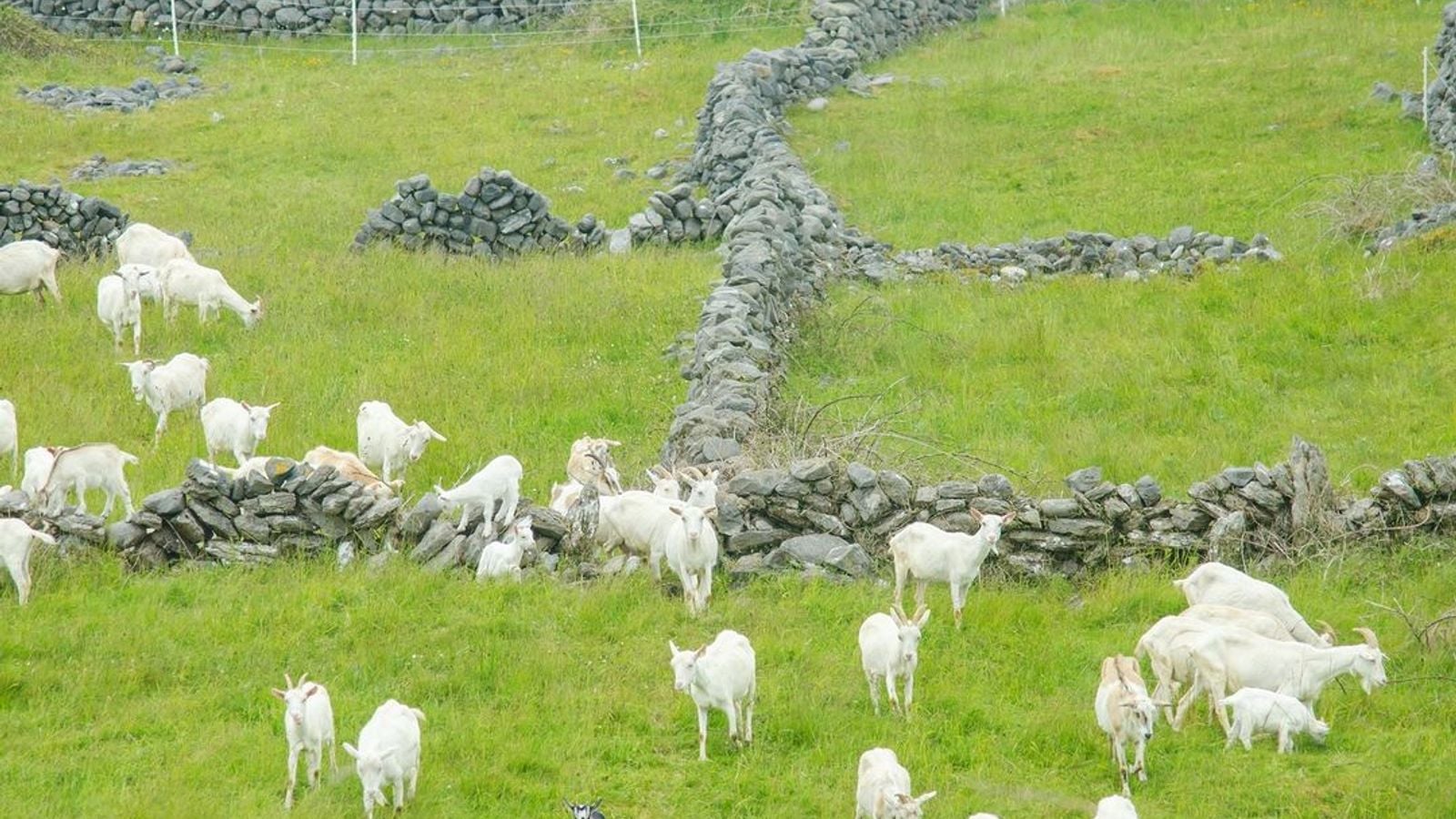
Stand on the clifftop of Inis Mór and look down. What you see isn’t just grass and sea. You see a jigsaw — thousands of tiny fields stitched together by grey stone walls that run to the very edge of the Atlantic. None of those walls contain mortar. Most are older than anyone can remember. And every single one of them has been placed by hand, stone by stone, in a tradition that never needed a written manual.
A Wall That Breathes
The first question every visitor asks is simple: why no mortar? The answer is deceptively brilliant.
A solid wall acts like a sail — it catches the wind. The gales rolling in off the Atlantic can reach over 100mph along the Irish coast. A mortared wall would crack and crumble within a generation.
A dry stone wall flexes. The gaps between the stones let the wind pass through, reducing pressure on the whole structure. Rainwater drains freely rather than pooling and freezing inside. The wall settles naturally over time, each stone finding its resting place. It works with the Irish weather, not against it.
The Art of Reading Stone
Building a dry stone wall isn’t simply a matter of piling rocks together. It is a discipline that takes years to master, and those who have it can tell simply by looking at a stone exactly where it belongs.
Each stone has a “bed” — the natural flat plane along which it was formed. Laid correctly, that bed faces downward. A stone placed wrong-side up will wobble, collect water, and eventually shift.
The largest, flattest stones form the base. Smaller stones fill the gaps. “Through stones” — long flat pieces — cross the full width of the wall at intervals to tie the two outer faces together. Capstones at the top are set at an angle to shed rain. The whole thing is an interlocking three-dimensional puzzle, and no two walls are exactly alike.
The Aran Islands: A Landscape Made by Hand
Nowhere in Ireland is the tradition more dramatic than on the Aran Islands, where the land itself tells the story. The islands were largely bare limestone rock when the first settlers arrived.
Over generations, they built the soil — carrying seaweed and sand from the shore, mixing it with crushed rock to create the thin, fertile fields that exist today. The stone had to go somewhere. And so it went into walls.
Today Inis Mór alone has over 1,500 kilometres of dry stone walls — an extraordinary figure for an island only 14 kilometres long. Seen from above, the effect is breathtaking: a human map scratched onto the limestone pavement, field by field, generation by generation. If you want to understand what life on the Aran Islands is really like, allow time simply to walk among the walls.
☘️ Enjoying this? 64,000+ Ireland lovers get stories like this every week. Subscribe free →
Knowledge Passed Through the Hands
There were no schools for this. No textbooks, no blueprints. The knowledge lived in families, passed from parent to child on cold mornings, watching and doing.
A skilled waller knew not just their own land but the stone of their parish — which quarry produced the flattest slabs, which hillside had the best throughstones, which field walls were likely to shift after a heavy frost. This hyper-local expertise meant that every region of Ireland developed its own distinct walling style.
The low, rounded walls of County Clare look nothing like the sharp-edged limestone walls of the Burren, or the dark slate walls of County Kerry. Each one is a signature of the land it came from.
In 2019, the Irish dry stone walling tradition was added to the UNESCO Intangible Cultural Heritage list — recognition of an art form that had existed for millennia without any official acknowledgement.
What the Walls Remember
Look at an old dry stone wall and you are looking at a record of everything that happened to the people who built it. Walls that run straight and true speak of stable, prosperous times.
Walls that suddenly veer off course, fade away in the middle of a field, or collapse inward around a vanished cottage foundation — those speak of harder times. Many of Ireland’s walls date to the Famine years of the 1840s, built under government relief schemes that paid starving labourers to construct roads and walls that nobody needed.
Those walls are still there. Some run to the edge of a cliff and stop. No one bothered to explain why.
The walls of Ireland are not decoration. They are memory, written in stone. If the landscape of the west of Ireland calls to you, start planning your Irish adventure here — and give yourself time to walk the walled fields slowly.
Still Standing
The oldest craft in Ireland asks nothing of you except to notice.
Next time you drive a country road and see a dry stone wall running alongside it — grey, uneven, unmortared, perhaps sagging slightly at one corner — slow down. Someone placed every stone in that wall with bare hands. They knew which stone went where before they even picked it up.
And a thousand years later, the wall is still standing.
☘️ You Might Also Love
☘️ Want More Hidden Ireland?
Join 64,000+ subscribers who discover Ireland’s best-kept secrets every week.
Subscribe Free — Join the Community →
Free forever · Unsubscribe anytime · No spam
📥 Free Download: Ireland Travel Planning Guide
Our most popular resource — itineraries, insider tips, and the 50 places you must not miss.
Tours & experiences you might love


Powered by Viator. Some links are affiliate links — we may earn a small commission at no extra cost to you.
Secure Your Dream Irish Experience Before It’s Gone!
Planning a trip to Ireland? Don’t let sold-out tours or packed attractions spoil your journey. Iconic experiences like visiting the Cliffs of Moher, exploring the Rock of Cashel, or enjoying a guided walk through Ireland’s ancient past often sell out quickly—especially during peak travel seasons.

Booking in advance guarantees your place and ensures you can fully immerse yourself in the rich culture and breathtaking scenery without stress or disappointment. You’ll also free up time to explore Ireland’s hidden gems and savour those authentic moments that make your trip truly special.
Make the most of your journey—start planning today and secure those must-do experiences before they’re gone!