

Scattered across Ireland’s countryside — rising from graveyards, monastery ruins, and cliff edges — stand some of the most puzzling stone structures in the world. Ireland’s round towers have defied explanation for over a thousand years. And the debate is still very much alive.
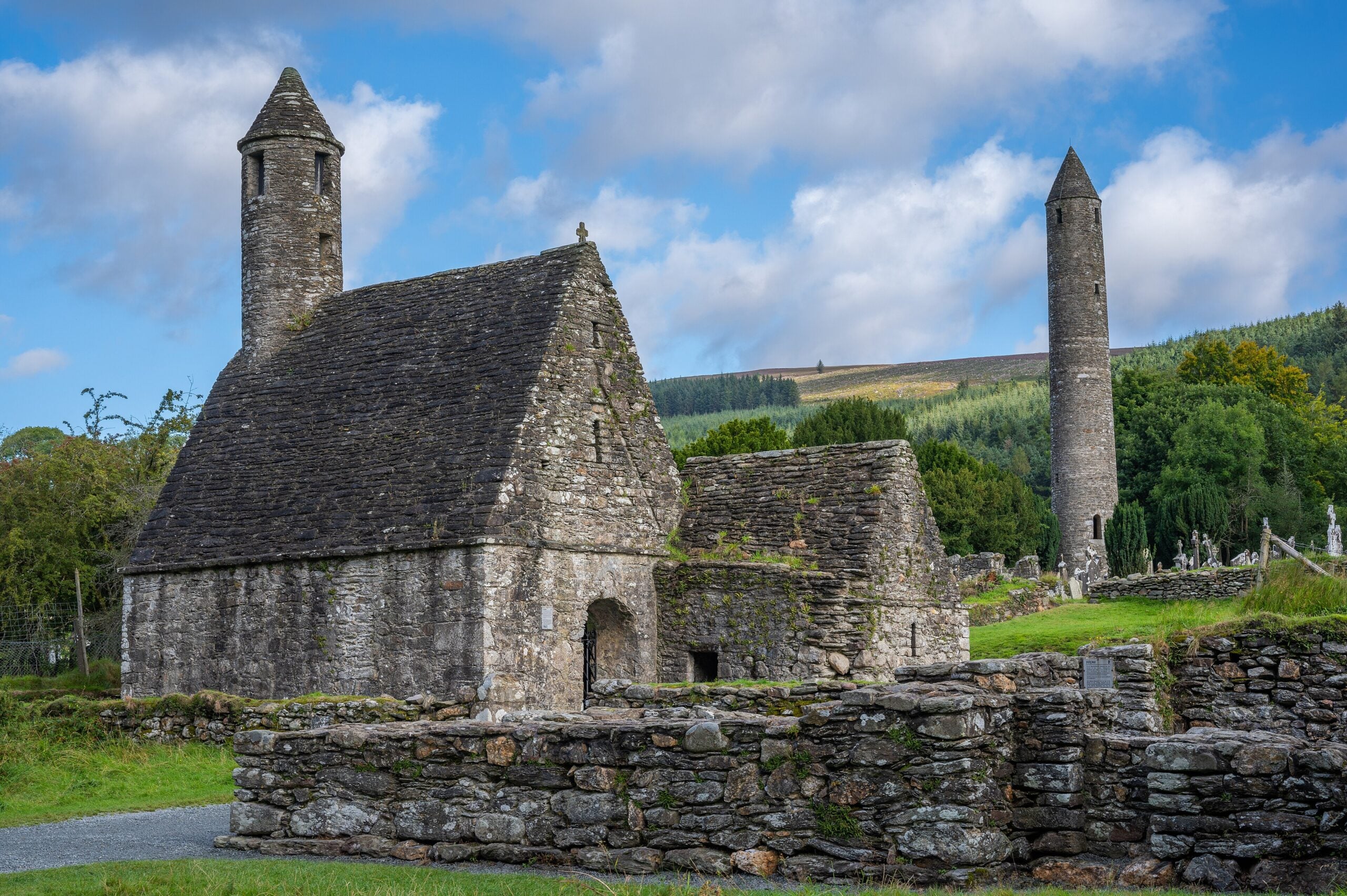
What Exactly Are Ireland’s Round Towers?
Around 65 of them still stand across Ireland, with traces of another 50 or so recorded in historical documents. Most were built between the 9th and 12th centuries, during Ireland’s golden age of monastic life.
They rise between 18 and 40 metres tall, slim and pencil-like against the Irish sky. Each has a single doorway — but that door is set high above the ground, sometimes as much as five metres up, reachable only by ladder.
That raised doorway is where a thousand years of argument begin.
The Viking Refuge Theory
For generations, the most popular explanation has been straightforward: the towers were places of safety during Viking raids. When Norse longships appeared on the horizon, monks could climb a rope ladder into the tower, haul it up behind them, and wait out the attack with their sacred manuscripts and treasures out of reach.
It’s a vivid image. The Vikings were certainly raiding Ireland’s coasts from the 790s onwards. But the theory has problems. Several annals record towers burning during attacks, with monks trapped inside. And the raised door, while making entry difficult from outside, would have made escape even harder.
The Bell Tower Theory
The more conservative scholarly view is that these were simply cloigtheach — Irish for “bell house.” Monks climbed to the top and rang a bell to summon the community to prayer. The height made sense: sound carries further from elevation.
This was the accepted explanation for centuries. But Irish monks were using handbells long before round towers appeared. And many towers stand at some distance from their associated churches — a strange position for a bell meant to be heard across a community.
The Treasury Theory
A third view has gained ground in recent decades: that the towers were primarily used to store the monastery’s most precious valuables. Manuscripts, sacred relics, chalices, vestments — all irreplaceable, all vulnerable to theft or fire.
The elevated door supports this reading. To enter, you needed a ladder — which could simply be removed and stored inside. No ladder, no access. It was the medieval equivalent of a vault with the combination removed.
Ground level was simply too dangerous for anything precious in a world of raiding and rivalry.
The Astronomical Theory
More recently, a small but serious group of researchers has proposed something altogether stranger. Some Irish round towers appear to be aligned with sunrise on significant Christian feast days. Could they have served as calendrical instruments — tall fixed sundials, effectively — helping monks track the sacred year?
Whether this was intentional design or happy coincidence has not been settled. It may never be.
Why the Mystery Matters
What strikes most visitors is not just the height or the age of these towers, but the evident skill of their construction. The stones are cut and dressed with care. The mortar was mixed to endure centuries of Atlantic weather. The proportions feel deliberate.
Whoever built these towers knew exactly what they were doing. What they were doing — that’s the question that has occupied scholars, local historians, and curious visitors for over a millennium.
For those wanting to understand more of the world these monks inhabited, the ancient Ogham alphabet carved into Ireland’s standing stones offers another window into this remarkable era of Irish history.
Where to Find Ireland’s Most Impressive Round Towers
Glendalough in County Wicklow has perhaps Ireland’s most iconic example, rising 30 metres above an ancient monastic valley. The setting — surrounded by mountains, a dark lake below — is extraordinary in any season.
Kilmacduagh Abbey in County Galway has a tower with a slight but unmistakable lean — Ireland’s own answer to Pisa, standing alone amid the limestone pavements of the Burren.
Rock of Cashel in County Tipperary incorporates a round tower into one of Ireland’s most dramatic architectural complexes, its silhouette visible for miles across the Tipperary plain.
If you’re planning your trip to Ireland, mark any one of these sites on your map and make a point of visiting. Stand at the base, look up, and consider who climbed those walls, what they stored inside, and what they feared from beyond the monastery gates.
The Last Word
Perhaps the most fitting thing about Ireland’s round towers is that they’ve outlasted every civilisation that tried to explain them. The Vikings who may have prompted their construction are long gone. The monks who built them are long gone. The round towers remain.
They are among Ireland’s most enduring mysteries — and perhaps its most beautiful ones. Whatever they were built for, they were built to last. And so far, over a thousand years in, they have kept their word.
☘️ You Might Also Love
64,000 Ireland lovers can’t be wrong.
Every week, our free newsletter delivers hidden gems, seasonal guides, local stories, and practical travel tips — straight to your inbox. Join the community that loves Ireland as much as you do.
☘️ Want More Hidden Ireland?
Join 64,000+ subscribers who discover Ireland’s best-kept secrets every week.
Subscribe Free — Join the Community →
Free forever · Unsubscribe anytime · No spam
📥 Free Download: Ireland Travel Planning Guide
Our most popular resource — itineraries, insider tips, and the 50 places you must not miss.
Tours & experiences you might love


Powered by Viator. Some links are affiliate links — we may earn a small commission at no extra cost to you.
Secure Your Dream Irish Experience Before It’s Gone!
Planning a trip to Ireland? Don’t let sold-out tours or packed attractions spoil your journey. Iconic experiences like visiting the Cliffs of Moher, exploring the Rock of Cashel, or enjoying a guided walk through Ireland’s ancient past often sell out quickly—especially during peak travel seasons.

Booking in advance guarantees your place and ensures you can fully immerse yourself in the rich culture and breathtaking scenery without stress or disappointment. You’ll also free up time to explore Ireland’s hidden gems and savour those authentic moments that make your trip truly special.
Make the most of your journey—start planning today and secure those must-do experiences before they’re gone!