

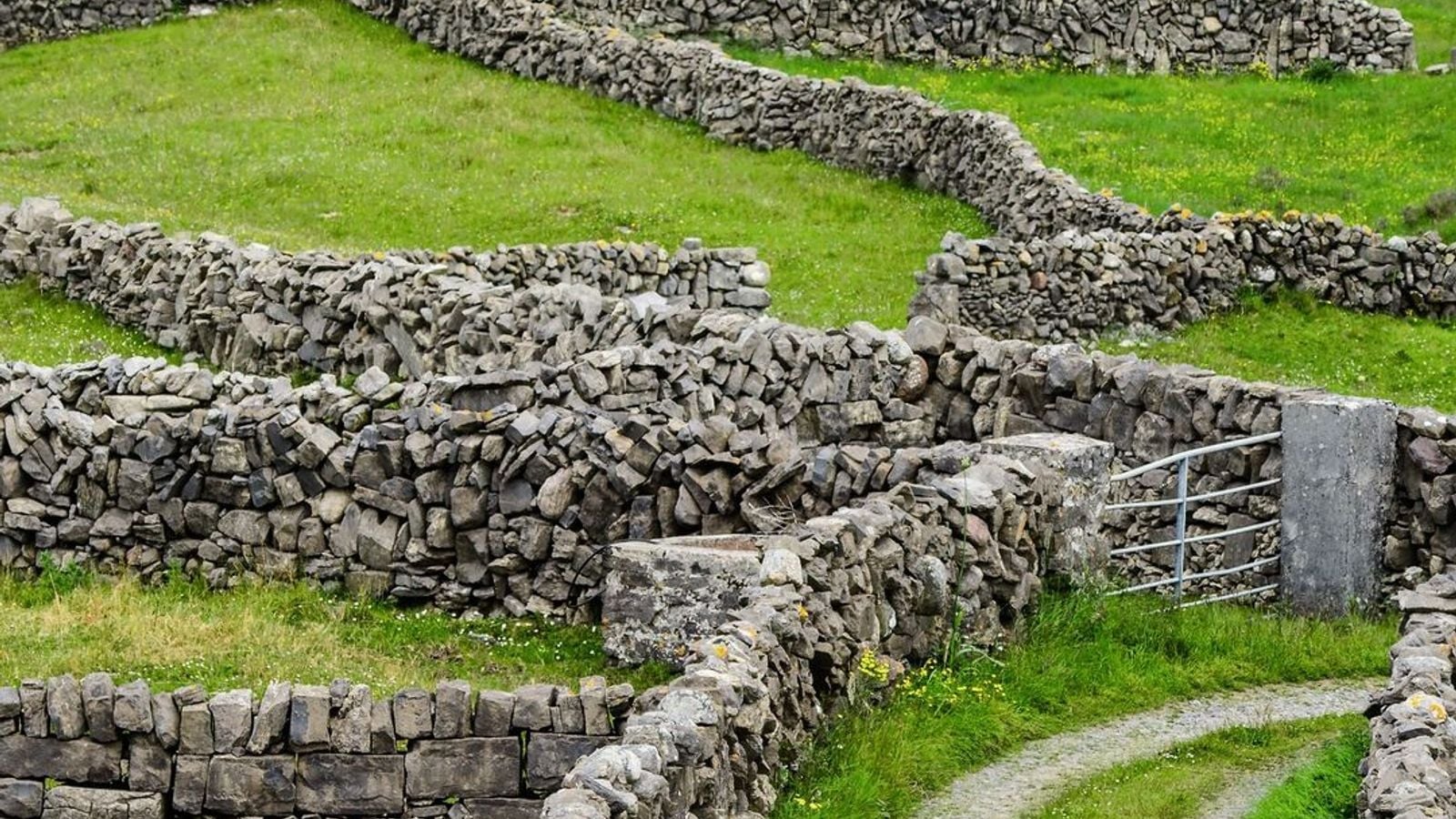
Look out across any Irish landscape and you will see them — miles of grey stone walls threading through fields, climbing hillsides, disappearing over ridges into the mist. They look as if they grew from the earth. But every single stone was placed by a human hand.
What Dry Stone Walls Actually Are
Most of Ireland’s field walls are what craftspeople call dry stone — built without mortar, relying on weight, balance, and the careful fitting of stone against stone. That sounds simple. It is not.
A well-built dry stone wall can stand for centuries. The secret is that it breathes. It shifts and settles with frost and thaw instead of cracking. A mortared wall freezes, expands, and eventually falls. A dry stone wall holds together because the stones were chosen and placed to carry each other.
The craft took years to learn. Skilled wallers could read a stone the way a carpenter reads timber — judging which face would sit flat, which angle would carry the load above it. Their work is still standing in fields their descendants have never seen.
The Fields That Didn’t Exist
On the Aran Islands — three limestone outcrops in the mouth of Galway Bay — the walls tell a different story. When the first settlers arrived, there was almost no soil. The surface was bare karst limestone, cracked and fissured, with barely a handful of earth in any crevice.
The islanders made their own soil. They gathered seaweed from the shore and sand from the beach, mixed it with crushed rock and organic matter, and spread it over the bare stone. Then they walled it in to stop the Atlantic wind carrying it away.
Every field on Inishmore was created. Every stone in those walls was moved by human hands because there were no other tools. Today, the Aran Islands have an estimated 1,500 kilometres of stone walls — on an island you can drive across in twenty minutes.
The Invisible Labour Nobody Counted
No historian kept a record of this work. No government counted the hours. But the walls themselves are the record — millions of tonnes of stone moved without machinery, by families who had no choice.
In much of Ireland, the walls exist because the land had to be cleared before anything could grow. Every stone you see was once sitting where a potato crop needed to be planted. Farmers dug them out, carried them to the field edges, and built rather than dumped them — because a wall held back cattle, marked a boundary, and sheltered a crop from wind.
Children carried stones before they could carry much else. The work continued through cold springs and wet autumns, year after year, generation after generation. The man who began a wall often never finished it. His son finished it, and his son after that.
☘️ Enjoying this? 64,000+ Ireland lovers get stories like this every week. Subscribe free →
How the Walls Shaped the Land — and the People
The walls are why Irish fields are small. In parts of England, large-scale land consolidation wiped out medieval field patterns and created open farmland. In many parts of Ireland, the old field systems survived, and the walls stayed as their boundaries.
Small fields meant small farms. Small farms meant a particular kind of life — intense, local, communal. The walls are the architecture of that life, pressed permanently into the landscape.
When land changed hands — as it often did across Irish history — the walls remained. They outlasted the farmers who built them. They are, in a real sense, the most permanent record the Irish left on their own land. If you want to see where ordinary Irish families lived and worked across the last thousand years, look at the shape of the fields. The walls drew those shapes.
What Happens When a Wall Falls
A dry stone wall holds together as long as someone tends it. Once that stops, the process reverses. A corner stone loosens, frost opens the gap, and within a few winters an entire section collapses.
In parts of the west — where farms were abandoned after the Famine — entire field systems are returning to scrub and rough pasture. The walls are going with them. Collapsed walls create their own quiet habitat: lizards shelter in the gaps, mosses colonise the stone faces, and the rubble becomes an archaeological layer beneath the heather.
Elsewhere, the tradition is being kept alive. In the Burren in County Clare — a great limestone plateau that shares its character with the Aran Islands — dry stone walling is still practised as part of active farming. Some builders still work entirely by hand, using skills passed down from wallers who learned from their own grandfathers.
Where to See Them for Yourself
The finest stone wall landscapes in Ireland are found in the west. The Aran Islands and Connemara offer the most dramatic concentrations — walls running straight to the clifftop, walls enclosing tiny plots of brilliant green, walls that look from a distance like a net thrown over the limestone.
Walking among them, you get a sense that no photograph quite captures. The stones are old. The work was hard. And the people who did it left almost nothing behind except this — thousands of miles of walls that are still, somehow, standing.
Start planning your visit at our Ireland travel planning hub.
☘️ You Might Also Love
Tours & experiences you might love


Powered by Viator. Some links are affiliate links — we may earn a small commission at no extra cost to you.
Secure Your Dream Irish Experience Before It’s Gone!
Planning a trip to Ireland? Don’t let sold-out tours or packed attractions spoil your journey. Iconic experiences like visiting the Cliffs of Moher, exploring the Rock of Cashel, or enjoying a guided walk through Ireland’s ancient past often sell out quickly—especially during peak travel seasons.

Booking in advance guarantees your place and ensures you can fully immerse yourself in the rich culture and breathtaking scenery without stress or disappointment. You’ll also free up time to explore Ireland’s hidden gems and savour those authentic moments that make your trip truly special.
Make the most of your journey—start planning today and secure those must-do experiences before they’re gone!
Subscribe Free