

Stand inside any ancient Irish monastery graveyard and look up. Rising above the ruins is a slender stone tower — perfectly round, impossibly tall. Now look for the door. It is three or four metres off the ground, with no steps to reach it.
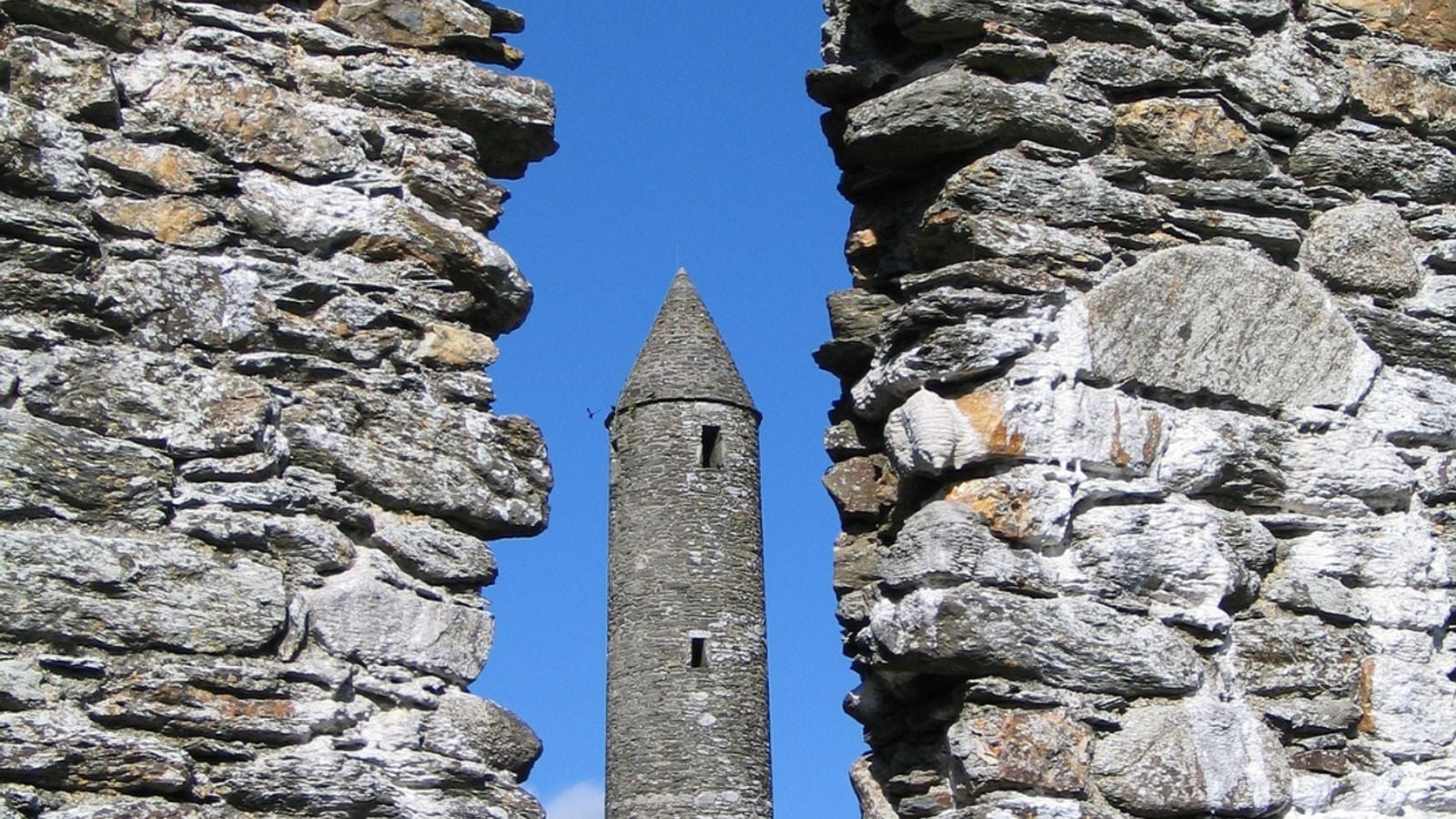
No ladder. No rope. Just a doorway hanging in the air, silent and unreachable. And yet monks used it regularly, sometimes in a terrible hurry.
A Tower Found Beside Every Irish Monastery
Ireland has around 65 surviving round towers, and almost all of them stand beside the ruins of early Christian monasteries. They rise between 20 and 40 metres into the sky, tapering gently upwards and finishing in a conical stone cap.
You will not find anything quite like them in England, France, or Germany. They are entirely and unmistakably Irish — a silhouette so distinctive that it has become one of the defining symbols of the country.
Their Irish name is cloigtheach, which simply means “bell house”. But that name may be misleading. The towers were used for something far more urgent than ringing a bell.
The Door That Makes No Sense
Every Irish round tower has its entrance positioned several metres above the ground. There is no permanent staircase, no carved footholds, no ramp. To enter one, you needed a portable wooden ladder — and once you were inside, you pulled it up behind you.
The door could then not be reached from below. At all.
This was not an accident of design or a quirk of later modification. It was deliberate from the start. The monks who commissioned these towers knew exactly what they were building.
The Viking Problem
From the 790s onwards, Viking longships arrived regularly on Irish shores. Monasteries were the most attractive targets in the country. They held gold altar vessels, silver reliquaries, illuminated manuscripts worth more than most men earned in a lifetime, and the accumulated wealth of centuries of donations from kings.
A round tower gave the monastery three things at once: a bell to warn the surrounding community, a high vantage point for spotting approaching ships on a river or lough, and a place of last resort.
When the warning came, monks gathered the most precious objects — the sacred books, the relics, the plate — and climbed the ladder. Once inside, they hauled it up. The Vikings below had no way in. The stone walls would not burn. The community waited in darkness until the danger passed.
☘️ Enjoying this? 64,000+ Ireland lovers get stories like this every week. Subscribe free →
Not Everyone Agrees
Some historians argue that the towers were built purely as bell towers. The name cloigtheach supports this interpretation. Ringing a large bell from height sends sound across a far wider area than ringing it at ground level.
Others point out that many towers were constructed after the worst of the Viking raids were already over. If defence was the only purpose, why keep building them?
The honest answer is that nobody fully knows. The monks who built the towers left no written explanation behind. Each tower stands in patient silence while historians argue about it — which, after a thousand years, seems only fair.
The Round Towers You Can Still Visit
The most photographed round tower in Ireland stands at Glendalough in County Wicklow, rising beside a sixth-century monastic city in a wooded glacial valley. It is one of the most atmospheric ancient sites in the country. If you are planning a visit, the County Wicklow guide covers everything you need to make the most of the area.
At the Rock of Cashel in Tipperary, a round tower stands beside a roofless cathedral and a Romanesque chapel on a limestone outcrop above the Golden Vale. At Ardmore in County Waterford, you will find the tallest complete round tower in Ireland at 29 metres.
And in Clondalkin — a suburb of Dublin — a round tower stands quietly in the middle of a housing estate, a slightly surreal encounter with the deep past. If you are putting together an itinerary to see several, the Ireland trip planning guide is the best place to start.
What the Monks Were Protecting
Inside the towers went the things that mattered most. Illuminated manuscripts — books of Gospels and psalters produced over months of painstaking work. Sacred relics. Altar vessels of gold and silver. The accumulated knowledge of generations, irreplaceable and vulnerable.
If these objects were stolen, they were gone forever. The monks who climbed that ladder and pulled it up after them were doing something every generation has done: protecting what matters most when the world turns dangerous.
Ireland’s round towers have stood for over a thousand years now. The monks are long gone. The Vikings stopped coming. Many of the manuscripts they sheltered ended up in libraries across Europe. But the towers remain — still perfectly round, still tapering skyward, still with doors that you cannot open without someone else’s help.
☘️ You Might Also Love
☘️ Join 64,000+ Ireland Lovers
Every Friday, get Ireland’s hidden gems, local secrets, and travel inspiration — the kind you won’t find in any guidebook.
Free forever · · Unsubscribe anytime
Tours & experiences you might love


Powered by Viator. Some links are affiliate links — we may earn a small commission at no extra cost to you.
Secure Your Dream Irish Experience Before It’s Gone!
Planning a trip to Ireland? Don’t let sold-out tours or packed attractions spoil your journey. Iconic experiences like visiting the Cliffs of Moher, exploring the Rock of Cashel, or enjoying a guided walk through Ireland’s ancient past often sell out quickly—especially during peak travel seasons.

Booking in advance guarantees your place and ensures you can fully immerse yourself in the rich culture and breathtaking scenery without stress or disappointment. You’ll also free up time to explore Ireland’s hidden gems and savour those authentic moments that make your trip truly special.
Make the most of your journey—start planning today and secure those must-do experiences before they’re gone!