

They call it the Garden of Ireland, and the moment you drive through the Wicklow Gap with nothing but heather-covered mountains rolling to every horizon, you understand why. County Wicklow is a paradox — barely an hour south of Dublin, yet home to some of the most remote and hauntingly beautiful valleys on the island. This is the county where ancient monks chose to pray, where rebels hid from the British Crown, and where every bend in the road reveals another landscape that makes you pull over and reach for your camera.
This is the sixth article in our 32 Counties of Ireland series, following Kerry, Cork, Galway, Clare, and Donegal. Each guide covers the essential attractions, hidden gems, local food, and practical tips you need to plan your visit.
Why County Wicklow?
Wicklow has been quietly stealing hearts for centuries. At just over 2,000 square kilometres, it packs an extraordinary amount into a compact space — a nearly 23,000-hectare national park, Ireland’s highest continuously-flowing waterfall, one of the world’s greatest gardens, and a 6th-century monastic city that draws over a million visitors a year. The Wicklow Way, one of Ireland’s oldest and most famous long-distance walking trails (the first waymarked trail in the Republic of Ireland), runs 127 kilometres from the Dublin suburbs to the rolling farmland of County Carlow.
What makes Wicklow special is the contrast. You can be sitting in a Dublin café at breakfast and standing beside the glacial Upper Lake at Glendalough by mid-morning. The county’s proximity to the capital has never diminished its wildness — if anything, it makes the transition more dramatic. One moment you are in the Dublin region, home to around 1.4 million people, and the next you are surrounded by blanket bog, granite peaks, and the kind of silence that modern life has almost forgotten.
The Must-See Attractions
Glendalough — The Valley of Two Lakes
There is no more atmospheric place in Ireland. Glendalough — from the Irish Gleann Dá Loch, meaning Valley of Two Lakes — is a 6th-century monastic settlement founded by St Kevin, a hermit who retreated here to live a life of prayer among the granite cliffs and oak forests of the valley. What he started grew into one of the great centres of learning in early medieval Europe, surviving Viking raids and centuries of turbulence before finally falling into ruin after the English dissolution of the monasteries.
Today, the round tower stands 30 metres tall against the Wicklow sky, surrounded by Celtic crosses, the ruins of a cathedral and six churches, and the two glacial lakes that give the valley its name. The Upper Lake is the quieter of the two — a dark mirror of water reflecting the sheer cliffs above it, reached by a peaceful woodland walk from the main site. Come early in the morning, before the coaches arrive, and you will have the valley almost to yourself.
Powerscourt Estate and Gardens — Aristocratic Splendour
In 2014, National Geographic named Powerscourt the third most beautiful garden in the world, behind only Versailles and Kew. That ranking is no exaggeration. The estate sits at the foot of the Great Sugar Loaf mountain, with 47 acres of formal gardens that were designed and redesigned over 150 years by successive Viscounts Powerscourt. The Italian Garden, the Japanese Gardens, the Triton Lake with its winged horse fountain, and the sweeping views across the Dargle Valley to the Sugar Loaf are among the finest designed landscapes in Europe.
The house itself — a magnificent Palladian mansion originally built in the 1730s — was gutted by fire in 1974, the day before a major celebration. It has since been partially restored and now houses exhibitions, a terrace café, and one of the best garden shops in Ireland.
How many of Ireland’s 32 counties can you name? ☘️
Counties of Ireland — the geography-quiz tool. Place all 32 on the map and see if you can beat the average.
Powerscourt Waterfall — Ireland’s Highest Continuous Falls
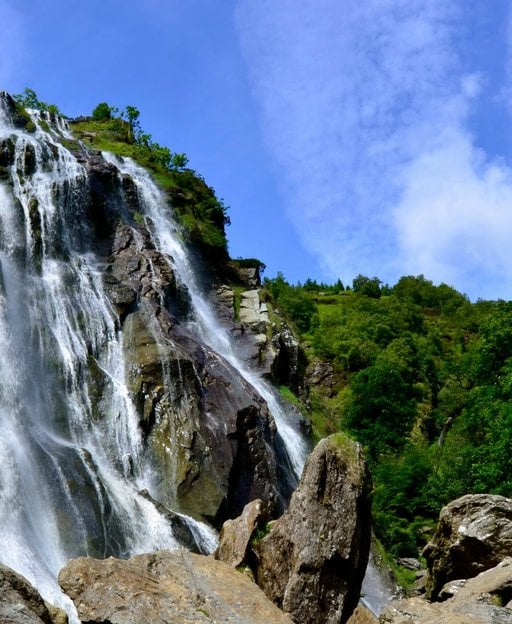
A short drive from the main estate, Powerscourt Waterfall drops 121 metres down a granite cliff face into a wooded glen — the highest continuously-flowing waterfall in Ireland (the seasonal Sruth in Aghaidh an Aird in Sligo/Leitrim is taller but only flows after heavy rain). The site is managed separately from the gardens and has its own car park, picnic areas, and walking trails. The waterfall is at its most impressive after heavy rain, when the Dargle River pours over the edge in a thundering white curtain. In summer, the surrounding beech and oak woods make it one of the most peaceful spots in the county.
Wicklow Mountains National Park — Almost 23,000 Hectares of Wilderness
The Wicklow Mountains are the largest continuous upland area in Ireland, and the national park that protects the heart of them covers almost 23,000 hectares of blanket bog, heathland, and native woodland. The park is centred on Glendalough but extends far beyond it, taking in the peaks of Lugnaquilla (925 metres — Leinster’s highest point), Tonelagee, Mullaghcleevaun, and the iconic flat-topped Djouce.
The Military Road, built by the British after the 1798 rebellion to flush out rebels hiding in the mountains, runs 58 kilometres from Rathfarnham in Dublin to Aghavannagh in the south. It remains one of the most spectacular drives in Ireland — a narrow ribbon of tarmac crossing empty bog at 500 metres elevation, with views that stretch to the Irish Sea on one side and the Midlands on the other.
The Hidden Gems Most Tourists Miss
Lough Tay — The Guinness Lake
Seen from the Sally Gap road, Lough Tay is one of the most photographed views in Wicklow — a dark, peat-stained lake set between steep cliffs, with a crescent of white sand at its southern shore that makes it look like a perfectly poured pint of Guinness. The resemblance is no coincidence — the lake and the surrounding Luggala Estate belonged to the Guinness family for decades. The estate was sold to the Irish state in 2019, but access remains restricted. The best view is from the R759 road above, where the lake appears suddenly and dramatically below you.
☘️ Enjoying this? 64,000+ Ireland lovers get stories like this every week. Subscribe free →
Glenmalure Valley — Ireland’s Longest Glacial Valley
Glenmalure is raw and untamed in a way that Glendalough never quite manages. This is the longest glacial valley in Ireland, a deep U-shaped gash running between Lugnaquilla and the surrounding mountains, with a single road that ends at a car park beside the Avonbeg River. It was here that the rebel leader Michael Dwyer evaded capture by the British for years after the 1798 rebellion, using the maze of valleys and mountain passes to stay one step ahead. The valley still feels remote — there are no visitor centres, no cafés, just mountains, river, and sky.
Avondale House — Birthplace of Charles Stewart Parnell
Recently restored after a major refurbishment, Avondale House in Rathdrum was the birthplace and home of Charles Stewart Parnell — the uncrowned king of Ireland and the most powerful Irish political figure of the 19th century. The house is set in a beautiful forest park with waymarked trails, a treetop walk, and panoramic views of the Avonmore Valley. The restoration brought new life to the house and grounds, making it one of Wicklow’s most enjoyable half-day visits.
Brittas Bay — Wicklow’s Finest Beach
Most visitors do not associate Wicklow with beaches, but Brittas Bay — a long curve of golden sand backed by dunes on the county’s east coast — is one of the finest in Leinster. On a warm summer day, it fills with Dublin families who have made the 90-minute drive south, but walk far enough along the sand and you will find quiet stretches where you can hear nothing but the waves. The dune system is a protected habitat for rare plants and nesting birds.
☘️ Love discovering Ireland’s hidden stories?
Join over 64,000 subscribers who get our free weekly Ireland newsletter — stories, places, and traditions you won’t find in any guidebook.
Subscribe free to Love Ireland →
Food and Drink in County Wicklow
Wicklow punches well above its weight when it comes to food. The Strawberry Tree at BrookLodge in Macreddin Village holds the distinction of being Ireland’s only certified organic restaurant — everything on the menu is sourced from certified organic producers, many of them within the county. It is a remarkable dining experience in a beautiful valley setting.
In Greystones, the Happy Pear has become a national phenomenon — a plant-based café and food brand founded by twin brothers David and Stephen Flynn that has grown from a tiny shop to a multi-million euro business. Their café on the seafront is always packed, and for good reason.
Avoca Handweavers, based in the Vale of Avoca since 1723, runs what may be Ireland’s most famous café. The food is home-style cooking done impeccably — scones, soups, and bakes that draw visitors from across the country. Their original mill in Avoca village is worth visiting for the weaving demonstrations alone, and the café upstairs is the reward.
For pub food, Johnnie Fox’s in Glencullen — often cited as the highest pub in Ireland — serves excellent traditional meals with live music and a raucous atmosphere that has been drawing visitors since the 1700s. And if you are passing through Roundwood, stop at The Roundwood Inn, one of the oldest inns in Ireland, for a bowl of game stew that has warmed hikers for generations.
Practical Tips for Your Wicklow Visit
Getting there: Wicklow is the most accessible county in Ireland for visitors flying into Dublin. The northern Wicklow attractions (Powerscourt, Enniskerry, Glendalough) are 45 to 90 minutes from Dublin city centre by car. The DART commuter train runs to Bray and Greystones, and St Kevin’s Bus runs a daily service from Dublin to Glendalough in the summer season, dropping to a more limited winter timetable.
Getting around: A car is essential for exploring inland Wicklow — the mountain roads are the experience. The R115 (Military Road), R759 (Sally Gap), and R756 (Wicklow Gap) are the three great scenic drives. Allow extra time; the roads are narrow and you will want to stop frequently.
Where to stay: Glendalough has the Glendalough Hotel right beside the monastic site. BrookLodge in Macreddin Village is the luxury choice. Greystones and Bray offer seaside accommodation with easy Dublin access. For something different, try glamping at Glendalough Glamping — dome tents in a forest clearing beside the valley.
Best time to visit: May to September for the best weather and longest days. October is stunning for autumn colour in the valleys. Glendalough is beautiful year-round, but arrive before 10am to avoid the tour bus rush. The Wicklow Mountains are exposed — bring waterproofs and layers even in summer.
Next in the Series
We have now explored six of Ireland’s 32 counties — Kerry, Cork, Galway, Clare, Donegal, and now Wicklow. Next, we head to County Wexford — the Sunny South-East, where Viking history, endless beaches, and the oldest opera festival in Europe are waiting.
☘️ Never miss a county in this series
Subscribe to Love Ireland — our free weekly newsletter with stories from every corner of the island. Join over 64,000 readers who love Ireland as much as you do.
Subscribe free to Love Ireland →
☘️ You Might Also Love
☘️ Join 64,000+ Ireland Lovers
Every Friday, get Ireland’s hidden gems, local secrets, and travel inspiration — the kind you won’t find in any guidebook.
Free forever · · Unsubscribe anytime
☘️ Want More Hidden Ireland?
Join 64,000+ subscribers who discover Ireland’s best-kept secrets every week.
Subscribe Free — Join the Community →
Free forever · Unsubscribe anytime · No spam
📥 Free Download: Ireland Travel Planning Guide
Our most popular resource — itineraries, insider tips, and the 50 places you must not miss.
Tours & experiences you might love


Powered by Viator. Some links are affiliate links — we may earn a small commission at no extra cost to you.
Secure Your Dream Irish Experience Before It’s Gone!
Planning a trip to Ireland? Don’t let sold-out tours or packed attractions spoil your journey. Iconic experiences like visiting the Cliffs of Moher, exploring the Rock of Cashel, or enjoying a guided walk through Ireland’s ancient past often sell out quickly—especially during peak travel seasons.

Booking in advance guarantees your place and ensures you can fully immerse yourself in the rich culture and breathtaking scenery without stress or disappointment. You’ll also free up time to explore Ireland’s hidden gems and savour those authentic moments that make your trip truly special.
Make the most of your journey—start planning today and secure those must-do experiences before they’re gone!