

Walk through those arched stone doors on Princes Street in Cork city and the noise hits you first. Voices calling out prices. The slap of fresh fish on marble slabs. The hiss of a coffee machine somewhere above your head.
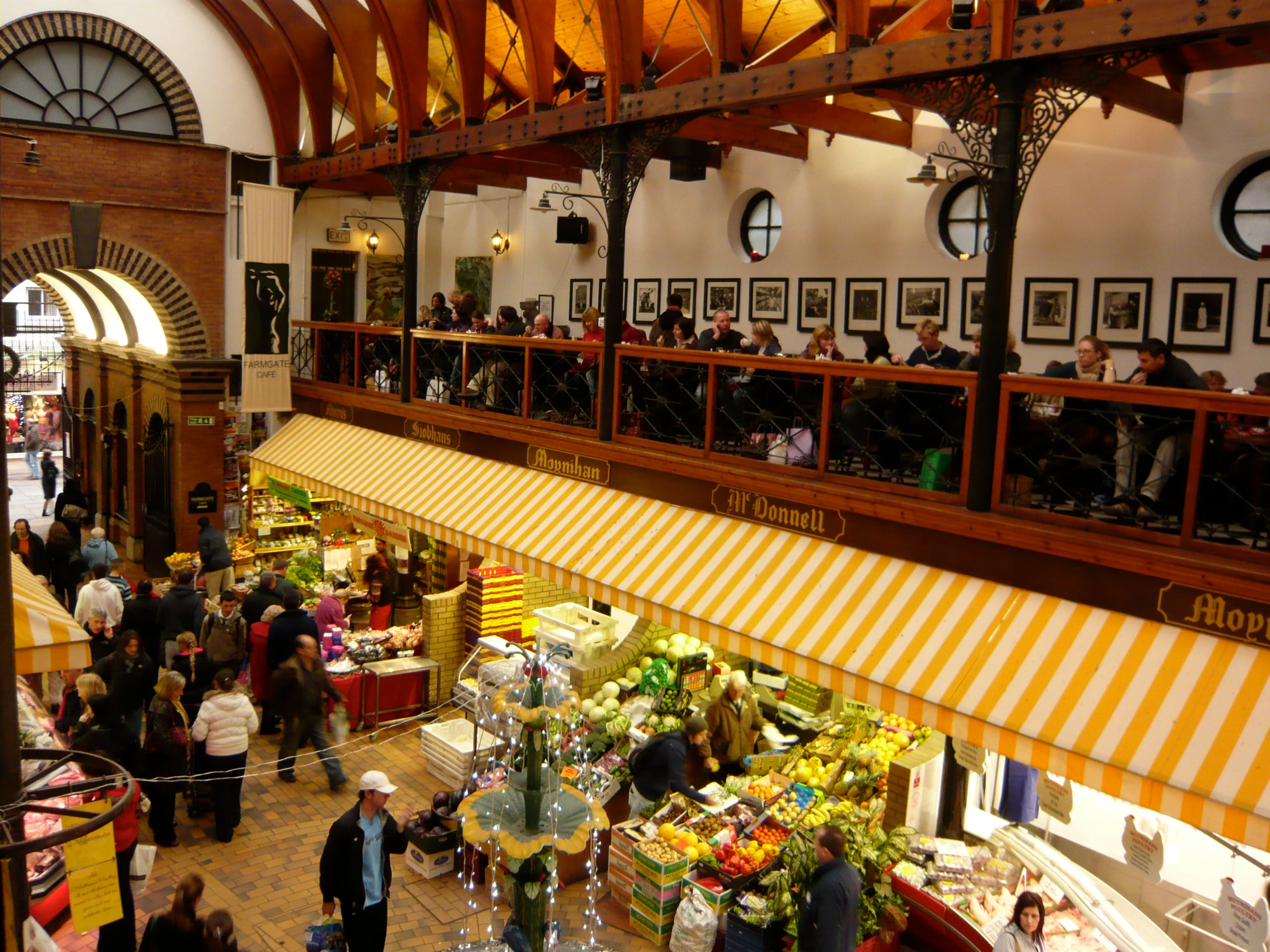
Then you look up and understand why people make special trips for this place.
Why the Name “English” Has Nothing to Do With England
The market opened in 1788, built by the Protestant-controlled Cork Corporation of the day — sometimes called the “English” corporation, reflecting who held power in the city, not the market’s trading language or customers.
The name most visitors hear didn’t take hold until decades later. After the 1840 reform of Cork’s local government, the city’s Catholic majority took control of the corporation and built their own covered market, St Peter’s Market, which became known as the “Irish Market.” To tell the two apart, the older market by the Grand Parade kept the name it has had ever since: the English Market.
So the name has nothing to do with England the country — it’s a leftover label from a 19th-century political split inside Cork itself. (A popular theory that English-speaking and Irish-speaking traders once worked the two markets side by side makes for a nice story, but historians note it doesn’t hold up.)
That label was assigned more than 180 years ago. It has never been changed, and Cork has never felt the need to change it. The name is part of what the market is now.
What You’ll Find on the Stalls Today
The market layout hasn’t moved. It still runs through the same Victorian iron passageways and stone corridors it always has. What’s sold has shifted — fewer live animals, far more artisan produce — but the rhythm of the place is unchanged.
Fresh Atlantic fish arrives early. Farmhouse cheeses from across Munster sit alongside local butters and cured meats. There are vegetables that came out of Cork and Kerry soil that morning. And then there is spiced beef — a Cork food tradition specific to this city, a brine-cured and spiced cut that appears at Christmas and has no equivalent anywhere else in Ireland.
The smell of the English Market is its own thing. Salt and smoke and fresh bread and something sharp from the fish counter. It layers in a way that only happens in a space that has been used for the same purpose, by the same kinds of people, for over two hundred years.
☘️ Enjoying this? 64,000+ Ireland lovers get stories like this every week.
Thinking about it for retirement? If you’ve started thinking seriously about retiring there, our complete our full Retire in Ireland guide covers the visa, healthcare, cost-of-living, and the regions worth shortlisting.
The Farmgate Café — Above the Stalls
Climb the stairs at the far end of the market and you reach the Farmgate Café. It sits directly on the iron balcony above the stalls, looking down at the market floor below.
The kitchen uses what’s available fresh that morning from the traders downstairs. This is not a restaurant that happens to be near a market. It is a restaurant that is physically part of the market, in the most literal sense.
The menu changes with what arrived. The queues form early. If you go on a Saturday morning, go early or expect to wait. It is worth the wait.
How It Survived Two and a Half Centuries
The English Market stayed open through the 19th century famines, through two world wars, through every economic crisis that rattled Cork. Markets like this usually close when times get hard. This one got more essential.
Part of the reason is Cork’s specific relationship with food. This is a city that takes what it eats seriously, that has its own version of almost everything — its own breakfast traditions, its own way of smoking fish, its own attachment to local producers over imported alternatives.
The English Market is not a tourist attraction that sells food on the side. It is a working market where Cork people actually shop, every weekday. Visitors are welcome to come and watch, and most stay to eat. That distinction matters. You can feel it when you walk in.
For context on Cork’s wider heritage and what makes this county remarkable, the full guide to County Cork covers everything from the coastline to the city’s cultural history. And if the English Market gives you a reason to linger longer, planning your full Ireland trip is a good place to start.
Planning Your Visit
The market is open Monday to Saturday, 8am to 6pm (closed Sundays and bank holidays). The main entrance is on Princes Street, off the Grand Parade. You can also enter from Oliver Plunkett Street.
Arrive before noon if you want the full experience. The fish counter winds down as the morning goes on. The Farmgate Café fills quickly on weekends.
The English Market also sits close to the Blarney Stone to the north of the city — another Cork institution with a story behind its name that few people actually know.
The market is not a destination to rush through. It’s a place to slow down in — to watch where a city buys its food and has done, without interruption, for 238 years. Cork built its identity around this place. That’s not nothing.
☘️ You Might Also Love
☘️ Join 64,000+ Ireland Lovers
Every Friday, get Ireland’s hidden gems, local secrets, and travel inspiration — the kind you won’t find in any guidebook.
Subscribe free — enter your email:
Get the free guide
Enter your email and we will send you straight to the download.
Love more? Join 43,000 Scotland lovers → · Join 30,000 Italy lovers → · Join 7,000 France lovers →
Free forever · · Unsubscribe anytime
Tours & experiences you might love


Powered by Viator. Some links are affiliate links — we may earn a small commission at no extra cost to you.
Secure Your Dream Irish Experience Before It’s Gone!
Planning a trip to Ireland? Don’t let sold-out tours or packed attractions spoil your journey. Iconic experiences like visiting the Cliffs of Moher, exploring the Rock of Cashel, or enjoying a guided walk through Ireland’s ancient past often sell out quickly—especially during peak travel seasons.

Booking in advance guarantees your place and ensures you can fully immerse yourself in the rich culture and breathtaking scenery without stress or disappointment. You’ll also free up time to explore Ireland’s hidden gems and savour those authentic moments that make your trip truly special.
Make the most of your journey—start planning today and secure those must-do experiences before they’re gone!
Subscribe Free