

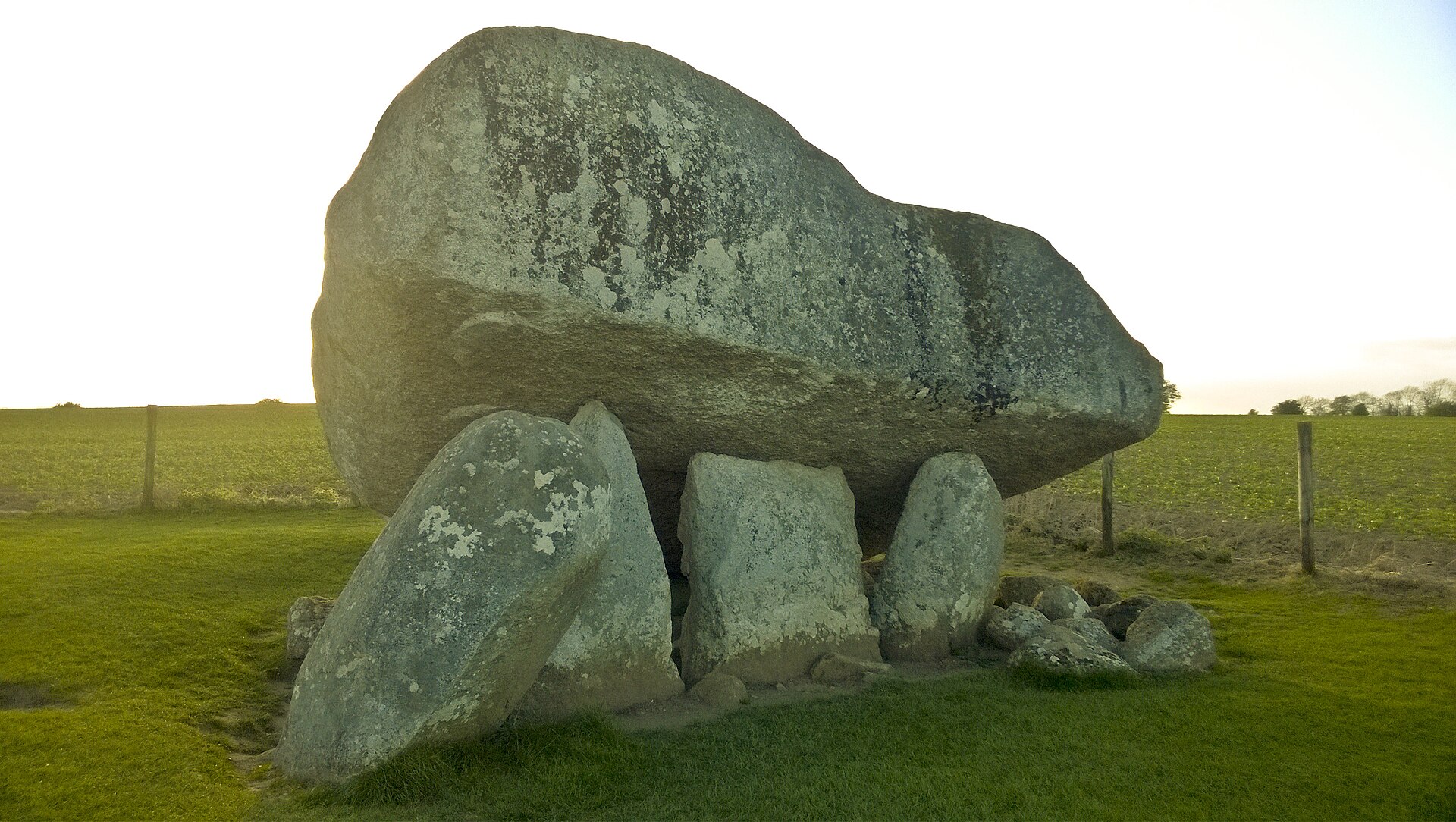
A single granite slab sits in a County Carlow field. It weighs over 100 tonnes — and quite possibly more. It has rested in the same spot for 5,000 to 6,000 years. No crane moved it. No machine cut it to shape. The people who built it used ropes, wooden rollers, and pure collective effort. That slab is the capstone of Brownshill Dolmen. It is the heaviest dolmen capstone in Europe, and one of the most remarkable prehistoric structures on the whole island of Ireland.
If you have not been to County Carlow, this monument alone is reason enough to go.
Want more of Ireland’s ancient and hidden places delivered straight to your inbox? Subscribe to the Love Ireland newsletter — free, weekly, and read by over 64,000 people who love what this island is made of.
What Is a Dolmen?
First, it helps to know what a dolmen actually is. A dolmen is a prehistoric megalithic tomb. Two or more upright stones — called orthostats — hold up a large flat capstone across the top. Builders first raised these tombs to house the dead. They packed earth and smaller stones around the outside to form a burial mound called a cairn.
Over thousands of years, that surrounding material erodes or disappears. Today you see only a massive capstone propped up by granite uprights. This is the bare, skeletal core of what was once a much larger burial monument.
Ireland has hundreds of megalithic monuments across its landscape: passage tombs, court cairns, wedge tombs, and portal tombs. Brownshill is a portal tomb. You can spot the type by its two tall portal stones at the front, a lower door stone between them, and the huge capstone resting across the top. You find this style right across Ireland and Britain, with strong clusters in the west of Ireland and parts of Wales.
Europe’s Heaviest Dolmen Capstone
The capstone at Brownshill is a single piece of granite. It measures roughly 6.1 metres long, 4.7 metres wide, and close to 2 metres thick. Geologists put its weight at over 100 tonnes, and some sources go as high as 150 metric tonnes. Either way, it is the heaviest dolmen capstone in Europe. It also ranks among the heaviest prehistoric stone structures of this type anywhere in the world.
Here is some context. The largest single stones at Stonehenge weigh about 25 tonnes. Even on the most cautious estimate, the Brownshill capstone outweighs those Stonehenge stones several times over.
One end of the capstone dips almost to the ground. Archaeological evidence suggests the Neolithic builders could not fully raise the huge rear section. The weight seems to have pushed their methods to the very limit. Yet the portal stones still stand intact and in their original positions. This structure has held firm through thousands of Irish winters, with no modern help at all.
Granite itself explains much of this survival. It is a very hard-wearing stone, resistant to frost and slow to erode. The same qualities that made granite practical for Neolithic builders still protect their work today.
Age and Origins
Builders raised Brownshill Dolmen during the Neolithic period, broadly between 4000 and 3500 BC. That makes it 5,500 to 6,000 years old. It predates the Egyptian pyramids by at least 1,000 years, and it predates Stonehenge by a similar margin.
These were not wandering hunter-gatherers. They were farming communities who had settled across Ireland after the last Ice Age. They cleared forest, grew crops, and raised livestock. They also built permanent structures — including these huge stone monuments — to mark the land and honour their dead.
A portal tomb on the scale of Brownshill took real planning, teamwork, and hands-on engineering skill. Workers almost certainly quarried the capstone from nearby granite outcrops, as County Carlow sits on a large granite formation. Most archaeologists believe crews hauled big capstones like this into place with wooden rollers and earthen ramps. Experts have even rebuilt the method by hand, based on similar monuments in Brittany, France, and elsewhere in the British Isles.
No written records survive from this era in Ireland. We infer everything about Neolithic building methods from physical evidence, comparative archaeology, and practical experiments. One thing is clear. The people who built Brownshill judged the effort worthwhile, and they expected the monument to last.
Who Was Buried Here?
Portal tombs across Ireland served as communal burial sites, not individual graves. Human remains at comparable monuments usually include jumbled bones from several people. That pattern suggests communities opened and resealed these tombs over time as they added new burials, possibly across generations.
Nobody has ever formally excavated Brownshill. That makes it a rare Neolithic monument whose interior record stays entirely unknown. Similar structures suggest it would have anchored the community that built it, both as a burial site and as a ritual landmark.
Some Irish portal tombs show a deliberate astronomical alignment. Builders placed them to catch sunlight at key moments in the year, such as the equinoxes or solstices. Nobody has yet proven whether Brownshill shares any such alignment.
Ireland has 5,000 years of stories — and we keep finding new ones to tell. Join 64,000 readers on the Love Ireland newsletter and get a piece of this island’s history delivered to your inbox every week. Free to subscribe.
How to Visit Brownshill Dolmen
Brownshill Dolmen lies about 3 kilometres east of Carlow town, off the Hackettstown Road (R726). It is a National Monument in State care, and the Office of Public Works (OPW) looks after it. Entry is free. The site stays open all year, with no booking, no gate, and no ticket.
A small car park sits at the roadside. From there, a short path crosses a field to the dolmen — a walk of no more than five minutes. The ground is mostly flat but unpaved, and it can turn muddy after rain. Wear boots or sturdy shoes, especially between October and April.
Keep these quick tips in mind before you go:
- Cost: Free, all year round — no ticket or booking needed.
- Getting there: Around 3 km east of Carlow town on the R726 (Hackettstown Road).
- Parking: A small free car park sits right at the roadside.
- The walk: A five-minute stroll across a flat but unpaved field.
- Footwear: Bring boots or sturdy shoes, as the field gets muddy after rain.
- Facilities: None on site — no toilets, no café, no visitor centre.
- Best light: Visit at dawn or dusk for dramatic low-angle light and quiet.
- Dogs: Welcome in the field, but keep them on a lead.
You will find no facilities on site. There is no café, no toilet, and no visitor centre. The dolmen simply stands in a quiet field, with open countryside all around. This is not a managed attraction with a gift shop. It is a 6,000-year-old stone in a field, and that plainness is a big part of its appeal.
Try to visit at dawn or dusk if you can time it. Low-angle light makes the granite look extraordinary. You will also likely have the whole site to yourself at those hours. Summer midday draws the most people, though even then the field rarely feels crowded.
If you have mobility needs, note that the path from the car park is level but unpaved. A wheelchair may struggle in wet weather. You can still see the dolmen clearly from a fair distance, so a good view is possible even without reaching the stone itself.
County Carlow: More to Explore
County Carlow is one of Ireland’s smaller inland counties, yet it packs in a lot of heritage. If you make the trip to see Brownshill, there is plenty nearby to fill a full day or weekend.
Carlow Castle stands in Carlow town itself — or rather, what is left of it does. The castle dates from the 13th century. In 1814, a local doctor tried to convert it into a mental asylum and accidentally demolished most of it. He misjudged the explosive charges he used to blast out the interior walls, and he brought down most of the building. A surviving round tower and fragments of curtain wall still make an atmospheric short stop.
The Barrow Way is a long-distance walking and cycling route. It follows the River Barrow south from County Kildare, through Carlow, and on to St Mullins. The full route runs for about 114 kilometres. You do not have to walk all of it, though — the stretch around Carlow town makes an easy riverside stroll. This towpath stays well-maintained and largely flat.
Altamont Gardens lie about 22 kilometres southeast of Carlow town, near Tullow. Many people rate them among the finest gardens in Ireland. The grounds hold formal gardens, woodland walks, and a lake, and the planting shifts a lot through the seasons. There is an entrance fee, but the gardens reward a visit at most times of year.
St Laserian’s Cathedral in Old Leighlin sits roughly 12 kilometres from Carlow town. This medieval church traces its origins to the 7th century. It ranks among the oldest ecclesiastical sites in Leinster, and it keeps much of its early character despite later building phases.
Practical Travel Information
By car: From Dublin, Brownshill is about 85 kilometres — around 75 to 90 minutes via the M9 to Carlow, then the R726 east to the dolmen. From Cork, it is roughly 130 kilometres. From Kilkenny city, the drive is about 30 kilometres via the R448.
By public transport: Bus Éireann and Dublin Coach both serve Carlow town from Dublin, in about 90 minutes. From Carlow town, no direct bus reaches the dolmen. You face a 3-kilometre walk along the Hackettstown Road or a short taxi ride.
Where to stay: Carlow town offers hotels, guesthouses, and B&Bs across different price points. The town centre is compact and walkable. If you prefer a rural base, several guesthouses dot the Barrow Valley and the wider county.
Best time to visit: The site opens year-round with no seasonal limits. Spring and autumn usually bring the best light and the quietest conditions. Summer feels busier across the wider area, but the dolmen itself rarely gets crowded.
Facilities: A free car park sits on site. There are no toilets, no café, and no ticketing. Dogs on leads are welcome in the field. Admission stays free at all times.
People have stood in that field and gazed up at the Brownshill capstone for 6,000 years. This stone once challenged Neolithic engineers, and it has outlasted whole civilisations. It still sits in a County Carlow field, doing exactly what it has always done.
Frequently Asked Questions
What is Brownshill Dolmen?
Brownshill Dolmen is a Neolithic portal tomb near Carlow town in County Carlow, Ireland. Builders raised it between roughly 4000 and 3500 BC. Its huge granite capstone is the heaviest of any dolmen in Europe.
How heavy is the Brownshill Dolmen capstone?
Geologists estimate the capstone at over 100 tonnes, and some sources put it as high as 150 tonnes. That makes it the heaviest dolmen capstone in Europe. For comparison, the biggest single stones at Stonehenge weigh about 25 tonnes.
Is Brownshill Dolmen free to visit?
Yes. Brownshill Dolmen is a National Monument in State care, and entry is completely free. The Office of Public Works maintains it, and the site stays open all year with no booking, gate, or ticket.
How do you get to Brownshill Dolmen?
The dolmen lies about 3 kilometres east of Carlow town, off the Hackettstown Road (R726). A small free car park sits at the roadside. From there, a short five-minute path crosses a field to the stone.
How old is Brownshill Dolmen?
Brownshill Dolmen dates from the Neolithic period, broadly 4000 to 3500 BC. That makes it around 5,500 to 6,000 years old. It predates both the Egyptian pyramids and Stonehenge by roughly 1,000 years.
Discover more of Ireland’s ancient places and hidden corners every week. Subscribe to the Love Ireland newsletter — free, weekly, and written for people who love this island as much as we do.
Image Credit: Shutterstock
Thinking about it seriously?
If you’ve started actually planning a move, our complete the full Move to Ireland guide walks through every step, every cost, and the paperwork that catches most people out.
Tours & experiences you might love


Powered by Viator. Some links are affiliate links — we may earn a small commission at no extra cost to you.
Secure Your Dream Irish Experience Before It’s Gone!
Planning a trip to Ireland? Don’t let sold-out tours or packed attractions spoil your journey. Iconic experiences like visiting the Cliffs of Moher, exploring the Rock of Cashel, or enjoying a guided walk through Ireland’s ancient past often sell out quickly—especially during peak travel seasons.

Booking in advance guarantees your place and ensures you can fully immerse yourself in the rich culture and breathtaking scenery without stress or disappointment. You’ll also free up time to explore Ireland’s hidden gems and savour those authentic moments that make your trip truly special.
Make the most of your journey—start planning today and secure those must-do experiences before they’re gone!