

Standing on the quay at Cobh, looking out over Cork Harbour, you find it hard not to feel the weight of what happened here. Six million people left Ireland through this port between 1848 and 1950 — more than the entire population of the island today. Most left during or after the Great Famine, and most never came back.
Cobh (pronounced “Cove”) sits on Great Island in Cork Harbour, about 24 kilometres south-east of Cork city. It ranks among the most historically significant towns in Ireland — and one of the most undervisited. Its story is not a comfortable one, but it is one every visitor to Ireland should know. Start your visit at Cobh Heritage Centre, where you can trace your own emigrant ancestors, before exploring the rest of the town.
Watch: Bob Explores Cobh
Love Ireland? Get inspiring stories, hidden gems, and travel ideas delivered to your inbox every week. Subscribe to the Love Ireland newsletter — it’s free.
Six Million Goodbyes
Between 1848 and 1950, Cobh — then known as Queenstown — served as the main departure point for Irish emigrants heading to America, Canada, and Australia. At the height of the Great Famine in the late 1840s, ships left almost daily, carrying people who had nothing left to stay for.
The numbers are difficult to grasp. Ireland’s population fell from around 8 million before the Famine to just over 4 million by 1900. Death and emigration combined to halve the population within a few decades, and Cobh became the last piece of Irish soil that millions of those emigrants ever stood on.
Many of the ships that departed were overcrowded and poorly provisioned. People came to call them “coffin ships” — not because passengers expected to die, but because so many did. Typhus, dysentery, and starvation took thousands on the crossings. Those who survived reached North America with nothing, starting over in a foreign country they had never seen.
The Cobh Heritage Centre, which occupies the original Victorian railway station on the waterfront, tells this story in detail. I found it among the best heritage museums I have visited anywhere in Ireland — honest, well-researched, and not afraid of the difficult parts. We recommend you visit here before anything else in Cobh, so you’ll gain the context you need to understand what you are looking at.
Before you set out, it helps to know what to prioritise. Here are the key sights that reward a day in Cobh:
- Cobh Heritage Centre — the emigration story told in the former Victorian railway station on the quay.
- The Annie Moore statue and the deepwater quay — where the emigrant ships and ocean liners once tied up.
- St Colman’s Cathedral — Ireland’s tallest spire, funded by the diaspora abroad.
- Titanic Experience Cobh — housed in the original White Star Line ticket office.
- Old Church Cemetery — resting place of many who died aboard the Lusitania.
The Famine Pier and Annie Moore
At the waterfront, near the Heritage Centre, stands a bronze statue of Annie Moore and her two brothers. Annie Moore, from County Cork, became the first immigrant to pass through Ellis Island when it opened on 1 January 1892. She was 17 years old, and she never returned to Ireland.
An identical statue stands at Ellis Island itself. The two figures face each other across the Atlantic — one in Cobh, where she left, and one in New York, where she arrived. It counts among the more affecting pieces of public art in Ireland, and it captures the one-way nature of the journey that so many made.
The pier itself rewards a walk to the very end. When I walked out there on a quiet morning, before the tourist coaches arrived, the harbour held a remarkable stillness. Wide water stretches out before you, and the sky feels enormous. You can stand on the very spot where so many people paused and wondered if they would ever see this view again.
St Colman’s Cathedral: Built from Loss
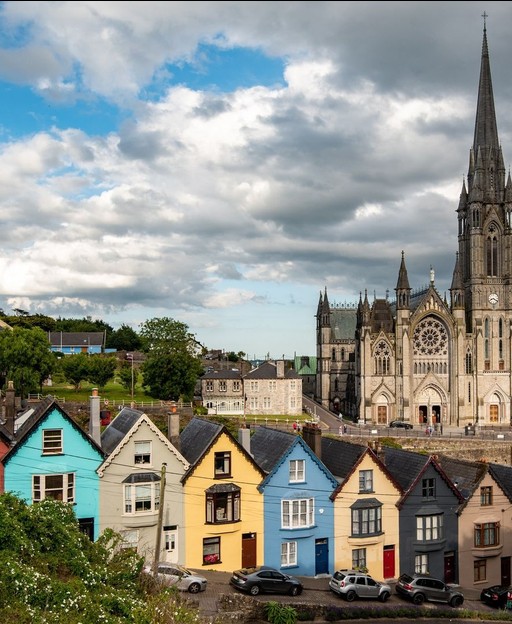
Rising above the town’s colourful terraced houses, St Colman’s Cathedral is the most striking building in Cobh. Its granite spire reaches 91 metres — the tallest spire in Ireland. On a clear day, you can see it from the water long before you reach the town itself.
Builders worked in the Gothic Revival style, breaking ground in 1868 and finishing only in 1915. Donations from Irish emigrants and their descendants abroad funded the work almost entirely — people who had left through Cork Harbour and still wanted to give something back to the community they had come from.
Inside, the cathedral holds one of the finest carillons in Europe — 49 bells, played from a keyboard in the tower. Recitals take place regularly, and when I heard them the sound carried across the whole town and out over the harbour. Visitors enter free of charge, and I’d urge you to give the carvings, the stained glass, and the sheer scale of the interior a slow, unhurried visit.
What makes St Colman’s remarkable is not just its architecture but its meaning. A community that had suffered catastrophic loss — through famine, forced emigration, and grinding poverty — chose to build something on a monumental scale. It stands as an act of defiance as much as devotion. For a very different but equally storied piece of Irish architecture, you’ll enjoy our look at Classiebawn Castle and what to know before you visit.
Love Ireland? Get inspiring stories, hidden gems, and travel ideas delivered to your inbox every week. Subscribe to the Love Ireland newsletter — it’s free.
Cobh and the Titanic
On 11 April 1912, RMS Titanic made its last port of call at Cobh — then still called Queenstown — before heading out into the Atlantic. The ship anchored in the harbour while tenders ferried passengers and mail out to it. A total of 123 passengers boarded at Queenstown, and it was the last time any of them saw Ireland.
Of the 123 who boarded at Cobh, only 44 survived. Most were travelling third class, in the lower decks of the ship, and had little chance of reaching the lifeboats in time.
The Titanic Experience Cobh occupies the building that served as the White Star Line offices in 1912. Curators have done the exhibition well — it focuses on the Cobh passengers specifically, giving them names, faces, and stories rather than treating them as statistics. It reads not as a celebration of the ship but as a memorial to the people.
The Lusitania and the Old Church Cemetery
Three years after the Titanic disaster, Cobh again stood at the centre of a maritime tragedy. On 7 May 1915, a German U-boat torpedoed RMS Lusitania off the coast of County Cork, about 18 kilometres south of the Old Head of Kinsale. The ship sank in 18 minutes. Of the 1,959 people on board, 1,198 died.
Rescuers brought many of the victims to Cobh. They lie in the Old Church Cemetery on the hill above the town, in a section that feels quiet and set apart from everything else. Caretakers keep the graves well maintained, and a stone monument marks the site. You’ll find it a sobering place to visit, and not one that appears on many tourist itineraries.
The sinking of the Lusitania helped draw the United States closer to entering the First World War. Rescuers brought most of the American passengers who died ashore at Cobh. The town’s connection to 20th-century history runs deeper than most people realise.
Practical Information for Visiting Cobh
You can reach Cobh easily from Cork city. The train runs directly from Cork Kent Station to Cobh Station, with the journey taking about 25 minutes, and services run regularly throughout the day. When you arrive, you’ll step straight off the train onto the waterfront, directly beside the Heritage Centre — right in the heart of things.
By car, the journey from Cork city takes around 30 minutes via the N25 and the Great Island Bridge. You’ll find parking along the waterfront and in the town centre, and the compact town is easy to walk around on foot.
In my experience you can cover the main sites comfortably in a full day. The Cobh Heritage Centre and the Titanic Experience each take around 90 minutes if you read the exhibitions properly, while St Colman’s Cathedral warrants at least half an hour. A short walk uphill from the town centre brings you to the Old Church Cemetery, and we suggest you save it for last.
Several good cafés and restaurants line the waterfront. The town genuinely welcomes visitors and does not feel overcrowded even in summer. It makes a good base for exploring the wider Cork Harbour area, including Fota Wildlife Park, which sits on the same train line. If you’re building a longer Irish itinerary, you might pair it with a stretch of the Atlantic coast, such as Coumeenoole Beach in wild Kerry.
Ferries run from Cobh to Spike Island, a star-shaped fort with a monastic, military, and prison history — allow half a day for the return trip and tour. The self-guided Titanic Trail walking route links the harbour, the White Star Line offices, and the memorial garden, and makes a good way to see the town’s key sites in order.
Frequently Asked Questions About Cobh
Why was Cobh called Queenstown?
The town took the name Queenstown in 1849 to mark a visit by Queen Victoria. It kept that name for more than 70 years before reverting to the Irish name Cobh in 1920, as Ireland moved towards independence. You’ll still see the old name on Titanic-era records and photographs.
How do you pronounce Cobh?
You pronounce it simply as “Cove”. The spelling reflects the Irish form of the word, but the sound is identical to the English word for a small coastal bay — fitting for a town wrapped around one of the world’s great natural harbours.
How much time do you need in Cobh?
You can see the main sights comfortably in a single full day, allowing roughly 90 minutes each for the Heritage Centre and the Titanic Experience, plus time for the cathedral and the waterfront. Stay overnight and you’ll also catch the harbour at its quietest, early in the morning before the day-trippers arrive.
Is Cobh worth visiting for people without Irish ancestry?
Absolutely. While descendants of emigrants often find the visit especially moving, you do not need Irish roots to appreciate Cobh. The town packs in emigration history, Titanic and Lusitania heritage, striking architecture, and a genuinely welcoming harbour setting that rewards any traveller.
Why Cobh Matters
Ireland has a lot of beautiful places, and Cobh is not always the most obvious choice on a short itinerary. But for anyone who wants to understand Ireland — its history, its relationship with emigration, the diaspora that now numbers 70 million people worldwide — Cobh is essential. For a walk through the town’s most photographed streetscape, don’t miss Cobh’s Deck of Cards, Ireland’s most colourful street, which sits just below the cathedral.
The emotional weight of the place is real, and you do not need Irish ancestry to feel it. Standing on the quay, looking out over the harbour, understanding that this is where so much of the story began — or ended, depending on how you look at it — leaves an impression that is hard to shake off.
The cathedral above, the emigrant statues below, the ships that came and went — all of it together makes Cobh one of the most layered and significant places in Ireland. You’ll come away feeling it deserves far more than a passing visit.
Love Ireland? Get inspiring stories, hidden gems, and travel ideas delivered to your inbox every week. Subscribe to the Love Ireland newsletter — it’s free.
Thinking about it seriously?
If you’ve started actually planning a move, our complete the full Move to Ireland guide walks through every step, every cost, and the paperwork that catches most people out.
Tours & experiences you might love


Powered by Viator. Some links are affiliate links — we may earn a small commission at no extra cost to you.
Secure Your Dream Irish Experience Before It’s Gone!
Planning a trip to Ireland? Don’t let sold-out tours or packed attractions spoil your journey. Iconic experiences like visiting the Cliffs of Moher, exploring the Rock of Cashel, or enjoying a guided walk through Ireland’s ancient past often sell out quickly—especially during peak travel seasons.

Booking in advance guarantees your place and ensures you can fully immerse yourself in the rich culture and breathtaking scenery without stress or disappointment. You’ll also free up time to explore Ireland’s hidden gems and savour those authentic moments that make your trip truly special.
Make the most of your journey—start planning today and secure those must-do experiences before they’re gone!