

Cú Chulainn is Ireland’s greatest mythological hero. He fought single combat against armies. He earned his name at seven years old by killing a monstrous dog with his bare hands. He defended the province of Ulster alone while every other warrior lay in an enchanted sleep. He died young, tied to a standing stone so he could face his enemies on his feet. The story of Cú Chulainn is more than two thousand years old, and it is still told in Ireland today.
His story comes from the Ulster Cycle, the great collection of Irish myths centred on the province of Ulster. These tales were written down by monks in the early medieval period, but they draw on an oral tradition that goes back much further. Cú Chulainn himself is believed to represent a heroic ideal from the Iron Age, perhaps as far back as the first century BC.
How Cú Chulainn Got His Name
He was born Sétanta. His mother was Deichtine, sister of the great king Conchobar mac Nessa of Ulster. His father was either the mortal chieftain Sualtam or, in some versions, the god Lugh of the Long Arm. That divine parentage placed him above ordinary men from the start.
As a young boy, Sétanta set off alone for the court of King Conchobar at Emain Macha in County Armagh. He arrived during a feast held at the home of Culann the smith. Culann had let loose a massive guard dog to protect his property. Nobody told Sétanta the dog was out.
When the dog attacked, the boy killed it with his bare hands and a hurling stick. Culann was devastated to lose such a valuable animal. Sétanta offered to make amends. He would train a replacement hound himself and guard Culann’s property until the new dog was ready.
The druid Cathbad declared that from that day on, the boy would be known as Cú Chulainn — the Hound of Culann. The name stuck. He carried it through a life of extraordinary violence and extraordinary honour.
Training at the Warriors’ School
Cú Chulainn trained at the school of the warrior woman Scáthach on the Isle of Skye, off the coast of Scotland. This was not an ordinary school. Scáthach taught only the greatest fighters. She passed on skills that no other teacher possessed.
It was there that Cú Chulainn received his most famous weapon, the Gáe Bulg. This was a spear or a barbed javelin, thrown with the foot, that entered the body as one wound and opened into thirty barbs inside. There was no surviving a strike from the Gáe Bulg. It killed every time.
He also met Aoife there, a rival warrior woman and Scáthach’s equal. He fought her in single combat, won, and chose to spare her life. She later gave birth to his only son, Connla. That choice would have devastating consequences.
He trained alongside the hero Ferdiad, who became his closest friend and foster brother. The two were inseparable. They trained together, fought together, and loved each other with the fierce loyalty that Irish heroic tradition describes between warrior companions. That friendship would be destroyed by politics and honour years later, in the most tragic single combat in Irish mythology.
The Cattle Raid of Cooley
The greatest story in the Ulster Cycle is the Táin Bó Cúailnge — the Cattle Raid of Cooley. It is Ireland’s equivalent of the Iliad. Two great armies clash over a bull. A province is defended by a single man. The stakes could not be higher.
Queen Medb of Connacht wanted the Brown Bull of Cooley, the most prized animal in Ulster. She raised an army from four provinces and marched on Ulster to take it by force. She chose her moment carefully. A curse had been placed on the warriors of Ulster by the goddess Macha. When Ulster needed them most, they would be struck with the pains of childbirth and be unable to fight. The curse worked. The army of Ulster fell helpless.
The curse did not touch Cú Chulainn. He was of divine blood. He stood alone against the armies of Connacht at the ford of the river, fighting a series of single combats each day while the mass of the army waited. This was his right under the laws of heroic combat. No army could engage en masse while the champion was fighting.
He held the ford for weeks. He fought one warrior after another, each day, exhausted and wounded, receiving care and healing at night from unseen helpers sent by the gods. He was not invincible. He bled. He hurt. But he did not stop.
☘️ Enjoying this? 65,000 Ireland lovers get stories like this every week. Subscribe free →
Cú Chulainn Against Ferdiad
The hardest day of the Cattle Raid was the combat against Ferdiad. Queen Medb had tried many warriors against Cú Chulainn and lost them all. She turned to Ferdiad, the only man alive who could match Cú Chulainn, the friend he loved above all others.
Ferdiad refused at first. He would not fight his foster brother. Medb shamed him publicly. She used words like weapons — she told him Cú Chulainn had described him as an inferior fighter, which was a lie. She offered bribes. She promised him her daughter in marriage. In the end, Ferdiad came.
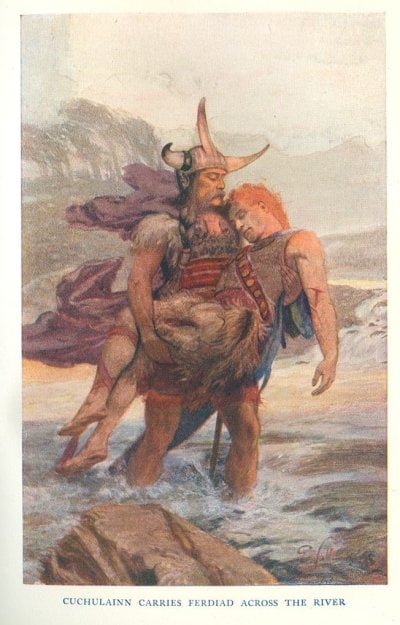
The combat lasted three days. Each night they treated each other’s wounds and shared food and drink across the ford. They slept under the same blankets. They were brothers still, even as they tried to kill each other each morning.
On the fourth day, Cú Chulainn used the Gáe Bulg. Ferdiad died. Cú Chulainn held his friend’s body in the river and wept. The lament he spoke over Ferdiad is one of the most moving passages in all of early Irish literature. He described Ferdiad as his companion, his shield, his love. He said the battle was wrong. He said he wished it had not been him who killed him.
That moment has stayed in Irish culture for two thousand years. It is the price of heroism. The code of honour demanded the combat. The man inside the hero mourned what that code cost him.
The Warp Spasm — Ríastrad
Cú Chulainn had a power that set him apart from all other warriors. When his battle frenzy came upon him, his body transformed. The Irish texts describe this as the ríastrad — sometimes translated as the warp spasm or the hero’s distortion.
In the ríastrad, his body twisted and turned inside his own skin. One eye sank deep into his head. The other bulged out as big as a cauldron. His muscles swelled beyond human proportion. His hair stood up like thorns. A light shone around him. He became something beyond a man — a figure of terror to any enemy who saw him.
This transformation made him unstoppable in battle. But it also made him dangerous to allies and to himself. His foster mother Emer and the women of Ulster had to throw cold water on him to bring him back. They used three vats of water, each barrel boiling away from the heat of his rage, before he cooled enough to be approachable.
The ríastrad is one of the earliest descriptions in world literature of the berserker state — the battle fury known in Norse and Germanic traditions as well. Scholars believe it reflects a real psychological and physical state that Iron Age warriors entered in extreme combat. Whatever its source, it is one of the most vivid images in all of Irish mythology.
The Death of Cú Chulainn
Cú Chulainn’s death was brought about by magic and by the breaking of his sacred prohibitions. He was bound by a series of geasa — sacred rules that he could never violate without destroying himself. One geis said he could never refuse hospitality. Another said he could never eat dog meat.
His enemies knew his geasa. They planned carefully. A woman offered him cooked dog at a crossroads. Refusing would break one geis. Accepting would break another. He ate the dog. His strength was already weakened.
In the battle that followed, he was hit by magical spears thrown by the sons of men he had killed. Each spear was cast with a declaration that it would kill a king. The first spear took his charioteer. The second killed his horse. The third struck Cú Chulainn himself in the stomach, and his intestines spilled out.
He knew he was dying. He walked to a standing stone at the shore of a lake, the place now called Ardee in County Louth, and tied himself to it with his own belt. He would not die on the ground. He faced his enemies standing.
The Morrigan, the goddess of war who had loved him and been refused, settled on his shoulder in the form of a crow. The enemy warriors did not approach until they saw the crow. While she perched there, they knew Cú Chulainn still lived. When she flew away, they knew he had gone.
His enemies cut off his head and his right hand, as was the custom for a defeated champion. His body remained bound to the standing stone until Ulster’s warriors came to claim him. In Irish tradition, a stone called Cú Chulainn’s Stone marks the place where he stood at Knockbridge, near Dundalk in County Louth.
For more on the Morrigan’s role in Irish mythology, see our guide to the ancient Irish goddess who still appears as a crow. The geis and its role in Irish heroism is explored in why every Irish hero had one rule they could never break. To understand the wider epic tradition Cú Chulainn belongs to, see our piece on the ancient Irish epic as big as Homer. For the battle traditions behind these stories, read our guide to Celtic warriors.
Where to Visit Cú Chulainn’s Ireland
The landscape of the Cú Chulainn legend is still there. County Louth and County Armagh are where the stories are set. You can visit the real places that appear in the myths.
Dundalk, County Louth. This is Cú Chulainn’s home territory. The town centre contains a bronze statue of the hero in his chariot. Dún Dealgan Mound, on the outskirts of town, is the traditional site of Cú Chulainn’s birthplace. A Norman motte was built on top of it in the twelfth century, but the mound itself is much older. The views from the top take in the Cooley Peninsula, the setting of the Táin Bó Cúailnge.
The Táin Way. A 40km circular walking and cycling trail around the Cooley Peninsula in County Louth, beginning and ending in Carlingford, follows the landscape of the great cattle raid. The trail connects real places mentioned in the text — rivers, hills, and crossroads that still carry the old names. Walking it with a copy of the story is a remarkable experience.
Navan Fort (Emain Macha), County Armagh. This large Iron Age earthwork near Armagh city was the seat of the kings of Ulster in the mythological tradition. It was the court of Conchobar mac Nessa, Cú Chulainn’s uncle and king. The site is now managed by the Navan Centre and Fort, which brings the mythology to life with exhibitions and guided tours. Archaeologists have confirmed that Emain Macha was a major ritual site from around 700 BC onwards. The myths and the ground match each other in remarkable ways.
Ardee, County Louth. The town of Ardee takes its name from Áth Fhirdhiadh — the Ford of Ferdiad — where Cú Chulainn and Ferdiad fought their legendary combat. The centre of the town contains a monument marking this site. Standing there, you are standing at one of the most famous locations in Irish mythology.
If your family came from County Louth, Armagh, or the wider Ulster region, the Cú Chulainn tradition was part of the culture they grew up in. The stories were told at winter firesides. The place names carried the memory. When your ancestors emigrated — to Boston, to New York, to Australia — they carried this world inside them, even if they never spoke its name. Our heritage trip planning guide explains how to visit your ancestral county and connect with the places your family came from. For ancestry research, our guide to tracing your Irish roots covers every record and archive available.
Frequently Asked Questions About Cú Chulainn
Who was Cú Chulainn?
Cú Chulainn was the greatest hero of Irish mythology, central to the Ulster Cycle of tales. He was born Sétanta and earned the name Cú Chulainn — Hound of Culann — by killing a guard dog as a child. His mother was Deichtine, sister of the King of Ulster, and his father was either the mortal Sualtam or the god Lugh. He defended Ulster single-handedly during the Cattle Raid of Cooley and died young, bound to a standing stone facing his enemies.
What is the Cattle Raid of Cooley?
The Táin Bó Cúailnge (Cattle Raid of Cooley) is the central epic of the Ulster Cycle and Ireland’s equivalent of the Iliad. Queen Medb of Connacht marched an army to Ulster to steal the Brown Bull of Cooley. Because the warriors of Ulster were struck by a curse, only Cú Chulainn could fight. He defended the province in a series of single combats at the ford of the river, including the devastating combat against his friend Ferdiad, until the Ulster warriors recovered.
What was the ríastrad?
The ríastrad (sometimes called the warp spasm or hero’s distortion) was Cú Chulainn’s battle frenzy. In this state, his body contorted, one eye sank into his skull while the other bulged out, his muscles swelled, and a supernatural light surrounded him. He became nearly unstoppable in combat but dangerous to everyone around him. It required cold water and the intervention of the women of Ulster to calm him down after battle.
How did Cú Chulainn die?
Cú Chulainn died after his enemies exploited his sacred prohibitions, or geasa. He was tricked into eating dog meat, weakening his power. In the following battle, he was struck by three magical spears. Fatally wounded, he tied himself to a standing stone so he could die on his feet. His enemies waited until the Morrigan, goddess of war, flew from his shoulder as a crow — the sign that he had died. His death is associated with the area around Knockbridge, near Dundalk in County Louth.
Where can I visit the places connected to Cú Chulainn?
The main sites are in counties Louth and Armagh. Dundalk contains a statue of Cú Chulainn and Dún Dealgan Mound, his legendary birthplace. Ardee (Áth Fhirdhiadh) marks the ford where he fought Ferdiad. Navan Fort (Emain Macha) near Armagh city was the court of the King of Ulster. The Táin Trail connects these locations along a walking and cycling route through the landscape of the myth.
Ireland’s Hero — and Yours
Cú Chulainn represents something in the Irish character that has survived every upheaval. He is not a god and not a king. He is a man who chose to stand alone when it was required of him. He loved deeply and it cost him. He followed a code of honour even when that code destroyed what he cared about most. He died on his feet.
The Rising of 1916 used Cú Chulainn as its central symbol. The statue in the General Post Office in Dublin — sculpted by Oliver Sheppard — shows the dying hero bound to his stone. It was chosen because it represented the willingness to sacrifice everything for a principle. That image is still there today.
If your Irish ancestors came from Ulster, they grew up with these stories. They knew the Cooley Peninsula. They knew what Emain Macha meant. They carried a version of Cú Chulainn’s world with them wherever they went. You are part of that story too.
Explore more Irish mythology with our article on the Morrigan, the ancient war goddess. You can also discover the four treasures Ireland’s ancient gods left behind. And if you want to trace your own roots in Ulster and beyond, our complete guide to tracing your Irish ancestry has everything you need.
☘️ Join 65,000+ Ireland Lovers
Every Friday, get Ireland’s hidden gems, local secrets, and travel inspiration — the kind you won’t find in any guidebook.
Subscribe free — enter your email:
📲 Know someone who’d love this? Share on WhatsApp →
Free forever · One email per week · Unsubscribe anytime
Tours & experiences you might love


Powered by Viator. Some links are affiliate links — we may earn a small commission at no extra cost to you.
Secure Your Dream Irish Experience Before It’s Gone!
Planning a trip to Ireland? Don’t let sold-out tours or packed attractions spoil your journey. Iconic experiences like visiting the Cliffs of Moher, exploring the Rock of Cashel, or enjoying a guided walk through Ireland’s ancient past often sell out quickly—especially during peak travel seasons.

Booking in advance guarantees your place and ensures you can fully immerse yourself in the rich culture and breathtaking scenery without stress or disappointment. You’ll also free up time to explore Ireland’s hidden gems and savour those authentic moments that make your trip truly special.
Make the most of your journey—start planning today and secure those must-do experiences before they’re gone!