

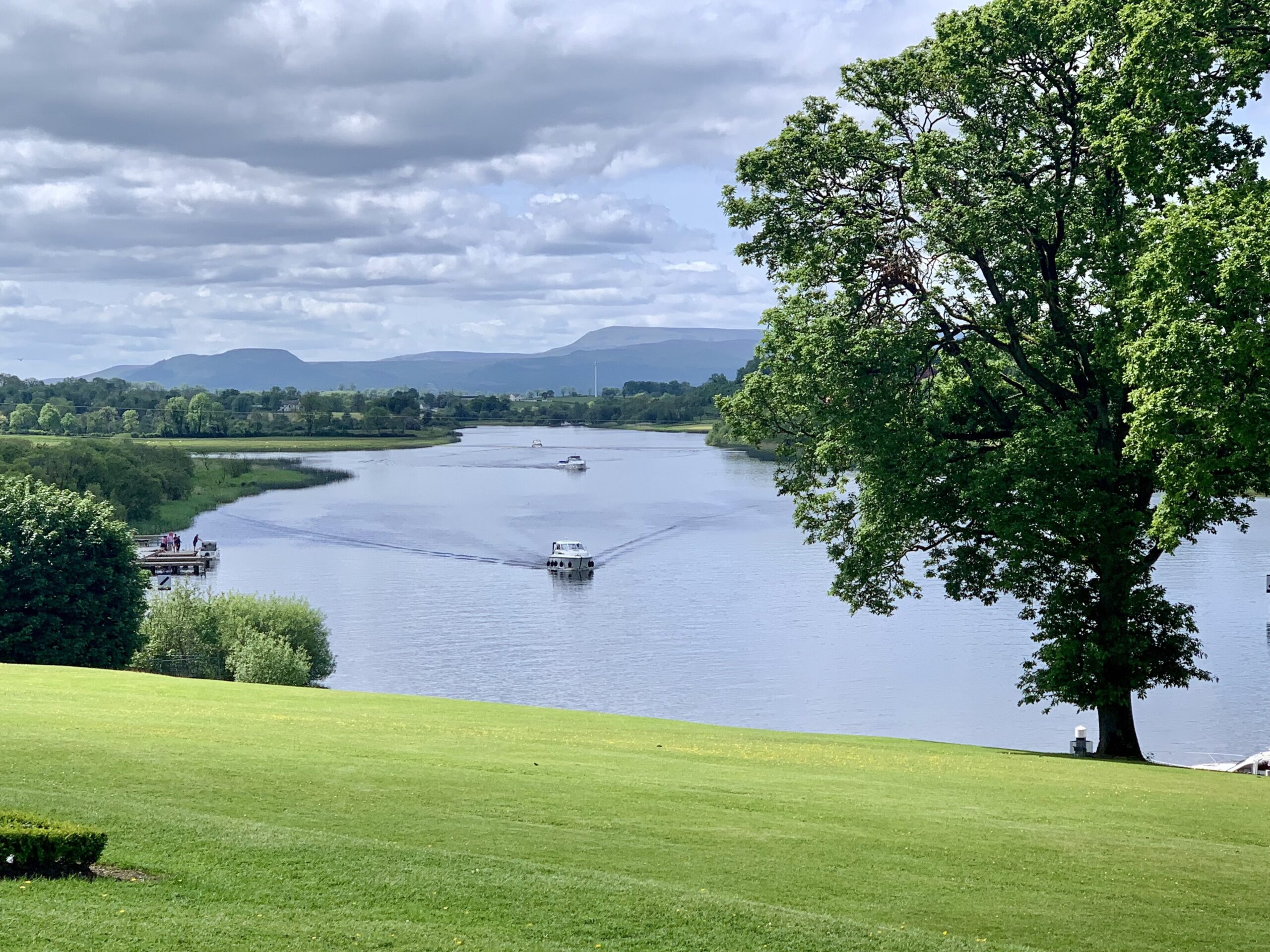
County Fermanagh is unlike any other county in Ulster. More than a third of its surface is water. The Upper and Lower Lough Erne stretch across the land in a chain of islands, causeways, and narrow peninsulas. The Gaelic families who lived here were shaped by that water. Their surnames — Maguire, McManus, Cassidy — carry the memory of a world built on lakes and lakeshore.
Free Irish ancestry tool ☘️
Have an Irish surname? Find your ancestral Irish county — we’ll trace your name to where the family originated, with a short note on its history.
Irish Surnames from Fermanagh: The Land of the Erne
The county’s name comes from the Irish Fir Manach — “men of Manach.” Manach was an ancient people who lived here long before recorded history. By the thirteenth century, the Maguires had risen to rule the lake lands. They held Fermanagh for more than three hundred years.
Before the Plantation of Ulster in 1610, Fermanagh was the heartland of Maguire power. The islands of Lough Erne sheltered monasteries that had survived Viking raids. The lakeshore held the towers of lords who answered to no one but the Maguire chief. That world ended with the Plantation. But the names survived.
If you are starting your heritage research, our guide to tracing your Irish ancestry covers every key archive and database.
Maguire – Mag Uidhir: The Lords of Fermanagh
No surname is more closely tied to County Fermanagh than Maguire. The Gaelic form is Mag Uidhir — “son of Odhar.” The personal name Odhar means dun or pale-coloured.
The Maguires first appear in the Annals around 1300. Donnchaidh Maguire was the first chief to hold Fermanagh as a recognised lordship. From that point until the Plantation, the Maguires were the paramount lords of the county. Their seat was Enniskillen Castle, built on an island in the River Erne where it narrows between the two loughs. Every major decision for Fermanagh passed through that castle.
The last great chief was Cuconnacht Maguire. He joined the Flight of the Earls in 1607. He never returned to Ireland. He died in Genoa in 1608, on his way to Spain. With him went the Gaelic order in Fermanagh.
His kinsman Hugh Maguire died fighting at Cork in 1600. Between them, the two men mark the violent end of three centuries of Maguire rule.
Today, Maguire and McGuire are the same name. The Mac- spelling followed a phonetic shift in how Ulster Irish was anglicised. Both forms are equally valid. If your family name is Maguire or McGuire, County Fermanagh is almost certainly where your research should start.
McManus and Cassidy – The Maguire Inner Circle
McManus comes from Mac Maghnuis — “son of Magnus.” The name Magnus was Norse. It entered Gaelic use through the medieval period. The McManus family were a sub-sept of the Maguires. Their territory was the islands of Lough Erne. They appear in records from the thirteenth century.
The islands of Lough Erne mattered. Devenish Island held a monastery with a round tower still standing today. White Island had carved stone figures from the early Christian period. The island world of the Erne was where the McManus family lived and held power across the medieval centuries.
Cassidy is Ó Caiside in Gaelic. The Cassidys were the hereditary physicians to the Maguire chiefs. This was one of the most important roles in Gaelic society. The ollamh leighis — the chief physician — held land and status equal to a minor lord.
The Cassidy family produced medical manuscripts in the tradition of the Gaelic learned class. They kept knowledge alive for generations. When the Maguires fell with the Plantation, the Cassidys lost that protection. Many left for Europe or America in the centuries that followed.
If your surname is Cassidy, Fermanagh is your starting point. The name remains strongly concentrated in Fermanagh and the south Ulster area today.
O’Flanagan and Corrigan – Fermanagh’s Ancient Families
O’Flanagan is Ó Flannagáin in Gaelic — “descendant of Flannagán.” The root flann means ruddy or red. The O’Flanagans were kings of Clann Cholggan, a territory in south Fermanagh around the modern Lisnaskea area. They ruled this land before the Maguires rose to dominance. When the Maguires took control of Fermanagh in the 1200s, the O’Flanagans became their vassals. They kept their territory but lost their independence.
O’Flanagan survives today as Flanagan across Ulster and the Irish diaspora in America. If your Flanagan line traces to south Ulster, a Fermanagh origin is very likely.
Corrigan is Ó Corragáin in Gaelic. The Corrigans were a small native sept based in south Fermanagh. They do not appear in national history the way the Maguires do. But they were there — farming, surviving, and passing the name on through every catastrophe the county faced. Corrigan appears in Plantation-era records. The name is concentrated in south Fermanagh, Cavan, and Monaghan today.
☘️ Enjoying this? 65,000 Ireland lovers get stories like this every week.
Thinking about it seriously?
If you’ve started actually planning a move, our complete the full Move to Ireland guide walks through every step, every cost, and the paperwork that catches most people out.
Subscribe free →
How Fermanagh Surnames Crossed the Atlantic
County Fermanagh sent emigrants to America in two main waves.
The first was the Flight of the Earls in 1607. This was not a mass emigration. It was the departure of the lords. Cuconnacht Maguire and his household left from Rathmullan in County Donegal. They took with them the last of the native Gaelic ruling class. Many followers joined them in Europe. Some fought in Irish brigades in Spain, France, and Austria. Their descendants — the Wild Geese — lived and died across Catholic Europe for generations.
The second wave came during and after the Great Famine of 1845 to 1852. Fermanagh lost around a quarter of its population to death and emigration. Families left through the ports of Sligo, Derry, and Belfast. They arrived in New York, Boston, and Philadelphia. They found work on railways, in factories, and in domestic service.
The names Maguire, McManus, Cassidy, and Flanagan appear throughout the Catholic communities of the eastern United States. Many descendants of these families live today in Pittsburgh, Boston, and Chicago — cities that absorbed waves of Fermanagh emigrants across the nineteenth century.
Our Irish heritage trip planning guide explains how to visit your ancestral county in person.
How to Trace Your Fermanagh Ancestry
PRONI — Public Record Office of Northern Ireland
PRONI in Belfast holds the main collection of church, estate, and landed records for County Fermanagh. Church records — both Catholic and Church of Ireland — survive in good numbers from the early nineteenth century. Many are searchable online at proni.gov.uk. For any Fermanagh research, this is where you start.
Fermanagh Local Studies Library
The Fermanagh Local Studies Library in Enniskillen holds local newspapers, gravestone records, and estate papers. The collection covers the county from the seventeenth century. Researchers with Fermanagh surnames should contact the library before consulting national archives — local collections often hold details that central archives miss.
Griffith’s Valuation and Online Resources
Griffith’s Valuation listed every land-holder in Ireland in the 1850s and 1860s. You can search County Fermanagh records free at askaboutireland.ie. The 1901 and 1911 census returns are fully searchable at census.nationalarchives.ie. For a full guide to every key archive, see our step-by-step guide to tracing your Irish roots.
Where to Visit in Fermanagh to Connect with Your Heritage
Enniskillen Castle. The castle stands where the Maguires built their original fortress on an island in the River Erne. The current structure dates from the sixteenth century. It now houses the Fermanagh County Museum and the Inniskillings Museum. This is the physical heart of Maguire power in Ulster.
Devenish Island. This island on Lower Lough Erne was a major monastic site from the sixth century. The round tower still stands — one of the best preserved in Ireland. St Molaise founded the monastery here. The island is reached by ferry from Trory Point. It is one of the finest heritage sites in Ulster.
Tully Castle. Built in 1619 during the Plantation, Tully Castle is now a roofless ruin on the shore of Lower Lough Erne. The castle was attacked and burned in 1641. The ruins are open to visitors. A walled garden beside the castle has been restored and is worth seeing.
White Island. A short ferry ride from Castle Archdale, White Island holds a row of seven carved stone figures in the ruins of a medieval church. The figures date from the early Christian period. They are among the strangest and most striking carved stones in Ireland. A visit connects you directly to the monastic world the Maguires protected.
Ulster American Folk Park, Omagh. Just across the Tyrone border, this open-air museum tells the story of Ulster emigration to America across three centuries. The research centre holds passenger lists, church records, and emigration papers for Fermanagh families.
Our 7-day Irish ancestry itinerary gives a full framework for visiting heritage sites across Ulster. Our guide to Irish surnames from Tyrone covers the neighbouring county and its Cenél nEóghain connections. Our guide to Irish surnames from Derry explores the O’Kane heartland to the north.
Frequently Asked Questions About Fermanagh Surnames
What is the most common Irish surname from County Fermanagh?
Maguire — written as McGuire in some family lines — is the most historically significant surname in County Fermanagh. The Maguires ruled as lords of Fermanagh from around 1300 until the Plantation of Ulster in 1610. Both spellings come from the same Gaelic original, Mag Uidhir. The name remains strongly concentrated in Fermanagh and the surrounding Ulster counties.
What does Maguire mean in Irish?
Maguire comes from the Gaelic Mag Uidhir — “son of Odhar.” The personal name Odhar means dun or pale-coloured. The family first appear in the historical record around 1300. Their last chief, Cuconnacht Maguire, joined the Flight of the Earls in 1607 and died in Genoa in 1608.
Is McManus a Fermanagh surname?
Yes. McManus comes from Mac Maghnuis — “son of Magnus.” The McManus family were a sub-sept of the Maguires based on the islands of Lough Erne. They held power there from the thirteenth century. McManus is found today across Fermanagh, Roscommon, and the Irish diaspora in America and Australia.
What was the Cassidy family’s role in Fermanagh?
The Cassidys — Ó Caiside in Gaelic — served as hereditary physicians to the Maguire chiefs. This was a high-status role in Gaelic society. The family held land in return for their medical service. They produced manuscripts and kept medical knowledge alive across several generations. Cassidy remains concentrated in Fermanagh and south Ulster today.
Where can I trace my County Fermanagh ancestry?
Start with PRONI in Belfast at proni.gov.uk for church and estate records. Use askaboutireland.ie for Griffith’s Valuation. Search the 1901 and 1911 census at census.nationalarchives.ie. The Fermanagh Local Studies Library in Enniskillen holds local newspapers, gravestone records, and estate papers for the county.
Your Fermanagh Roots Are Waiting
County Fermanagh does not draw the crowds that Kerry or Galway attract. But it holds a deep and specific history. The Maguires were one of the last great Gaelic dynasties to hold their land intact. The islands of Lough Erne preserved monastic culture for a thousand years. The names that came from this water-bound territory are among the most distinctive in Ulster.
If your name is Maguire, McManus, Cassidy, or Flanagan, you carry something real. A family that survived invasion, plantation, and famine — and still passed the name on.
Walk the ruins of Enniskillen Castle and you stand where the last Gaelic lords of Fermanagh held court. Take a ferry to Devenish Island and you stand where monks copied manuscripts for eight hundred years.
That name is yours now. Follow it home.
Explore more of our Irish surnames series — covering Cork, Galway, Kerry, Dublin, Clare, Mayo, Donegal, Tipperary, Limerick, Waterford, Wexford, Kilkenny, Sligo, Roscommon, Antrim, Down, Tyrone, Derry, and Armagh. Our guide to Irish surnames from Armagh explores the ancient ecclesiastical capital and its heritage.
☘️ Join 65,000+ Ireland Lovers
Every Friday, get Ireland’s hidden gems, local secrets, and travel inspiration — the kind you won’t find in any guidebook.
Subscribe free — enter your email:
📲 Know someone who’d love this? Share on WhatsApp →
Free forever · One email per week · Unsubscribe anytime
Tours & experiences you might love


Powered by Viator. Some links are affiliate links — we may earn a small commission at no extra cost to you.
Secure Your Dream Irish Experience Before It’s Gone!
Planning a trip to Ireland? Don’t let sold-out tours or packed attractions spoil your journey. Iconic experiences like visiting the Cliffs of Moher, exploring the Rock of Cashel, or enjoying a guided walk through Ireland’s ancient past often sell out quickly—especially during peak travel seasons.

Booking in advance guarantees your place and ensures you can fully immerse yourself in the rich culture and breathtaking scenery without stress or disappointment. You’ll also free up time to explore Ireland’s hidden gems and savour those authentic moments that make your trip truly special.
Make the most of your journey—start planning today and secure those must-do experiences before they’re gone!
Subscribe Free