

County Kilkenny carries some of the most storied surnames in Ireland. Whether your family name is Fitzpatrick, Butler, Brennan, or Phelan, the roots of these Irish surnames from Kilkenny reach back over a thousand years. They belong to ancient Gaelic kingdoms, Norman conquerors, and merchant families who built the Marble City itself. This guide explores the most significant Kilkenny surnames — their Gaelic origins, their meanings, and the history behind each name.
Try our free Irish ancestry tools ☘️
Have an Irish surname? Find your ancestral Irish county — type your surname and we’ll trace it back to the county where it originated, with a short note on the family’s history.
Curious about your first name in Irish too? Your Irish Name translates first names to their Gaelic equivalent — with the meaning and the pronunciation.
Irish Surnames from Kilkenny: The Kingdom of Ossory
Before Kilkenny had a name, it had a kingdom. Ossory was one of the oldest political units in Ireland. It covered most of modern County Kilkenny and parts of Laois and Tipperary. The kings of Ossory ruled for centuries before the Normans arrived in the twelfth century.
Watch: Do You Qualify for an Irish Passport?
Tracing your Irish family? If one of your grandparents was born in Ireland, you may be able to become an Irish citizen. This 14-minute guide explains who qualifies, what it costs and how long it takes. Thinking of making the move? Get the free Moving to Ireland checklist.
The surnames that emerged from Ossory tell this story. They are some of the most distinctive in Ireland. Fitzpatrick comes directly from the old Ossory royal line. Brennan descends from the lords of Idough in the county’s northern territory. Phelan traces to the Déisi people who once stretched from Waterford into southern Kilkenny.
When the Normans came, they did not erase what was here. They added a new layer. Kilkenny became a Norman stronghold, and surnames like Butler, Grace, Rothe, and Comerford took root. Today, the county carries both Gaelic and Norman heritage in equal measure. If your surname appears on this list, you belong to one of the most remarkable genealogical landscapes in Ireland.
If you are only beginning your genealogy journey, our Irish heritage trip planning guide is a good starting point. It covers how to visit ancestral townlands, contact local archives, and make the most of your time on Irish soil.
Fitzpatrick – Mac Giolla Phadraig
No surname is more closely tied to County Kilkenny than Fitzpatrick. In Gaelic, the name is Mac Giolla Phadraig — “son of the devotee of St Patrick.” The personal name Giolla Phadraig honoured the patron saint of Ireland, and it was borne by a king of Ossory who died in 996 AD. His descendants took his name as their surname.
The Fitzpatricks were lords of Upper Ossory for centuries. Their territory covered northern Kilkenny and parts of Laois. When the Normans arrived, they recognised the family’s power. The English version of the name adopted the Norman prefix “Fitz,” meaning “son of,” but the Gaelic root remained: the devotion to St Patrick.
Fitzpatrick holds a unique place among Irish surnames. Most Gaelic families with the “Mac” prefix eventually Anglicised to “Mc” or dropped the prefix. Fitzpatrick kept its form and became the only major Gaelic surname to Anglicise with the “Fitz” prefix rather than the “Mc” or “O’” prefix. It is a Norman frame around a purely Irish identity.
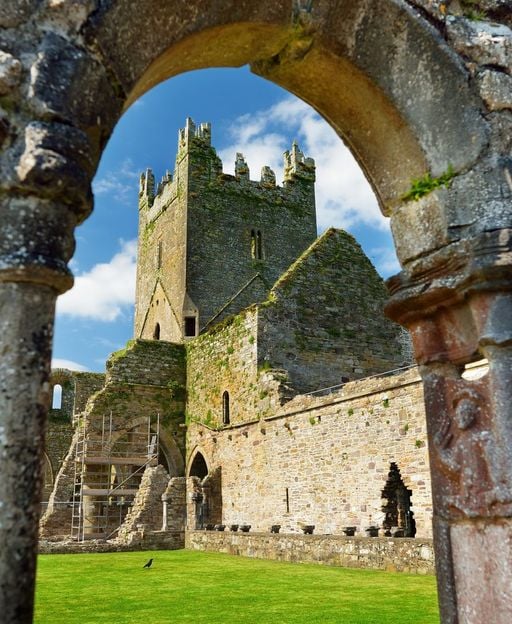
Today, Fitzpatrick remains one of the most common surnames in County Kilkenny. If this is your name, your line almost certainly traces to the ancient kingdom of Ossory. Jerpoint Abbey, founded in 1158 under the patronage of the MacGilpatrick kings, is one of the finest places to feel that connection today.
Brennan – Ó Braonáin
Brennan is one of Ireland’s most widespread surnames, but it has a deep Kilkenny root. The Gaelic form is Ó Braonáin, meaning “descendant of Braonán.” The personal name Braonán comes from the word braon, meaning “moisture” or “drop.” In early Irish poetry, the same word carried the sense of sorrow.
The principal sept of the Brennans was based in Idough, a territory in northern County Kilkenny known in Irish as Uí Duach. By the fourteenth century, the Brennans were recognised as lords of Idough and Upper Ossory. Their territory stretched into County Carlow and County Laois.
When the Cromwellian plantations of the 1650s displaced Gaelic families from their lands, many Brennans were scattered. Large numbers emigrated during the eighteenth and nineteenth centuries. Today, the surname is common across the United States, Canada, and Australia — a direct echo of the Kilkenny diaspora.
A second sept of Brennans, Mac Branáin (meaning “little raven”), also contributed to the overall numbers. Both branches merged in common usage under the single English spelling. If your family name is Brennan, the ancestral heartland of Idough in northern Kilkenny is worth exploring.
Phelan – Ó Faoláin
The name Phelan comes from the Gaelic Ó Faoláin, meaning “descendant of Faolán.” The personal name Faolán derives from faol, meaning “wolf.” Wolf names were common in early Ireland. They signified strength, loyalty, and the warrior spirit.
The Phelans were part of the ancient Déisi people, a tribal grouping that once occupied territory across both County Waterford and southern County Kilkenny. They were a powerful family in the Kingdom of Ossory before the Norman arrival.
By the time of the 1901 census, Phelan and its variant O’Phelan ranked among the top ten surnames in County Kilkenny. The surname spread across the county and into neighbouring Waterford and Carlow. It is most concentrated in the south of the county, reflecting the original Déisi homeland. Our guide to Irish surnames from Waterford explores the Déisi connection further.
☘️ Enjoying this? 64,000+ Ireland lovers get stories like this every week. Subscribe free →
Murphy – Ó Murchadha
Murphy is the most common surname in all of Ireland, and Kilkenny has always had a strong Murphy presence. The Gaelic form is Ó Murchadha, meaning “descendant of Murchadh.” The personal name Murchadh means “sea warrior” — from muir (sea) and cath (battle).
Multiple Murphy septs existed across Leinster. The Kilkenny Murphys were primarily part of the Uí Ceinnselaigh branch, the same line that gave Ireland the MacMurrough kings of Leinster. They were spread widely across the county and are among its most documented families in the nineteenth century census and church records.
Butler – de Buitléir: The Norman Lords of Kilkenny
No surname shaped County Kilkenny more than Butler. The family arrived with the Norman invasion of the twelfth century. The name derives from the hereditary office of “butler” — in Old French, boteillier — meaning the official who supplied wine to the royal court.
Theobald Walter came to Ireland with Strongbow in the 1170s. He was granted the title of Chief Butler of Ireland by King Henry II. His descendants took the title as their surname. In Irish, the name became de Buitléir.
By 1391, the Butlers purchased Kilkenny Castle and made it their primary seat. They ruled as Earls of Ormond — and eventually Dukes of Ormond — for nearly six centuries. Their territory covered most of County Kilkenny and County Tipperary. The Butler family intermarried with Gaelic Irish nobility, Anglo-Norman families, and eventually with the English crown itself.
In 1967, the 23rd Earl of Ormond handed Kilkenny Castle to the people of Kilkenny for a symbolic payment of fifty pounds. Today it is a national monument and one of Ireland’s most visited heritage sites. The Butler connection to Kilkenny lasted nearly eight hundred years.
If your surname is Butler, your Kilkenny branch almost certainly connects to this extraordinary dynasty. See also our guide to Irish surnames from County Tipperary, where the Butler story runs equally deep.
Grace – de Gras
Grace is one of the most distinctive Norman surnames in County Kilkenny. The family descends from Raymond le Gros, one of the key commanders of the Norman invasion of Ireland in the 1170s. The Latin form of the name, Crassus (meaning “fat” or “stout”), became le Gras in Norman French, then Grace in English.
Raymond le Gros acquired territory in County Kilkenny in the late twelfth century. His descendants settled the area and became one of the county’s leading Norman families. The Grace family name appears in Kilkenny records from the medieval period onwards.
By the nineteenth century, Grace ranked among the top ten surnames in County Kilkenny. It is still strongly concentrated in the county today. The name is rare outside Kilkenny — a clear sign that this is one of the county’s most distinctly localised surnames.
Comerford – de Quemerford
Comerford is one of Kilkenny’s oldest Norman surnames. The family traces its name to Quemerford, a village in Wiltshire, England. Philip de Quemerford settled in County Kilkenny in the late thirteenth century after marrying into an established Irish family. The name gradually standardised as Comerford through the sixteenth century.
In Irish, the family was known as Comartún. They settled primarily in counties Kilkenny and Waterford, and later spread into County Tipperary. The Comerford family is among the most documented in Kilkenny’s medieval records. They were merchants, landowners, and eventually strong supporters of the Catholic cause during the Reformation.
The name remains most strongly associated with County Kilkenny to this day. If Comerford is your surname, your family has been in this county for over seven hundred years.
Rothe – Medieval Kilkenny’s Merchant Family
Rothe is a surname almost entirely specific to County Kilkenny. The family were Cambro-Norman in origin and settled in Kilkenny city during the medieval period. They became one of the wealthiest merchant families in the city, with strong ties to trade, the law, and the Catholic Church.
The most famous Rothe landmark is Rothe House on Parliament Street in Kilkenny city. Built between 1594 and 1610 by merchant John Rothe Fitz-Piers, it is one of the finest surviving examples of a Tudor merchant’s house in Ireland. Today it houses the Kilkenny Archaeological Society and serves as the county’s leading genealogy research centre.
If you are tracing Kilkenny ancestry, Rothe House is an essential stop. The family history research service at Rothe House can access church records, estate papers, and parish registers that cover the full county.
Shortall and Walsh – Two More Kilkenny Surnames
Shortall is one of the most distinctly Kilkenny surnames in Ireland. It is a Norman name, de Shortal, that became completely associated with County Kilkenny. Shortall families are rarely found outside the county in any significant number. If this is your name, your roots are almost certainly within the county boundaries.
Walsh (Breathnach in Irish) means “the Welsh person” and was given to families who came to Ireland from Wales during the Norman period. Walsh is now one of the four most common surnames in Ireland. In Kilkenny, Walsh families were widespread across the county, often working as farmers, craftsmen, and labourers. The name appears across all of Leinster and Munster in significant numbers. Our Wexford surnames guide traces the Walsh name in the neighbouring county.
Kavanagh – The Royal Name of Leinster
Kavanagh (Caomhánach in Irish) means “follower of Caomhán” — a reference to St Kevin of Glendalough. The name originated with Dómnall Caomhánach, a son of the last High King of Leinster, Diarmait Mac Murchada (Dermot MacMurrough). Diarmait was the Irish king who invited the Normans to Ireland in 1169, an act that changed the country forever.
Despite their connection to the Norman invitation, the Kavanaghs remained a Gaelic Irish family of royal descent. They continued to resist English control for centuries. The Kavanagh surname is concentrated in the Leinster counties — particularly Carlow, Kilkenny, and Wexford. Their original stronghold was in the Barrow Valley region that spans these counties.
The Kavanagh name in Wexford connects directly to this same royal line. Our article on Irish surnames from Wexford traces the MacMurrough dynasty in detail. Kilkenny’s Kavanaghs were a branch of the same family who held territory in the south and east of the county.
How to Trace Your Kilkenny Ancestry
Kilkenny has some of the best-preserved genealogy records in Ireland. Here are the key resources for tracing your Kilkenny roots.
Rothe House Genealogy Centre
Rothe House on Parliament Street in Kilkenny city is the county’s dedicated family history research centre. It holds church records, estate papers, and historical maps covering the full county. The centre offers professional research services for families tracing Kilkenny ancestry from abroad. Contact: [email protected] or visit rootsireland.ie for online access to digitised records.
National Archives of Ireland
The National Archives in Dublin holds civil registration records (from 1864), Griffith’s Valuation (1850s land survey), and the 1901 and 1911 census returns. These are essential for any Kilkenny family search. All records are fully searchable online at census.nationalarchives.ie and irishgenealogy.ie free of charge.
Parish Records
Most Catholic parish registers for County Kilkenny survive from the 1820s and 1830s onwards. Some earlier registers exist for Kilkenny city parishes. The Roman Catholic Diocese of Ossory covers County Kilkenny. Records are accessible via the National Library of Ireland and through rootsireland.ie.
If you want to turn your research into a journey, our 7-day Irish ancestry itinerary gives a complete framework for visiting ancestral sites, archives, and heritage centres across Ireland. Our heritage trip planning guide covers how to find your ancestral townland and what to do when you get there.
Where to Visit in Kilkenny to Connect with Your Heritage
Kilkenny rewards the heritage traveller. These are the sites that bring the county’s surname history to life.
Kilkenny Castle. The Butler family home for nearly six centuries. The castle sits at the heart of the city and is open to visitors year-round. The grand rooms reflect the power of the Earls of Ormond at their height. Entry to the castle grounds is free; the interior tours carry a small fee.
Jerpoint Abbey. Founded in 1158 under the patronage of the MacGilpatrick kings of Ossory, Jerpoint is one of Ireland’s finest medieval ruins. The Cistercian monastery sits near the village of Thomastown in south Kilkenny. Its carved stone cloister and intact tower make it one of the most atmospheric sites in Leinster. Fitzpatrick and Butler family connections run throughout its history.
Rothe House. The Tudor merchant’s house built by the Rothe family on Parliament Street is both a museum and a working genealogy centre. It is an ideal starting point for Kilkenny family research on the ground.
St Canice’s Cathedral. The medieval cathedral of Kilkenny city contains some of the finest medieval tomb sculpture in Ireland. Butler, Grace, and Rothe memorials line the nave and side chapels. The round tower beside the cathedral dates to the ninth century and can still be climbed today.
The Black Abbey. A Dominican friary founded in 1225. Several Kilkenny city families are buried here. The carved stone work and medieval stained glass make it one of the city’s most beautiful buildings.
For a complete framework of heritage research across Ireland, see our guide on how to trace your Irish ancestry. It covers every key database and archive, from DNA testing to passenger lists.
☘️ You Might Also Love
☘️ Join 64,000+ Ireland Lovers
Every Friday, get Ireland’s hidden gems, local secrets, and travel inspiration — the kind you won’t find in any guidebook.
Subscribe free — enter your email:
📲 Know someone who’d love this? Share on WhatsApp →
Love more? Join 43,000 Scotland lovers → · Join 30,000 Italy lovers → · Join 7,000 France lovers →
Free forever · · Unsubscribe anytime
Frequently Asked Questions About Kilkenny Surnames
What are the most common Irish surnames from County Kilkenny?
The most common surnames in County Kilkenny historically include Murphy, Walsh, Brennan, Maher, Butler, Phelan, Grace, Fitzpatrick, Comerford, and Ryan. Of these, Grace, Comerford, Fitzpatrick, and Shortall are most strongly associated with Kilkenny specifically and are rarely found in large numbers outside the county.
What does the surname Fitzpatrick mean in Irish?
Fitzpatrick comes from the Gaelic Mac Giolla Phadraig, meaning “son of the devotee of St Patrick.” The personal name Giolla Phadraig was borne by a king of Ossory who died in 996 AD. The “Fitz” prefix is Norman-French. The Fitzpatricks were lords of Upper Ossory in what is now northern County Kilkenny and southern County Laois.
Where can I trace my County Kilkenny ancestry?
Start with Rothe House in Kilkenny city (rothehouse.com), which offers professional genealogy research services. Online, the National Archives census records (census.nationalarchives.ie), Griffith’s Valuation, and the rootsireland.ie database are the most useful. Parish records for the Diocese of Ossory are available through the National Library of Ireland’s free online portal.
Is the Butler surname Irish or Norman?
Butler is a Norman surname that arrived in Ireland with the twelfth-century invasion. The name derives from the hereditary office of Chief Butler of Ireland, granted to Theobald Walter by King Henry II. The family, known in Irish as de Buitléir, became deeply embedded in Irish life. They owned Kilkenny Castle for nearly six hundred years and became one of the most powerful dynasties in Irish history.
What heritage sites in Kilkenny connect to these surnames?
Kilkenny Castle is central to the Butler story. Jerpoint Abbey in Thomastown connects to the Fitzpatrick kings of Ossory. Rothe House on Parliament Street carries the Rothe merchant family name and serves as the county genealogy centre. St Canice’s Cathedral holds medieval tombs for the Butler, Grace, and Rothe families. The Black Abbey has further connections to Kilkenny’s Norman merchant families.
Your Kilkenny Roots Are Waiting
County Kilkenny is one of the most layered genealogical counties in Ireland. Its surnames carry over a thousand years of Gaelic kingship, Norman conquest, merchant wealth, and Catholic survival. Whether your name is Fitzpatrick from the old Ossory line, Butler from the Norman lords, or Brennan from the chiefs of Idough, your family left marks across this county that are still visible today.
The Marble City is more than a beautiful destination. It is a living archive. Walk through Kilkenny Castle and you walk through Butler history. Step into Jerpoint Abbey and you stand in the ground that the MacGilpatrick kings consecrated over eight hundred years ago. The surnames on this list are not just words. They are a direct connection to the people who built this county.
Explore more of our Irish surnames series — covering Cork, Galway, Kerry, Dublin, Clare, Mayo, Donegal, Tipperary, Limerick, Waterford, and Wexford. Each county has its own distinctive surnames, its own history, and its own story waiting to be reclaimed.
Tours & experiences you might love


Powered by Viator. Some links are affiliate links — we may earn a small commission at no extra cost to you.
Secure Your Dream Irish Experience Before It’s Gone!
Planning a trip to Ireland? Don’t let sold-out tours or packed attractions spoil your journey. Iconic experiences like visiting the Cliffs of Moher, exploring the Rock of Cashel, or enjoying a guided walk through Ireland’s ancient past often sell out quickly—especially during peak travel seasons.

Booking in advance guarantees your place and ensures you can fully immerse yourself in the rich culture and breathtaking scenery without stress or disappointment. You’ll also free up time to explore Ireland’s hidden gems and savour those authentic moments that make your trip truly special.
Make the most of your journey—start planning today and secure those must-do experiences before they’re gone!
Subscribe Free