

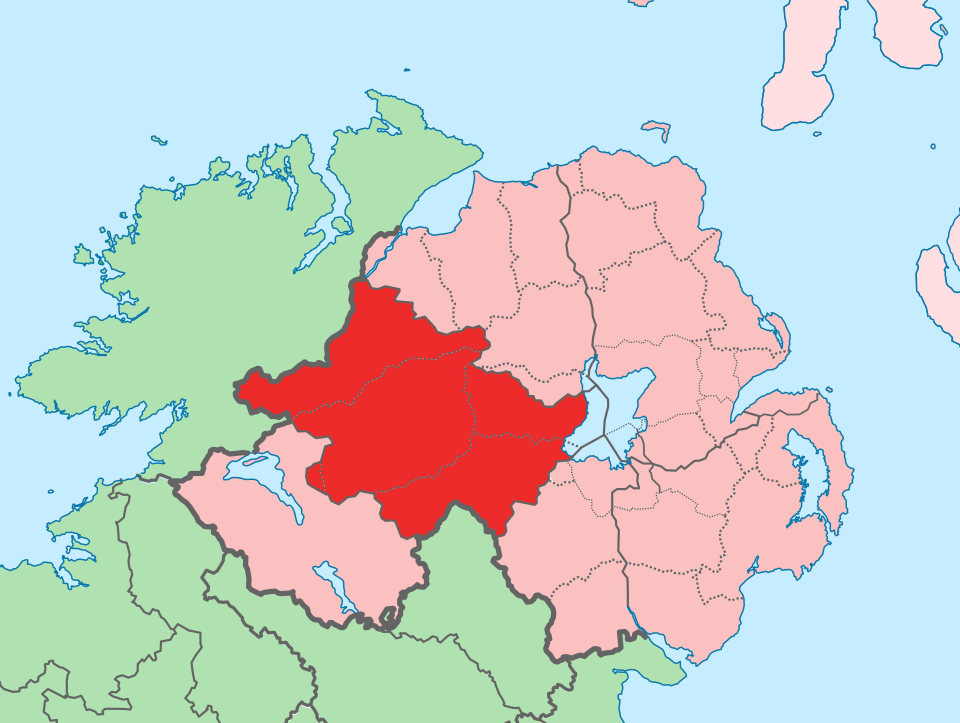
County Tyrone covers more land than any other county in Northern Ireland. It sits at the heart of Ulster, between the Sperrin Mountains and the drumlin country of the south. The Irish surnames from Tyrone carry centuries of history. O’Neill, Quinn, Donnelly, Devlin — these names trace to royal dynasties, hereditary officials, and Gaelic chieftains who shaped the whole province. If your family carries a Tyrone name, you are connected to one of Ireland’s most powerful bloodlines.
Free Irish ancestry tool ☘️
Have an Irish surname? Find your ancestral Irish county — we’ll trace your name to where the family originated, with a short note on its history.
Irish Surnames from Tyrone: The Land of Eoghan
The county name comes from the Irish Tír Eoghain — Land of Eoghan. Eoghan was a son of Niall of the Nine Hostages. Niall was the legendary king who ruled around 400 AD. His descendants, the Cenél nEógain, built the most powerful dynasty in Ulster.
The O’Neills rose from this line. For centuries, they dominated Ulster and challenged English rule. When they finally fell, the whole Gaelic order fell with them. But the surnames survived. Today, Tyrone names appear across the United States, Canada, and Australia. They were carried there by emigrants who left their homeland but never forgot their roots.
If you are new to heritage research, our guide to tracing your Irish ancestry covers every key database and archive.
O’Neill – Ó Néill: Kings of Ulster
No name is more closely linked to County Tyrone than O’Neill. The Gaelic form is Ó Néill — “descendant of Niall.” The personal name Niall likely comes from niadh, meaning “champion.”
The O’Neills were kings of Tír Eoghain for centuries. Their inauguration took place at Tullaghogue Fort, a hill fort near Cookstown. A ceremonial stone stood at the site. Lord Mountjoy’s army destroyed it in 1602 to break the dynasty’s symbolic power.
The greatest O’Neill was Hugh, the 3rd Earl of Tyrone. He led the Nine Years’ War against Queen Elizabeth from 1593 to 1603. His forces won the Battle of the Yellow Ford in 1598. It was the most crushing English defeat in Irish history. When the war ended in defeat, Hugh left Ireland in 1607 in the Flight of the Earls. He never returned. He died in Rome in 1616.
If your surname is O’Neill, Neill, or Neal, a Tyrone origin is very possible.
Quinn and Donnelly – Two Pillars of Tyrone
Quinn is one of the most common surnames in County Tyrone. The Gaelic form is Ó Cuinn — “descendant of Conn.” The personal name Conn means “leader” or “head.” The Quinns descended from the Cenél nEógain, the same ancient lineage as the O’Neills. Over time they spread across Tyrone and into neighbouring Derry and Fermanagh.
Donnelly was one of the most powerful families in mid-Tyrone. The Gaelic form is Ó Donnghaile — “descendant of Donnghal.” The personal name comes from donn (dark or brown) and gal (valour). Their territory centred on Ballygawley. They were hereditary lords under the O’Neill system. During and after the Famine, the Donnellys spread widely. Today the name appears across the Irish diaspora in the United States.
Devlin, O’Hagan, and McAleer
Devlin comes from the Gaelic Ó Doibhilin. The roots suggest a meaning linked to “dark” and possibly “rock.” The Devlins were hereditary chiefs of Muintir Devlin in east Tyrone. Their territory lay around Stewartstown and Cookstown. The name remains concentrated in Tyrone and south Derry today.
O’Hagan is Ó hÁgáin in Gaelic. The personal name Agan possibly means “young.” The O’Hagans held a unique role in Tyrone. They were the hereditary inaugurators of the O’Neill kings at Tullaghogue Fort. Without the O’Hagan ceremony, no man could rightfully call himself the O’Neill. This made them one of the most important families in Ulster.
McAleer is Mac Giolla Chiar in Gaelic — “son of the dark-complexioned devotee.” The element giolla referred to a servant or devotee, often religious. McAleer appears almost nowhere else in Ireland. Finding this name in your family tree points you directly to Tyrone or the adjoining parts of County Derry.
☘️ Enjoying this? 65,000 Ireland lovers get stories like this every week.
Thinking about it for retirement?
If you’ve started thinking seriously about retiring there, our complete our full Retire in Ireland guide covers the visa, healthcare, cost-of-living, and the regions worth shortlisting.
Subscribe free →
McLaughlin and Gormley – The Cenél nEógain Legacy
McLaughlin (also MacLaughlin or MacLochlainn) comes from Mac Lochlainn — “son of Lochlann.” The name Lochlann referred to Scandinavia, the land of the Vikings. The Mac Lochlainns were among the most senior of all the Cenél nEógain families. They ruled as kings of Ailech before the O’Neills rose to power. In the twelfth century, Muirchertach Mac Lochlainn was High King of Ireland. Their influence faded after that, but the name endured in Tyrone and Derry for centuries.
Gormley comes from Ó Goirmleigh — “descendant of Goirmleach.” The personal name contains goirm, meaning “blue” or “illustrious.” The Gormleys were a Tyrone sept with territory in the western part of the county. They were keepers of certain church lands. Today the name is most common in Tyrone and Donegal.
How Tyrone Surnames Crossed the Atlantic
County Tyrone lost a large part of its people during the Great Famine of 1845 to 1852. Thousands left for America. They settled in Pittsburgh, Philadelphia, Boston, and New York. They took their Tyrone names with them.
But Tyrone had been sending emigrants to America long before the Famine. In the eighteenth century, tens of thousands of Ulster people — often called the Ulster-Scots or Scotch-Irish — crossed the Atlantic. Many were Presbyterian farmers who had come to Ulster from Scotland a century earlier. They brought Tyrone family names to the American frontier.
Several US presidents trace roots to Ulster. Andrew Jackson’s family came from County Antrim. Woodrow Wilson had strong Ulster connections. If you trace your Tyrone line back before 1800, you may find yourself connected to one of America’s oldest immigrant communities.
The Ulster American Folk Park in Omagh tells this story in full. It is one of the best emigration museums in Ireland. Our Irish heritage trip planning guide covers how to visit county heritage sites in person.
How to Trace Your Tyrone Ancestry
PRONI — Public Record Office of Northern Ireland
PRONI in Belfast holds church records, estate papers, and census records covering County Tyrone. Many records are available online at proni.gov.uk. This is the essential starting point for any Tyrone research.
Griffith’s Valuation
Griffith’s Valuation listed every property in Ireland in the 1850s and 1860s. It records tenants by name and townland. You can search Tyrone records free at askaboutireland.ie. This is often the earliest reliable source for a surname in a specific area.
Church Records and Online Resources
Most Tyrone churches began keeping registers in the early nineteenth century. Many survived because they were held locally rather than in Dublin. PRONI holds copies of most. The 1901 and 1911 census returns for Tyrone are fully searchable at census.nationalarchives.ie. For a full guide to the key archives, see our step-by-step guide to tracing your Irish roots.
Where to Visit in Tyrone to Connect with Your Heritage
Tullaghogue Fort. This is where the O’Neill kings were crowned for centuries. The earthworks survive near Cookstown. It is quiet and largely unvisited. For anyone with O’Neill ancestry, it is one of the most significant places in Ireland.
Ulster American Folk Park, Omagh. This open-air museum traces the journey from Ulster to America across three centuries. Full-scale reconstructions show the conditions emigrants faced. The research centre holds passenger lists, church records, and emigration documents covering Tyrone families.
Ardboe High Cross. This tenth-century high cross stands on the western shore of Lough Neagh. It is one of the finest early Christian monuments in Ulster. The carved scenes survive in remarkable detail.
Beaghmore Stone Circles. These Bronze Age stone circles sit in the Sperrin foothills. Seven circles and a series of stone rows date to around 2000 BCE. They are among the least-visited ancient monuments in Ireland.
Dungannon. The historic seat of the O’Neills. The town sits at the centre of O’Neill territory in mid-Tyrone and has strong heritage connections throughout.
Our 7-day Irish ancestry itinerary gives a full framework for visiting heritage sites across Ireland. Our guide to Irish surnames from Antrim covers the neighbouring county and its Ulster connections. Our guide to Irish surnames from Down explores the Ulster coast.
Frequently Asked Questions About Tyrone Surnames
What are the most common Irish surnames from County Tyrone?
The most common surnames historically associated with County Tyrone include O’Neill, Quinn, Donnelly, Devlin, O’Hagan, McLaughlin, McAleer, Gormley, and McCann. Of these, McAleer is the most distinctively Tyrone surname and rarely appears in large numbers outside the county.
What does the O’Neill name mean in Irish?
O’Neill comes from the Gaelic Ó Néill — “descendant of Niall.” The personal name Niall likely derives from niadh, meaning “champion.” The O’Neills were the royal family of Tír Eoghain and one of the most powerful dynasties in Irish history.
What happened to the O’Neills of Tyrone?
Hugh O’Neill led the Nine Years’ War against English rule from 1593 to 1603. After defeat and the loss of his lands, he left Ireland in 1607 in the Flight of the Earls. He died in Rome in 1616. His descendants spread across Europe and America. Many O’Neills who stayed in Ireland adapted to changed conditions and kept the name alive.
Where can I trace my County Tyrone ancestry?
Start with PRONI in Belfast at proni.gov.uk for church and estate records. Search Griffith’s Valuation at askaboutireland.ie for nineteenth-century property records. For census records, use census.nationalarchives.ie. The Ulster American Folk Park in Omagh also holds genealogy resources for families who emigrated to North America.
Is McAleer a Tyrone-specific surname?
Yes. McAleer is one of the most localised surnames in Ireland. It comes from the Gaelic Mac Giolla Chiar — “son of the dark-complexioned devotee.” The name appears almost exclusively in County Tyrone and the adjoining parts of County Derry. Finding McAleer in your family tree makes a Tyrone connection almost certain.
Your Tyrone Roots Are Waiting
County Tyrone does not draw the crowds that Galway or Kerry attract. But it holds some of the deepest history in Ireland. The O’Neills fought the last great battle of Gaelic Ireland here. The Cenél nEógain built a dynasty that lasted a thousand years. The Sperrin Mountains watched it all.
If your surname is on this list, your family was part of that story. Walk the earthworks at Tullaghogue and you stand where Irish kings were crowned. Visit the Ulster American Folk Park in Omagh and you find the names of people just like your ancestors, crossing the Atlantic with nothing but a surname and a sense of who they were.
That name is yours now. Follow it home.
Explore more of our Irish surnames series — covering Cork, Galway, Kerry, Dublin, Clare, Mayo, Donegal, Tipperary, Limerick, Waterford, Wexford, Kilkenny, Sligo, Roscommon, Antrim, Down, and more. Each county has its own story and its own surnames waiting to be reclaimed.
☘️ Join 65,000+ Ireland Lovers
Every Friday, get Ireland’s hidden gems, local secrets, and travel inspiration — the kind you won’t find in any guidebook.
Subscribe free — enter your email:
📲 Know someone who’d love this? Share on WhatsApp →
Love more? Join 43,000 Scotland lovers → · Join 30,000 Italy lovers → · Join 7,000 France lovers →
Free forever · · Unsubscribe anytime
Tours & experiences you might love


Powered by Viator. Some links are affiliate links — we may earn a small commission at no extra cost to you.
Secure Your Dream Irish Experience Before It’s Gone!
Planning a trip to Ireland? Don’t let sold-out tours or packed attractions spoil your journey. Iconic experiences like visiting the Cliffs of Moher, exploring the Rock of Cashel, or enjoying a guided walk through Ireland’s ancient past often sell out quickly—especially during peak travel seasons.

Booking in advance guarantees your place and ensures you can fully immerse yourself in the rich culture and breathtaking scenery without stress or disappointment. You’ll also free up time to explore Ireland’s hidden gems and savour those authentic moments that make your trip truly special.
Make the most of your journey—start planning today and secure those must-do experiences before they’re gone!
Subscribe Free