

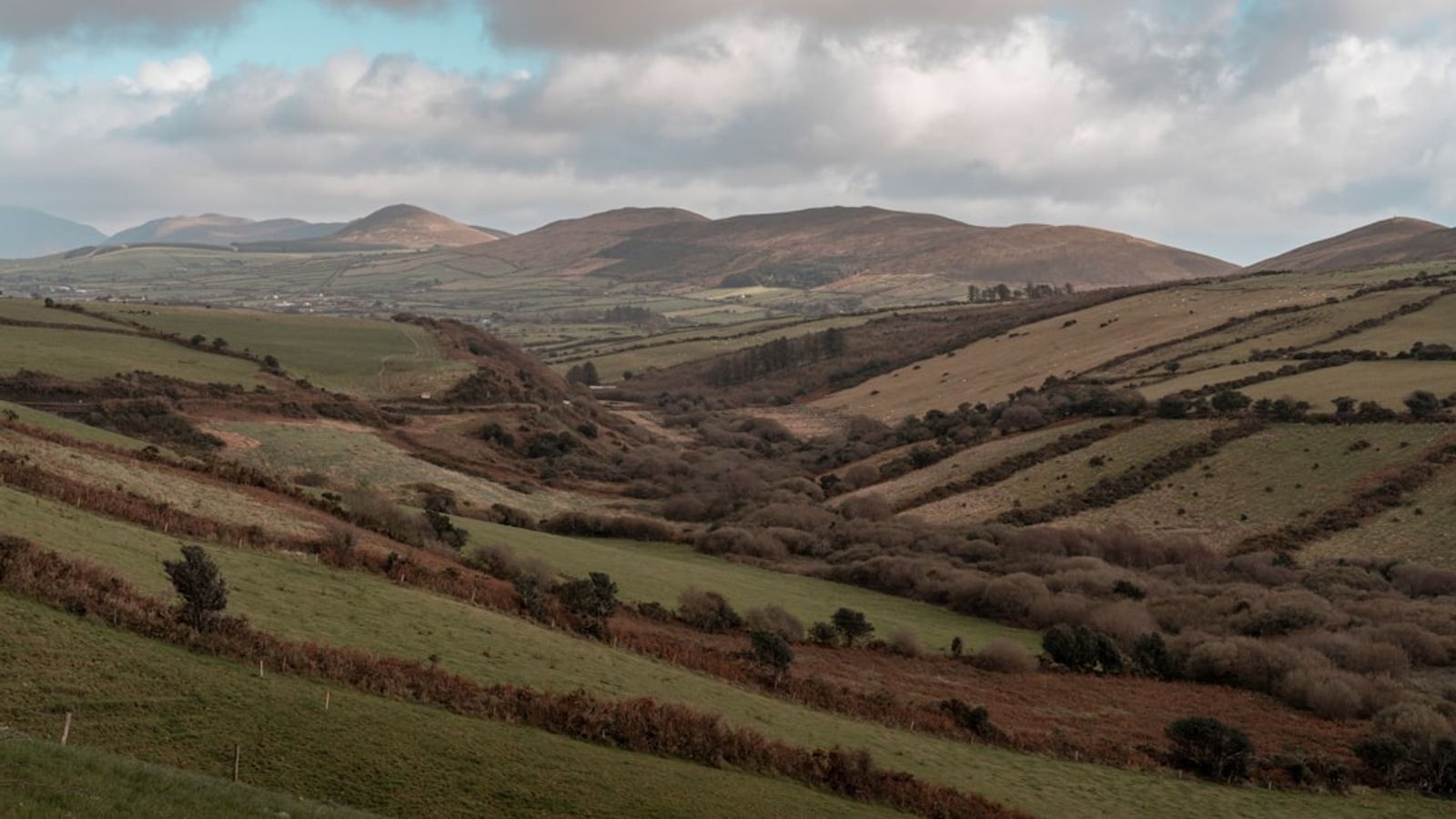
County Monaghan sits in the heart of Ulster’s drumlin belt. The land rolls in low, rounded hills shaped by glaciers thousands of years ago. Those hills gave the county its character — enclosed, intimate, watchful. Irish surnames from Monaghan carry the mark of the McMahons, the lords of Oriel. If your family carries a Monaghan name, you come from one of Ireland’s most distinct Gaelic territories.
Free Irish ancestry tool ☘️
Have an Irish surname? Find your ancestral Irish county — we’ll trace your name to where the family originated, with a short note on its history.
Irish Surnames from Monaghan: The Kingdom of Oriel
County Monaghan was the heartland of the ancient kingdom of Airghialla, known in English as Oriel. This kingdom stretched across modern Monaghan, Armagh, and Louth. The name Airghialla means “those who give hostages” — a reference to the ancient custom of pledging loyalty through kinship bonds.
Watch: Do You Qualify for an Irish Passport?
Tracing your Irish family? If one of your grandparents was born in Ireland, you may be able to become an Irish citizen. This 14-minute guide explains who qualifies, what it costs and how long it takes. Thinking of making the move? Get the free Moving to Ireland checklist.
The McMahons held Monaghan as their core territory for centuries. They built their power across the drumlins and lakelands of this corner of Ulster. For most of the medieval period, they answered to no one.
The Ulster Plantation of 1610 broke the old Gaelic order. Monaghan was one of the Ulster counties planted with English and Scottish settlers. The native families lost their land. But their surnames survived the plantation, the Famine, and the Atlantic crossing. Today those names are spread across the world.
If you are researching your roots, our guide to tracing your Irish ancestry covers every archive and database you need.
McMahon – Mac Mathghamhna: Lords of Oriel
No name is more closely tied to County Monaghan than McMahon. The Gaelic form is Mac Mathghamhna — “son of Mathghamhain.” The personal name Mathghamhain means “bear.” It was a strong warrior name in the Gaelic tradition before fixed surnames became common.
The McMahons ruled the Kingdom of Oriel from their base in County Monaghan. Their territory centred on what is now Monaghan town and the surrounding barony of Monaghan. They held power there for centuries.
The McMahons fought English conquest longer than most Ulster clans. They stood alongside Hugh O’Neill in the Nine Years War at the end of the sixteenth century. After that war ended in defeat, the plantation stripped them of their land.
Many McMahon men went into exile in Europe. Officers named McMahon served in the armies of France, Spain, and Austria in the seventeenth and eighteenth centuries. Patrice de Mac-Mahon, born in France to an Irish exiled family, became President of France in 1873.
In America, McMahon spread widely through Famine-era emigration. It is common in New York, New Jersey, Pennsylvania, and Massachusetts.
McKenna – Mac Cionaoith: Masters of Truagh
McKenna comes from the Gaelic Mac Cionaoith — “son of Cionaodh.” The personal name Cionaodh comes from old Irish words meaning “fire-born.” It was a common name among warriors and leaders in Gaelic Ulster.
The McKennas were lords of the barony of Truagh in the north of County Monaghan. Truagh sits along the border with County Tyrone. The McKennas held this territory for centuries alongside the McMahons. They were one of the four principal families of Oriel.
After the plantation, the McKennas lost their land. Many went into service as soldiers. Others kept small farms in north Monaghan. The name stays concentrated in Ulster today.
In America, McKenna arrived in large numbers during the Famine. It is common in the Irish communities of New York and Boston. The name appears in some records as Mackenna or Kenny.
McArdle – Mac Ardghail: South Monaghan’s Strong Men
McArdle comes from the Gaelic Mac Ardghail — “son of Ardghal.” The personal name Ardghal combines the Irish words for “high” and “valour.” It carried a strong martial meaning and was used across Ulster as a given name.
The McArdles based themselves in the south of County Monaghan. Their territory lay in the barony of Cremorne, close to the border with County Louth. They were one of the four main septs of Oriel alongside the McMahons, McKennas, and Connollys.
The McArdle name spread into County Louth and County Armagh after the plantation. It is still most common in south Ulster and north Leinster today.
☘️ Enjoying this? 64,000+ Ireland lovers get stories like this every week.
Thinking about it seriously?
If you’ve started actually planning a move, our complete the full Move to Ireland guide walks through every step, every cost, and the paperwork that catches most people out.
Subscribe free →
Connolly – Ó Conghaile: Fierce as a Hound
Connolly comes from the Gaelic Ó Conghaile — “descendant of Conghal.” The personal name Conghal means “fierce as a hound.” It was a common warrior name in early Gaelic Ireland.
The Connollys held the barony of Dartree in County Monaghan. They were one of the four great families of Oriel. There are also Connolly families from Counties Galway and Clare with separate origins. The Monaghan Connollys were a distinct sept with their own territorial base.
James Connolly, born in Edinburgh to Irish parents, came from a family with County Monaghan roots. He led the Irish Citizens Army in the 1916 Rising and was executed by the British government.
Today Connolly is one of the most common surnames in Ireland. It appears across Ulster, Connacht, and the Irish diaspora in America and Britain.
Keenan – Ó Cianáin: The Historians of Oriel
Keenan comes from the Gaelic Ó Cianáin — “descendant of Cianán.” The personal name Cianán is a diminutive of Cian, which means “ancient” or “enduring.”
The O’Keenans were the hereditary historians of the McMahon lords of Oriel. In Gaelic Ireland, every great lord kept a historian. This person recorded genealogy, praised the family’s deeds, and kept the oral tradition alive. The O’Keenans held that role for the McMahons.
Their most famous member is Maghnus Ó Cianáin. He joined the earls of Ulster on their flight from Ireland in 1607 — the Flight of the Earls — and wrote an account of the journey in Irish. It remains one of the most important historical documents from that period.
The name today appears as Keenan, Kenan, and O’Keenan across Ulster. It is found in Irish communities across the northeast of America.
Duffy – Ó Dubhthaigh: A Name Across Ulster
Duffy comes from the Gaelic Ó Dubhthaigh — “descendant of Dubhthach.” The personal name Dubhthach means “the dark one.” It was a common name in early Gaelic Ireland.
The Duffy sept had strong roots in County Monaghan. The name spread widely across Ulster and into Connacht, particularly County Donegal and County Roscommon. Each of those Duffy families was a distinct sept with separate origins. They shared the same surname but came from different lines.
Today Duffy is one of the most common Irish surnames. It is especially frequent in Donegal and Monaghan. In America, it arrived in large numbers with Famine emigrants. It is common in the Irish communities of New York, Chicago, and Boston.
How Monaghan Surnames Crossed the Atlantic
County Monaghan sent emigrants to America in two main waves.
The first wave came in the eighteenth century. Most of these emigrants were Protestant Ulster Scots — families who came to Ireland during the Plantation. They left through the ports of Newry or Belfast. They arrived in Philadelphia or New York, then moved inland to Virginia, the Carolinas, and beyond. They carried Monaghan surnames into the American frontier.
The second wave came during the Great Famine of 1845 to 1852. Monaghan suffered badly. The county lost large parts of its population to death and emigration. Catholic families — McMahons, McKennas, McArdles, Connollys — left by any route they could find. They arrived in New York and Boston. They settled in the Irish working-class communities of those cities.
Their descendants now number in the millions. Monaghan is a small county. But its surnames have spread across the English-speaking world.
Our Irish heritage trip planning guide explains how to visit your ancestral county in person.
How to Trace Your Monaghan Ancestry
Monaghan County Library and Local Studies Centre
The local studies collection in Monaghan town holds estate papers, land records, and local history materials. This is a strong starting point for families from the tenant farming class.
Monaghan Genealogy Centre
Monaghan is covered by the Irish genealogy network. Church records for the county — baptisms, marriages, and burials — are searchable through rootsireland.ie.
Griffith’s Valuation and Census Records
Griffith’s Valuation listed every landholder in County Monaghan in the 1850s. You can search it free at askaboutireland.ie. The 1901 and 1911 census returns are fully searchable at census.nationalarchives.ie. These are the best starting points for Famine-era research.
For a full step-by-step guide to every archive, see our guide to tracing your Irish ancestry.
Where to Visit in Monaghan to Connect with Your Heritage
Castle Leslie, Glaslough. Castle Leslie is one of the few great houses in Ireland still owned and run by the original family. It sits in a 1,000-acre estate in north Monaghan near the village of Glaslough. The Leslie family has roots that go back centuries. The castle runs heritage tours and welcomes visitors.
Clones. The town of Clones was one of the great monastic centres of early Christian Ireland. A round tower, a high cross, and the ruins of a twelfth-century abbey still stand in the town. Saint Tighearnach founded the monastery here in the sixth century. Clones was also a centre of lace-making in the nineteenth century.
Patrick Kavanagh Resource Centre, Inniskeen. Patrick Kavanagh is one of the finest poets in Irish history. He was born in Inniskeen in 1904. The resource centre in the village celebrates his life and work. Kavanagh wrote about the Monaghan landscape with honesty and deep feeling. His poem “The Great Hunger” is set in the drumlin country of this county.
Monaghan County Museum. The museum in Monaghan town holds a strong collection of local history. It includes material on the McMahon clan and the Kingdom of Oriel. It is a good starting point for any heritage visit to the county.
Our 7-day Irish ancestry itinerary gives a full framework for visiting heritage sites across Ireland. Our guide to Irish surnames from Armagh covers the county to the north. Our guide to Irish surnames from Cavan covers the county to the south. Our guide to Irish surnames from Fermanagh explores the lakelands to the west.
Frequently Asked Questions About Monaghan Surnames
What are the most common Irish surnames from County Monaghan?
The most historically significant surnames from County Monaghan include McMahon, McKenna, McArdle, Connolly, Keenan, and Duffy. McMahon is the dominant family — the lords of the ancient Kingdom of Oriel. McKenna held the barony of Truagh in the north of the county. All four main septs — McMahon, McKenna, McArdle, and Connolly — were rooted in the Oriel territory.
What does McMahon mean in Irish?
McMahon comes from the Gaelic Mac Mathghamhna — “son of Mathghamhain.” The personal name Mathghamhain means “bear.” The McMahons were the ruling family of County Monaghan for centuries. They led Ulster’s resistance against English conquest during the Nine Years War of 1593 to 1603.
Is Connolly a County Monaghan surname?
Yes. The Connolly sept held the barony of Dartree in County Monaghan and was one of the four great families of Oriel. There are also Connolly families from County Galway and County Clare with separate origins. James Connolly, who led the Irish Citizens Army in the 1916 Rising, came from a family with roots in County Monaghan.
Who were the O’Keenans in County Monaghan?
The O’Keenans were the hereditary historians of the McMahon lords of Oriel. Maghnus Ó Cianáin, a member of this family, wrote a first-hand account of the Flight of the Earls in 1607. That account is one of the most important surviving documents from the collapse of Gaelic Ulster. The name appears today as Keenan across Ulster and the Irish diaspora.
Where can I trace my County Monaghan ancestry?
Start with rootsireland.ie for church records covering baptisms, marriages, and burials. Use askaboutireland.ie for Griffith’s Valuation records from the 1850s. Search the 1901 and 1911 census at census.nationalarchives.ie. The local studies centre at Monaghan County Library also holds estate papers and land records.
Your Monaghan Roots Are Waiting
County Monaghan does not draw the same visitors as Kerry or Galway. But it holds a deep and layered history. The Kingdom of Oriel was one of the oldest political entities in Ulster. The McMahons held it for centuries. Their surnames survived the plantation, the Famine, and the Atlantic crossing.
If your name is McMahon, McKenna, McArdle, Connolly, Keenan, or Duffy, your family was part of that story. Walk through Clones and stand where the monastery once rose. Visit the Patrick Kavanagh centre in Inniskeen and hear the drumlin country described by the man who loved it most.
That name is yours. Follow it home.
Explore more of our Irish surnames series — covering Cork, Galway, Kerry, Dublin, Clare, Mayo, Donegal, Tipperary, Limerick, Waterford, Wexford, Kilkenny, Sligo, Roscommon, Antrim, Down, Tyrone, Derry, Armagh, Fermanagh, Cavan, and more.
☘️ Join 64,000+ Ireland Lovers
Every Friday, get Ireland’s hidden gems, local secrets, and travel inspiration — the kind you won’t find in any guidebook.
Subscribe free — enter your email:
📲 Know someone who’d love this? Share on WhatsApp →
Free forever · One email per week · Unsubscribe anytime
Tours & experiences you might love


Powered by Viator. Some links are affiliate links — we may earn a small commission at no extra cost to you.
Secure Your Dream Irish Experience Before It’s Gone!
Planning a trip to Ireland? Don’t let sold-out tours or packed attractions spoil your journey. Iconic experiences like visiting the Cliffs of Moher, exploring the Rock of Cashel, or enjoying a guided walk through Ireland’s ancient past often sell out quickly—especially during peak travel seasons.

Booking in advance guarantees your place and ensures you can fully immerse yourself in the rich culture and breathtaking scenery without stress or disappointment. You’ll also free up time to explore Ireland’s hidden gems and savour those authentic moments that make your trip truly special.
Make the most of your journey—start planning today and secure those must-do experiences before they’re gone!
Subscribe Free