

On the 17th of November 1953, twenty-two men, women and children boarded a government boat on the Great Blasket Island. They carried what they could. They did not look back. By nightfall, the island that had been continuously inhabited for centuries was empty — and it has remained so ever since.
A World Within Sight of Land
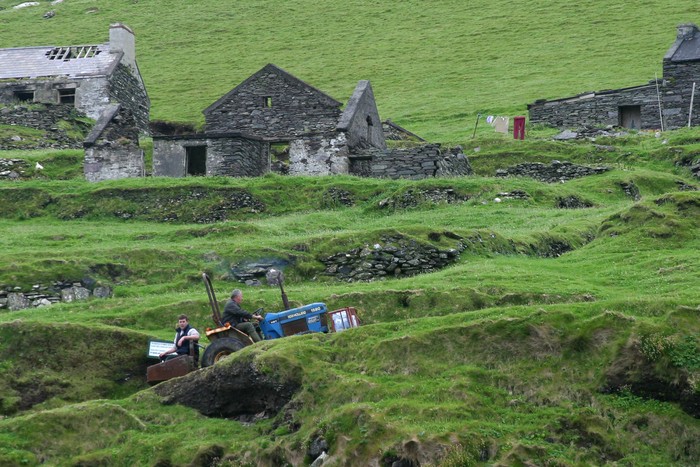
The Great Blasket sits six kilometres off the Dingle Peninsula in County Kerry, separated from the mainland by the Blasket Sound — a stretch of water that, on bad days, might as well be the width of an ocean. The island is three kilometres long and less than a kilometre wide, with steep green hills that drop sharply to the sea on every side.
At its peak in the early 1800s, around 150 people called it home. They fished from currachs — the traditional skin-covered boats of the Atlantic west — grew potatoes in stony fields, and spoke Irish in a dialect so ancient and pure that linguists from across Europe came specifically to record it.
There was no doctor on the island. No resident priest. No electricity. No running water. Just the Atlantic, the wind, and each other.
The Writers Who Made the World Listen
In the early twentieth century, something remarkable happened on the Great Blasket: three of its inhabitants wrote memoirs that became celebrated works of Irish literature — in Irish.
Tomás Ó Criomhthain published An tOileánach (The Islandman) in 1929. It described a life of extraordinary hardship and beauty, narrated with a clarity that astonished scholars. “I have written minutely of much that we did,” he wrote, “for it was my wish that somewhere there should be a memorial of it all.”
Muiris Ó Súilleabháin followed with Fiche Blian ag Fás (Twenty Years A-Growing) in 1933. Peig Sayers, one of Ireland’s greatest oral storytellers, had her life story transcribed and published in 1936. For a generation of Irish schoolchildren, Peig became required reading.
Together, the books created a portrait of island life unlike anything written before or since. European scholars arrived on the island with notebooks, desperate to capture a living Irish speech community. The islanders had become famous without having done anything other than survive.
☘️ Enjoying this? 64,000+ Ireland lovers get stories like this every week. Subscribe free →
The Winters That Broke a Community
The decline had been gradual. The Famine of the 1840s thinned the population sharply. Young people who emigrated rarely returned. By the 1940s, the community had fallen below fifty, with most residents elderly.
Then came the winter of 1946-47. Storms so severe that no boat could reach the island for months. A young islander died — and his body could not be taken to the mainland for burial. It had to be kept on the island until the seas calmed enough for the crossing. By all accounts, it was the moment the remaining islanders understood clearly that something had to change.
In 1947, the islanders formally petitioned the Irish government. “We are now only a few families,” they wrote. “We are unable to get priests when we are dying.” They asked to be resettled on the mainland. It was not a request made lightly — these were people whose families had lived on the island for generations.
The Last Departure
The government took six years to act. On the 17th of November 1953, it finally did.
The twenty-two remaining islanders — the youngest just nine months old — crossed the Blasket Sound to Dunquin on the Kerry mainland. Most were settled in new houses in Dunquin and the surrounding villages. The transition was not easy. Some said the quiet of the mainland felt wrong — that they missed the constant sound of the wind and sea.
The island’s dogs, unable to make the crossing, were left behind. A lighthouse keeper remained operational for some time. Otherwise, the Great Blasket fell silent for the first time in recorded memory.
What the Island Holds Today
The ruined village is still visible from the sea. Stone walls, collapsed roofs, the outline of a community that once argued, laughed, fished and told stories within them. Puffins nest on the cliff edges. Grey seals rest on the beaches where children once played. The hillside grass, no longer grazed, has grown thick and long.
Boats run to the island during summer months from Dunquin Pier, weather permitting. It is one of the more unusual things you can do on the Kerry coast, which has no shortage of remarkable places — including a monastery perched 600 feet above the Atlantic on a rock six miles offshore. But the Blasket offers something different: not just a sight, but a reckoning.
Standing in the ruins of Peig Sayers’ house, looking back across the Sound toward the Dingle Peninsula, you feel the weight of what happened here. This was not an abandoned place. It was a surrendered one.
The Blasket Centre in Dingle town preserves the stories, the language, and the photographs. If you are planning a trip to Ireland, it deserves an afternoon — it is one of the finest cultural museums in the country, and one of the most quietly affecting.
The Legacy of an Empty Island
The Great Blasket did not simply close. It ended a particular form of Irish life that had endured for centuries — one defined by tight community, elemental hardship, and an extraordinary closeness to the natural world.
The Irish spoken on the island is now preserved in recordings, academic dictionaries, and the published memoirs. Scholars still study Blasket Irish as a living record of the language before radio and television changed it permanently. In this sense, Tomás Ó Criomhthain got exactly what he wanted: a memorial. Not just to one man’s life, but to an entire way of existing in the world.
The island is still there. Six kilometres off the Kerry coast, its green slopes unchanged, its beaches white and empty. On clear days you can see it from the Slea Head Drive — a shape on the horizon that seems impossibly close and impossibly far away at the same time.
That is the Great Blasket: always visible, never reachable in the way that matters most.
☘️ You Might Also Love
Frequently Asked Questions
Why is this tradition still relevant in Ireland today?
Ireland’s rich cultural heritage means many customs and traditions described in this article have survived for centuries. They continue to shape Irish identity, from rural farming communities to urban life, and are celebrated as part of what makes Ireland unique.
How far back does this Irish tradition or practice date?
Many of Ireland’s folk customs and cultural practices have roots stretching back hundreds — even thousands — of years. This one reflects the deep connection between the Irish people and their land, language, and community life.
Where can visitors experience authentic Irish culture and traditions?
Ireland’s best cultural experiences are found beyond the tourist trail — in rural villages, local festivals, traditional music sessions, and county museums. The Irish Tourist Board (Fáilte Ireland) maintains a directory of authentic cultural experiences at ireland.com.
Do Irish diaspora communities around the world still practice these traditions?
Yes — Irish communities across the United States, Australia, Canada, and the UK actively preserve and celebrate Irish traditions. St Patrick’s Day events, Irish language classes, céilí dancing, and trad music sessions are found in cities worldwide.
☘️ Join 64,000+ Ireland Lovers
Every Friday, get Ireland’s hidden gems, local secrets, and travel inspiration — the kind you won’t find in any guidebook.
Subscribe free — enter your email:
Free forever · · Unsubscribe anytime
Tours & experiences you might love


Powered by Viator. Some links are affiliate links — we may earn a small commission at no extra cost to you.
Secure Your Dream Irish Experience Before It’s Gone!
Planning a trip to Ireland? Don’t let sold-out tours or packed attractions spoil your journey. Iconic experiences like visiting the Cliffs of Moher, exploring the Rock of Cashel, or enjoying a guided walk through Ireland’s ancient past often sell out quickly—especially during peak travel seasons.

Booking in advance guarantees your place and ensures you can fully immerse yourself in the rich culture and breathtaking scenery without stress or disappointment. You’ll also free up time to explore Ireland’s hidden gems and savour those authentic moments that make your trip truly special.
Make the most of your journey—start planning today and secure those must-do experiences before they’re gone!
Subscribe Free