

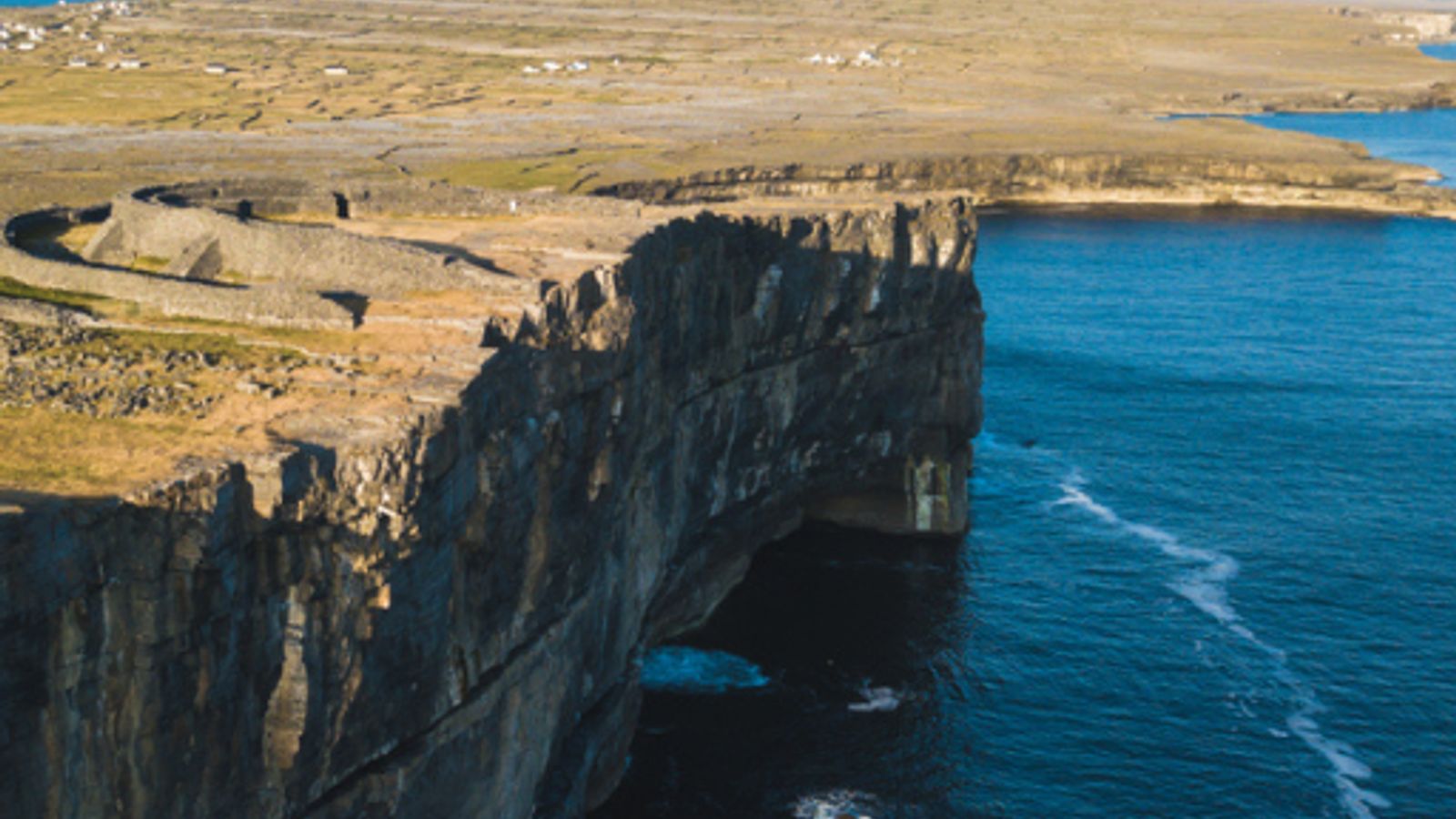
Picture yourself standing on bare limestone, three thousand years of history pressing into the ground beneath your feet. Behind you, three great rings of stone walls curve up from the earth. But when you turn and face west, there is nothing between you and the Atlantic Ocean far below.
Just a sheer drop of a hundred metres. Straight down to the crashing sea.
No wall. No barrier. Nothing at all.
This is Dún Aonghasa — the ancient stone fort on Inishmore in the Aran Islands. And the reason that one side has no wall has puzzled archaeologists, historians, and visitors for a very long time.
What Is Dún Aonghasa?
Dún Aonghasa sits on the edge of Inishmore, the largest of the three Aran Islands off the Galway coast. The island itself is a flat slab of limestone rising from the Atlantic, and the fort stands at its highest and most dramatic point.
The structure consists of three — and possibly once four — concentric stone walls. The innermost enclosure is roughly oval, measuring about 45 metres across. The walls are up to five metres high in places and almost four metres thick at the base.
Nobody built this with machines. Every stone was moved by hand, shaped and stacked by people whose names we will never know. The effort required was immense. That fact alone tells you how important this place was to the people who built it.
Archaeologists date the earliest construction to around 1100 BCE, placing it firmly in the Bronze Age. The site was later rebuilt and extended well into the Iron Age. It has been a place of significance for over three thousand years.
The Mystery of the Missing Wall
Here is what makes Dún Aonghasa unlike any other fort in Europe.
Every defensive structure in the ancient world — every ringfort, every hill fort, every walled settlement — forms a complete circuit. You build walls all the way round because you need to defend all the way round.
Dún Aonghasa does not do this.
On the western side, the fort simply ends. The inner wall walks right to the cliff edge and stops. From above, the fort looks like the letter D with the straight side replaced by the cliff itself. There is no continuation. No last wall. Just a vertical drop.
Two theories have emerged over the years. The first is that the builders were simply using the cliff as their fourth wall. Why build a stone barrier when you already have a hundred-metre vertical drop? Any attacker trying to scale those cliffs would face certain death before reaching the top. The cliff was more effective than any masonry could ever be.
The second theory is more dramatic. Some geologists believe that part of the original fort did once extend beyond the current cliff edge — and that the western edge of Inishmore has been slowly eroding and falling into the sea for thousands of years. If so, a significant section of Dún Aonghasa may now rest on the seabed far below.
Both theories may be correct. Nobody knows for certain, and that ambiguity is part of what makes this place so compelling. The Aran Islands have always held their secrets closely, and Dún Aonghasa is the most dramatic secret of all.
☘️ Enjoying this? 64,000+ Ireland lovers get stories like this every week. Subscribe free →
A Field of Stone Spikes
Before you even reach the outer wall of Dún Aonghasa, you walk through something that has almost no equivalent elsewhere in prehistoric Ireland.
Called chevaux-de-frise — a French term used by archaeologists — it is a dense field of jagged limestone pillars set upright in the ground at every angle. Some lean forward. Some point sideways. They cover a broad band around the outer wall, extending for dozens of metres in every direction.
The purpose was to slow attackers. An enemy charging toward the fort would immediately find themselves stumbling through this maze of pointed stone. Move too fast and you would fall. Move carefully and the defenders above would have time to react.
What is remarkable is how deliberate all of this is. Thousands of stones were individually selected, transported, and placed into the ground by hand. That level of effort strongly suggests that the people of Dún Aonghasa expected to face a serious threat — and prepared accordingly.
The ancient Irish tradition of dry stone construction has roots in this very era. Some of those same techniques have never changed across three thousand years.
Was It a Fort — or Something Else Entirely?
The walls and the chevaux-de-frise both point to a military purpose. But some things about Dún Aonghasa are harder to explain if defence was the only goal.
The innermost enclosure is not large. It could not hold a significant force. There is no evidence of a well or a reliable water supply within the walls. Archaeologists have found no trace of the kind of dense, permanent housing you would expect at a military stronghold designed to withstand a siege.
The position also raises questions. For a defensive fort, the site is remarkably exposed. If defenders were ever outflanked and pushed back toward the cliff, there was nowhere to go. The very feature that made one side impregnable made retreat impossible.
This has led some researchers to suggest that Dún Aonghasa served a ceremonial or ritual function. It may have been a gathering place of great symbolic importance — positioned at the very edge of the known world, the point where Ireland faces the open Atlantic with nothing beyond it.
In the ancient Irish imagination, the west was not simply a direction. It was where the Otherworld lay, just beyond the horizon. Tír na nÓg, the Land of Eternal Youth, was thought to lie somewhere out there across the water. A fort built at that edge, overlooking that sea, may have meant something far more than military strength.
What the Excavations Revealed
Detailed archaeological work at Dún Aonghasa began in earnest in the 1990s. Excavation teams carefully worked through layers of occupation going back thousands of years.
They found animal bones — cattle, pig, and sheep — suggesting feasting and communal meals. They found traces of metalworking and evidence that the site had been modified many times over the centuries, each generation altering what the previous one had left behind.
What they did not find was evidence of long-term, dense habitation. No buried foundations of permanent houses. No deep rubbish deposits of the kind found at sites where people lived day to day for generations. The picture that emerges is of a place visited repeatedly, used with great intensity at certain times, and then left.
A gathering place. A ritual site. A statement of identity and power, built at the very edge of the Atlantic to announce — to the world, or perhaps to something beyond the world — that people were here, and that they had built something that would last.
It did last. Three thousand years later, the walls still stand.
Visiting Dún Aonghasa Today
Getting to Dún Aonghasa is part of the experience. Ferries run to Inishmore from Doolin in County Clare and from Rossaveel in County Galway. From the island’s main village of Kilronan, the fort is roughly eight kilometres away.
Most visitors hire bicycles — the island is largely flat and well suited to cycling. Minibuses also make the journey. From the car park, a clear path winds up through the limestone karst landscape to the site entrance.
The final approach is on foot, climbing gently through the chevaux-de-frise, passing through each successive gateway in the walls. And then the ground falls away and you are standing at the edge.
There is no fence at the top. You can sit at the very lip of the cliff, with a hundred metres of air beneath you and the Atlantic crashing far below. It is one of the most viscerally powerful moments you can have in Ireland, and nothing quite prepares you for it.
If you are planning a trip to the west of Ireland, this planning guide is the best place to start. Dún Aonghasa deserves more than a passing visit — give it a full morning at least.
Whatever it was built for, whatever mysteries it still holds, Dún Aonghasa stands as one of the most remarkable places in Europe. Walk those ancient walls. Stand at that edge. Try to imagine the people who put this here three thousand years ago, looking out at the same ocean, under the same Atlantic sky.
They were doing something important. We are still not entirely sure what.
☘️ You Might Also Love
Love Ireland? So do 65,000 of us.
Every week, our free newsletter delivers hidden gems, seasonal guides, local stories, and practical travel tips — straight to your inbox. Join the community that loves Ireland as much as you do.
☘️ Join 64,000+ Ireland Lovers
Every Friday, get Ireland’s hidden gems, local secrets, and travel inspiration — the kind you won’t find in any guidebook.
Subscribe free — enter your email:
📲 Know someone who’d love this? Share on WhatsApp →
Free forever · · Unsubscribe anytime
📥 Free Download: Ireland Travel Planning Guide
Our most popular resource — itineraries, insider tips, and the 50 places you must not miss.
Tours & experiences you might love


Powered by Viator. Some links are affiliate links — we may earn a small commission at no extra cost to you.
Secure Your Dream Irish Experience Before It’s Gone!
Planning a trip to Ireland? Don’t let sold-out tours or packed attractions spoil your journey. Iconic experiences like visiting the Cliffs of Moher, exploring the Rock of Cashel, or enjoying a guided walk through Ireland’s ancient past often sell out quickly—especially during peak travel seasons.

Booking in advance guarantees your place and ensures you can fully immerse yourself in the rich culture and breathtaking scenery without stress or disappointment. You’ll also free up time to explore Ireland’s hidden gems and savour those authentic moments that make your trip truly special.
Make the most of your journey—start planning today and secure those must-do experiences before they’re gone!