

Before the fishing boats left the Aran Islands, the women of each family would press a handknitted sweater into the arms of the men heading out to sea. Not simply for warmth against the Atlantic gales — though they needed that too. Each stitch told a story. And in the worst of times, along Ireland’s wild western shore, that story could tell you who a man was.
The Islands Where the Sweater Was Born
The three Aran Islands — Inis Mór, Inis Meáin, and Inis Oírr — sit at the mouth of Galway Bay, battered year-round by the full force of the Atlantic Ocean. Life there has always been close to the bone.
Island fishermen spent long hours in currachs — the ancient skin-covered boats of the Irish west — working waters that have claimed generations of men. The Aran sweater, or geansaí Árann, was not a fashion choice. It was survival.
Made from undyed wool that retained its natural lanolin, the sweater repelled water and held warmth even when soaked. Island women knitted them tight and thick, stitch by stitch, through long winter evenings by firelight.
Every Stitch Was a Symbol
What makes the Aran sweater extraordinary isn’t just the warmth. It’s the language — a complex grammar of stitches, each carrying meaning handed down through families for generations.
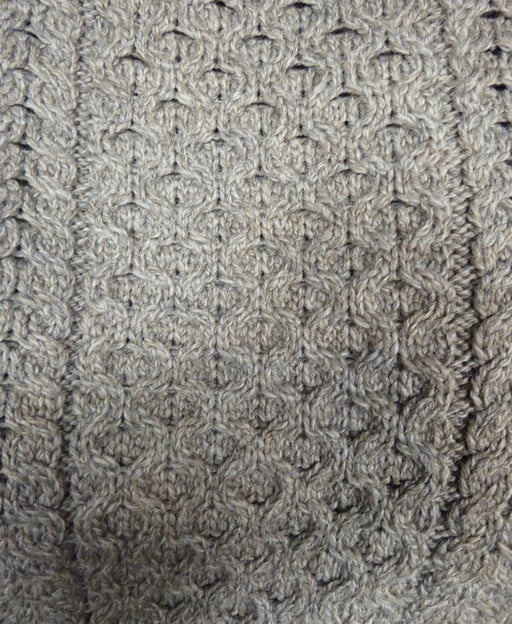
The cable stitch represents fishing ropes, twisted and strong — a prayer for safety and a good catch. The honeycomb stitch mirrors the industry of the bee and the promise that hard work brings its reward. The diamond stitch echoes the small walled fields of the islands themselves, representing wealth and success on land and sea.
The basket stitch symbolised the fisherman’s basket and the hope it would return full. The blackberry stitch — three small stitches pressed from one, like a berry on the branch — spoke of faith, the Holy Trinity pressed into every single row.
The Pattern That Named the Dead
The most haunting aspect of the Aran sweater tradition is this: each family wove its own distinctive combination of stitches into the garment, creating something as unique as a signature.
When men were lost at sea — and they were, often — a body washed ashore might be far from home, where no one knew the face. But the sweater, with its family pattern still intact, could speak. Island people knew the patterns of their neighbours. A man who could not be named could still be claimed.
J.M. Synge gave this tradition its most moving expression in Riders to the Sea (1904), where a mother identifies the body of her drowned son by the dropped stitch she herself had knitted into his stocking. The stitch was a mistake — a human, heartbroken mistake — that in the end brought him home.
The Women Who Kept the Knowledge Alive
Behind every Aran sweater was an island woman with the entire pattern held in her head. No written instructions. No pattern sheet. Just memory and hands.
A single Aran sweater could take four to six weeks to complete by hand, using anywhere from 100,000 to 200,000 individual stitches. The knowledge passed from mother to daughter, each generation learning the family’s unique combination — cable here, diamond there, honeycomb between — until it was as natural as breathing.
In Inis Meáin, the smallest and most traditional of the three islands, this craft never fully died out. Women there still knit in the old way. Life on the Aran Islands has changed remarkably little in some respects, and the sweater is part of that continuity.
How the Aran Sweater Crossed the Atlantic
For centuries the Aran sweater remained the quiet clothing of a quiet people. That changed almost overnight in January 1961.
The Clancy Brothers — the Irish-American folk group originally from County Tipperary — wore cream-coloured Aran sweaters on The Ed Sullivan Show, performing to an audience of millions. The image was immediate and unforgettable: Ireland as something raw, warm, and real. Demand for the sweaters exploded on both sides of the Atlantic.
Today it’s one of Ireland’s most recognisable cultural exports, worn by everyone from fishermen to fashion designers. But the sweater sold on a boutique shelf in Dublin city centre is not quite the same thing as the sweater knitted through the winter in a stone cottage on Inis Meáin, with the wind off the Atlantic pressing against the windowpane.
Finding a Real One Today
Authentic hand-knitted Aran sweaters are heavy, slightly rough to the touch, and carry the faint lanolin smell of undyed wool. They are not perfectly symmetrical. Each one is different — because each one was made by a person, not a machine.
Mass-produced versions are lighter, softer, and uniform. They’re not without their charm. But they carry none of the language, none of the story.
If you’re planning a trip to Ireland, seeking out a genuine Aran sweater — better still, watching one being made on the islands — is one of those quietly unforgettable experiences. You leave with something that has weight to it, and not just in wool.
The Aran sweater was never simply a garment. It was a prayer knitted in wool, a map of a family’s place in the world, and a way of saying this person belonged to us. In a country that has always found its deepest truths in its craft, it remains one of the most Irish things ever made.
You Might Also Enjoy
The 6 Best Ireland Newsletters to Subscribe to in 2026 — Our guide to the best free newsletters for anyone who loves Ireland.
☘️ You Might Also Love
☘️ Want More Hidden Ireland?
Join 64,000+ subscribers who discover Ireland’s best-kept secrets every week.
Subscribe Free — Join the Community →
Free forever · Unsubscribe anytime · No spam
📥 Free Download: Ireland Travel Planning Guide
Our most popular resource — itineraries, insider tips, and the 50 places you must not miss.
Tours & experiences you might love


Powered by Viator. Some links are affiliate links — we may earn a small commission at no extra cost to you.
Secure Your Dream Irish Experience Before It’s Gone!
Planning a trip to Ireland? Don’t let sold-out tours or packed attractions spoil your journey. Iconic experiences like visiting the Cliffs of Moher, exploring the Rock of Cashel, or enjoying a guided walk through Ireland’s ancient past often sell out quickly—especially during peak travel seasons.

Booking in advance guarantees your place and ensures you can fully immerse yourself in the rich culture and breathtaking scenery without stress or disappointment. You’ll also free up time to explore Ireland’s hidden gems and savour those authentic moments that make your trip truly special.
Make the most of your journey—start planning today and secure those must-do experiences before they’re gone!