

It stands in the middle of a grey limestone plain in County Clare, with not a tree in sight. The capstone tilts slightly. The light plays strange games on the rock at dusk. Most visitors to the Burren stop, take a photograph, and drive on.
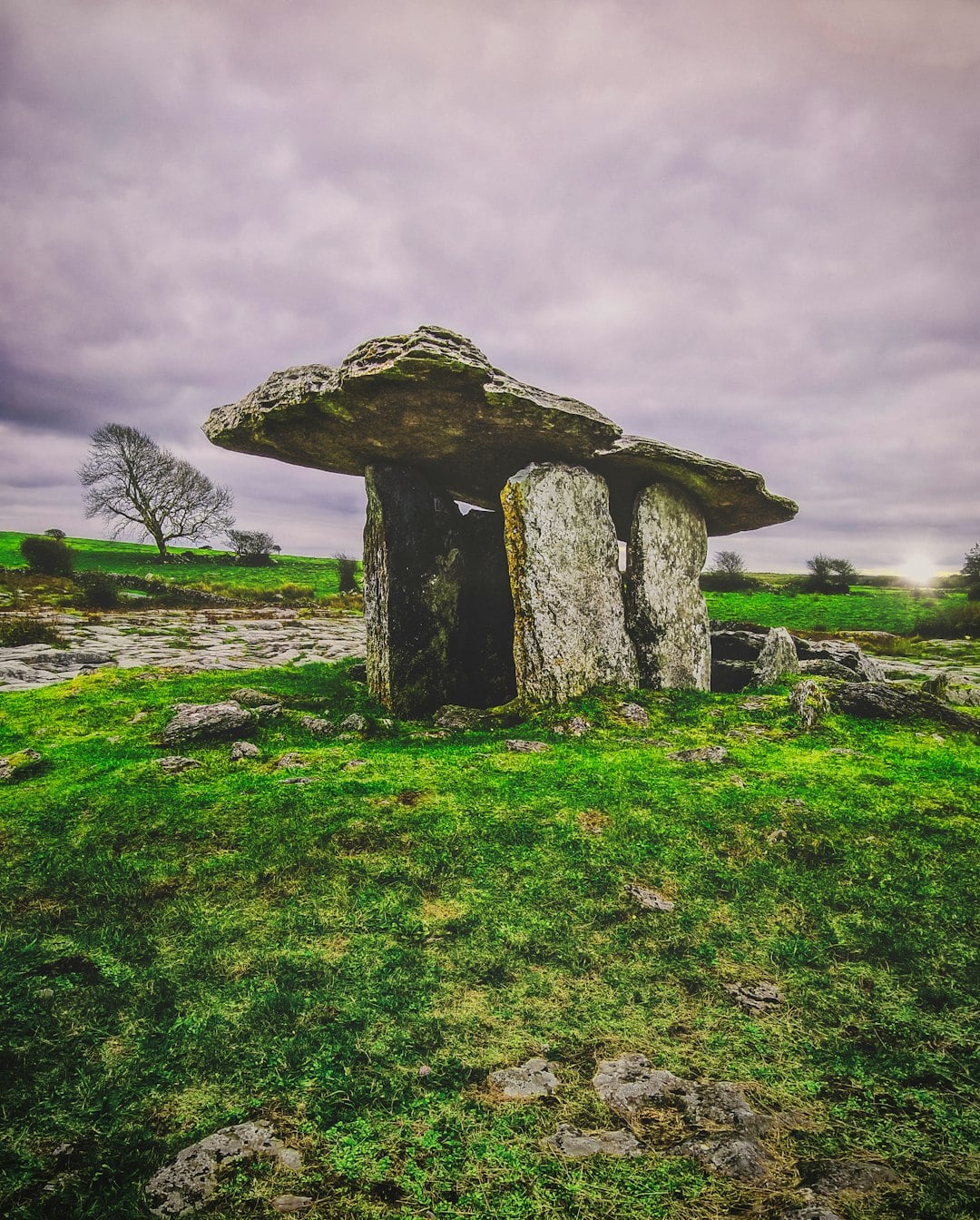
Then in 1985, the capstone cracked and the ancient tomb began to collapse. The damage gave archaeologists an unplanned chance to look beneath it — and what they found changed the way we understand the people who built it, and the Ireland they lived in.
A Portal Built Before the Pharaohs
Poulnabrone is a portal dolmen — a megalithic tomb built from upright standing stones with a flat capstone balanced across the top. It sits at the heart of the Burren, the extraordinary limestone landscape of north County Clare.
It was constructed around 3800 BCE. That is roughly 5,800 years ago. The Egyptian pyramids were still 1,200 years away. Stonehenge had not yet been begun.
The structure has two upright portal stones, a lower door stone at the front, and a thin capstone that weighs around five tonnes. The builders placed it on a rare patch of soil in the middle of bare rock. They chose this spot deliberately.
What the Excavation Found
Archaeologist Ann Lynch led the excavation in two seasons, 1986 and 1988, following the capstone’s collapse the year before. Her team worked carefully through the thin layer of soil beneath the tomb’s capstone.
The remains of at least 33 people had been placed inside Poulnabrone over a period of roughly 600 years. Men, women, and children. At least one newborn. All laid to rest beneath the same grey stones, by people who lived and worked across many generations.
Most had been placed in the tomb as defleshed bones — the body would be left elsewhere first, then the bones collected and brought here. This was a deliberate, considered ritual, repeated again and again across six centuries.
The Stories Written in Bone
Some of the remains carried clear signs of injury and illness. One person had survived a major wound to the hip. Several showed severe arthritis. Another had a healed fracture.
This tells us something important. These people were not alone when they suffered. Someone fed them when they could not feed themselves. Someone tended their wounds. They were cared for.
One person was buried with a polished stone ball. Another with a bone pendant. Centuries after the last Neolithic burial, during the Bronze Age, an infant was buried just outside the tomb’s entrance — proof that people were still returning to this place long after it was built.
☘️ Enjoying this? 64,000+ Ireland lovers get stories like this every week. Subscribe free →
Why This Landscape Felt Sacred
The Burren is one of the strangest places in Ireland. Its limestone pavement stretches in all directions, cracked and split by glacial pressure. From above, it looks like grey scales. From the ground, it feels like the edge of the world.
And yet it is full of life. In the deep cracks of the limestone, called grykes, grow plants that should never share a country — Mediterranean orchids and Arctic mountain avens, flowering side by side.
Poulnabrone sits on a natural limestone ridge. At dawn on certain mornings of the year, the rising sun aligns precisely with the tomb’s portal entrance. The people who built it were watching the sky. The Burren holds more ancient wonders than almost anywhere in Ireland.
The Crack That Nearly Brought It Down
A crack in one of the portal stones was first spotted in a 1950s survey. By the early 1980s it had widened enough to threaten the whole structure, and in 1985 the capstone came down. It was archaeologists, not the original builders, who saved it — carefully repairing the stone and reassembling the dolmen exactly as it had stood for nearly 6,000 years.
It was a close call for a monument that had stood since the Stone Age. The repair meant the tomb could be handed on, largely unchanged, to everyone who visits today.
The tomb still stands today almost exactly as it was when the last burial was made. It survived the Normans, the Plantations, and two world wars. It will likely outlast most things we build today.
A Place You Can Still Touch
You can visit Poulnabrone today. There is no ticket. No wall. No guided tour. You park beside the Burren road and walk across the limestone to reach it. County Clare has more to offer than most visitors ever find — and Poulnabrone is one of its greatest quiet gifts.
Stand close. Look through the portal stones at the sky. You are standing where people stood for 600 years, bringing their dead, saying goodbye, watching the same sunrise.
The 33 people buried here had no writing, no metal tools when they built this place. No roads, no currency. And yet they built something that has lasted nearly 6,000 years. They cared for their sick. They made pendants for their dead. They came back to the same place for centuries to honour those they had lost.
Next time you are planning your trip to Ireland, leave space for an afternoon in the Burren. Walk out to Poulnabrone. Touch the stone.
You are not visiting a ruin. You are visiting the last gift of a community to everyone who came after them.
☘️ You Might Also Love
Frequently Asked Questions
What is the historical significance of Secrets That Lay Hidden Beneath Ireland’s Most Famous Stone Tomb for 6,000 Years?
This is one of Ireland’s fascinating historical and cultural stories — a reminder of the depth of Irish heritage that extends far beyond the better-known landmarks. These hidden histories are what make exploring Ireland so rewarding for curious visitors.
Where in Ireland can you learn more about this history?
Ireland’s network of local museums, heritage centres, and county archives hold remarkable collections of local history. The National Museum of Ireland (museum.ie) and the National Library of Ireland also maintain extensive records of Irish cultural heritage.
Is this part of Irish culture still visible today?
Many aspects of Ireland’s ancient and folk culture are still visible if you know where to look. Local guides, heritage walks, and community festivals often reveal these hidden layers of Irish life that most tourists never see.
How does this story connect to modern Irish identity?
Irish people have a strong sense of connection to their heritage, and stories like this one are part of the cultural fabric that shapes modern Irish identity. The Irish language, traditional music, and folk customs all carry echoes of this long history.
☘️ Join 64,000+ Ireland Lovers
Every Friday, get Ireland’s hidden gems, local secrets, and travel inspiration — the kind you won’t find in any guidebook.
Subscribe free — enter your email:
Free forever · · Unsubscribe anytime
Tours & experiences you might love


Powered by Viator. Some links are affiliate links — we may earn a small commission at no extra cost to you.
Secure Your Dream Irish Experience Before It’s Gone!
Planning a trip to Ireland? Don’t let sold-out tours or packed attractions spoil your journey. Iconic experiences like visiting the Cliffs of Moher, exploring the Rock of Cashel, or enjoying a guided walk through Ireland’s ancient past often sell out quickly—especially during peak travel seasons.

Booking in advance guarantees your place and ensures you can fully immerse yourself in the rich culture and breathtaking scenery without stress or disappointment. You’ll also free up time to explore Ireland’s hidden gems and savour those authentic moments that make your trip truly special.
Make the most of your journey—start planning today and secure those must-do experiences before they’re gone!
Subscribe Free