

Ireland is full of ancient mysteries. But few are as visible — or as enduring — as the round towers.
These slim stone columns rise from the Irish landscape like ancient sentinels. Some stand over 30 metres tall. Most are at least 1,000 years old. And yet, despite two centuries of serious academic study, historians still cannot agree on why they were built.
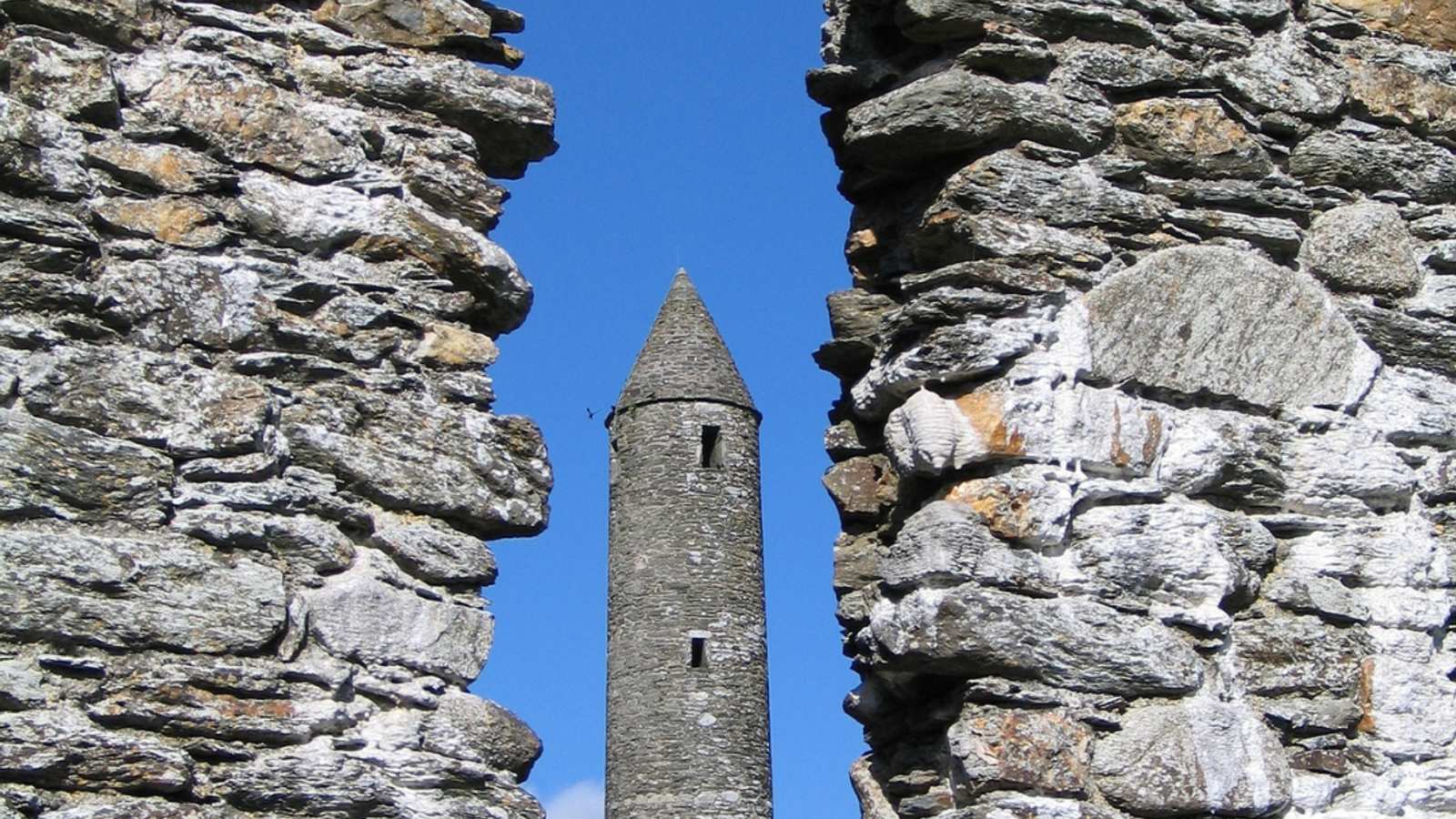
The Towers That Dot Every Irish County
There are around 65 surviving round towers in Ireland today. Another 30 or so exist only as ruins. You’ll find them standing beside ancient monastic sites — places like Glendalough in County Wicklow, Clonmacnoise in County Offaly, and Ardmore in County Waterford.
They were built roughly between 900 and 1100 AD, during the golden age of Irish monasticism. Each tower was constructed from carefully fitted stone, tapering gradually toward a conical cap at the top. They look like nothing else in the world.
The craftsmanship is extraordinary. Many have survived storms, wars, and a thousand years of Atlantic weather. The tower at Ardmore still stands at over 29 metres. The one at Glendalough, where the ruins of a 6th-century monastery spread across the Wicklow valley, has barely aged since the day it was finished.
What makes them mysterious is not how they were built. It’s why.
The Viking Raid Theory
The most widely known explanation for Ireland’s round towers is that they were built as refuges during Viking raids.
The Vikings began attacking Irish monasteries in earnest from around 795 AD. They came by sea, struck fast, and targeted the wealthiest monastic sites in the country. They seized gold, silver, jewelled reliquaries, and sacred books. They also took monks as slaves — a brutality that horrified the Christian world.
The round towers, this theory suggests, were built as a direct response. When raiders appeared on the horizon, monks would climb inside with their treasures and their manuscripts, pull up the rope ladder, and wait. The doorways on most round towers are set several metres above the ground — far too high to step through without a ladder. Raise it, and the tower becomes almost impossible to breach.
This explanation has real appeal. The timing fits. The locations fit. Chronicle accounts from the period mention monks seeking refuge during raids. The raised doorways are difficult to explain any other way.
For generations, it was the standard explanation, and many Irish school textbooks still teach it as settled fact.
Why That Theory Has Holes
The refuge theory sounds convincing. Until you begin to examine it carefully.
A round tower is not a fortress. The interior is narrow — usually no more than two metres across at the base. The internal space was divided into wooden floors connected by ladders, almost all of which have long since rotted away. A community of monks, crammed in with their treasures and books, would have been packed impossibly tight.
More critically: a besieged tower offers almost no means of escape or resistance. The Vikings could simply set fire to the wooden floors and smoke the occupants out. They could wait. They had longboats and time. A tower that traps you inside is only marginally better than no tower at all.
Then there’s the physical evidence — or rather, the lack of it. Ireland’s round towers show almost no signs of Viking assault. No consistent scorch marks. No archaeological evidence of violent breach at most sites. For structures supposedly designed to withstand raids, they appear largely to have been left alone.
Some researchers have also noted that the windows and doorways of many towers are positioned in specific orientations — not randomly arranged as you would expect from a purely defensive structure, but placed with apparent deliberate intent.
☘️ Enjoying this? 64,000+ Ireland lovers get stories like this every week. Subscribe free →
The Bell Tower Explanation
A second theory is far more straightforward: the round towers were belfries. Bell towers.
In early medieval Ireland, church bells were rung to call monks to the canonical hours of prayer and to announce services to the surrounding community. A tall tower would carry the sound of a bell considerably further across the countryside than any other structure available. And in the early Irish Church, the ringing of bells held deep spiritual significance — it was a sacred act, not a mechanical one.
The Irish name for round towers provides the most compelling clue. They are called cloigtheach — which translates directly as “bell house.” Not “refuge.” Not “watchtower.” Bell house.
This theory has gained real ground among scholars in recent decades. It fits the Irish name. It fits the positioning — towers are always found at monastic sites, exactly where you would want a community bell. It explains the height. And it makes sense of the sheer number of them: if you were building a bell tower, you built it to last.
Under this view, the towers may have served more than one purpose. They could ring bells in peaceful times and act as lookout posts when danger was on the water. The raised doorway was not primarily defensive — it was structural, common to tall buildings of the period.
The Stranger Theories
Not everyone has been satisfied with the practical explanations. Over the years, more unusual ideas have been put forward.
One theory holds that the towers were designed as solar observatories, with their doorways and windows carefully aligned to track the movement of the sun and stars across the Irish sky. Another, promoted by alternative historians, suggests they were built as giant conductors — channelling energy from the earth through the stone and into the monastic community.
A third theory, popular in the 19th century, proposed the towers were fire beacons used to guide ships along Ireland’s treacherous coastline — precursors to the lighthouses that came centuries later.
None of these ideas have gained serious academic traction. But they reflect something genuine: the round towers have always provoked imagination as well as scholarship. There is something about their height and their silence that refuses to let the matter rest.
Even standing at Glendalough today — with the mist rolling in from the Wicklow hills and the ancient granite dark with rain — it is hard not to feel that the tower is watching you back.
What We Know for Certain
Despite the debate, a few things about Ireland’s round towers can be said with confidence.
They were built by Irish monks during the peak centuries of Irish monasticism. They were expensive and technically demanding. Their builders clearly intended them to stand for a very long time — and on that count, at least, they succeeded.
Many of the monastic sites where they stand were extraordinary centres of culture. Glendalough, founded by Saint Kevin in the 6th century, trained scholars from across Europe. The monks who built the round towers also produced the intricate illuminated pages of the Book of Kells — and sent missionaries to exposed and dangerous places like Skellig Michael, where they built stone oratories on sheer Atlantic cliffs with nothing but faith and precision.
These were not men who built without purpose. Every stone was placed with intention. The towers, whatever their primary function, were clearly central to the life of the communities that raised them.
A Mystery Worth Visiting
The most remarkable thing about Ireland’s round towers is that the mystery itself becomes part of the experience.
You don’t need a definitive answer to feel the weight of a thousand years when you stand at the base of one. The stones were shaped by hand, hauled into place without any machinery, and fitted with such precision that many have outlasted everything built around them. The wooden floors are gone. The monks are gone. The prayers they sang have long since faded into the Wicklow air. But the towers remain.
Ireland has no shortage of historic sites worth building a visit around. But the round towers are something a little different from a castle or a cathedral. They’re not just old buildings. They are open questions left in stone — standing in the Irish rain, still waiting, after all this time, for someone to work out the answer.
The Best Round Towers to Visit Today
If you want to see these towers for yourself, a handful of sites stand out:
- Glendalough, Co. Wicklow — the most photographed round tower in Ireland, rising over the monastic valley described above.
- Kilmacduagh, Co. Galway — the tallest surviving round tower in the country at roughly 34.5 metres, with a visible lean that has earned it the nickname “the leaning tower of Kilmacduagh.”
- Clonmacnoise, Co. Offaly — part of one of Ireland’s most important monastic complexes, on the banks of the River Shannon.
- Ardmore, Co. Waterford — a beautifully preserved tower overlooking the sea, beside the ruins of St Declan’s cathedral.
- Devenish Island, Co. Fermanagh — reachable by boat on Lough Erne, with one of the best-preserved conical caps of any surviving tower.
For a longer list of towers, visitor tips, and photo spots, see the best round towers to visit in Ireland today.
Frequently Asked Questions
How many round towers are there in Ireland?
Around 65 round towers survive in Ireland today in some form, most dating from the 9th to 12th centuries — though only a small number, including Kilmacduagh and Devenish Island, still have their original conical stone cap intact.
Why do round towers have their doorway raised off the ground?
This is the detail at the heart of the Viking-raid theory discussed above: a doorway several metres up, reachable only by a ladder that could be pulled inside. For more on this specific debate, see our deeper look at the door-placement debate.
Can you climb inside a round tower?
Most round towers are closed to the public or only accessible on limited guided visits, since the original wooden floors and ladders have long since rotted away. Devenish Island is a notable exception, with modern floors and ladders installed for visitors.
☘️ You Might Also Love
☘️ Join 64,000+ Ireland Lovers
Every Friday, get Ireland’s hidden gems, local secrets, and travel inspiration — the kind you won’t find in any guidebook.
Free forever · · Unsubscribe anytime
☘️ Want More Hidden Ireland?
Join 64,000+ subscribers who discover Ireland’s best-kept secrets every week.
Subscribe Free — Join the Community →
Free forever · Unsubscribe anytime · No spam
📥 Free Download: Ireland Travel Planning Guide
Our most popular resource — itineraries, insider tips, and the 50 places you must not miss.
Tours & experiences you might love


Powered by Viator. Some links are affiliate links — we may earn a small commission at no extra cost to you.
Secure Your Dream Irish Experience Before It’s Gone!
Planning a trip to Ireland? Don’t let sold-out tours or packed attractions spoil your journey. Iconic experiences like visiting the Cliffs of Moher, exploring the Rock of Cashel, or enjoying a guided walk through Ireland’s ancient past often sell out quickly—especially during peak travel seasons.

Booking in advance guarantees your place and ensures you can fully immerse yourself in the rich culture and breathtaking scenery without stress or disappointment. You’ll also free up time to explore Ireland’s hidden gems and savour those authentic moments that make your trip truly special.
Make the most of your journey—start planning today and secure those must-do experiences before they’re gone!