

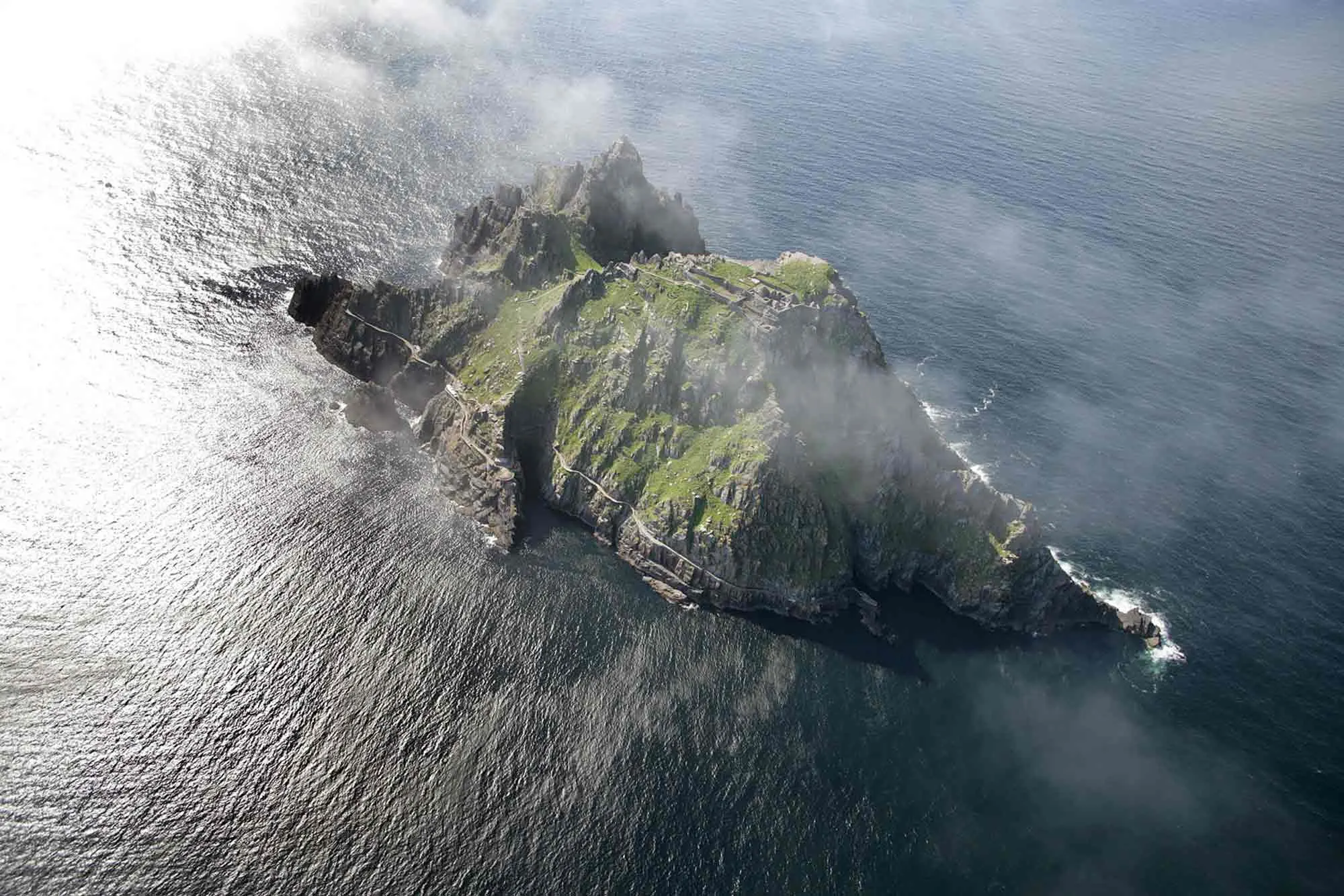
It rises from the Atlantic like a fist of black rock — two jagged peaks erupting from the sea, twelve kilometres off the Kerry coast, with nothing between them and the next landmass for thousands of miles. Skellig Michael looks as though the ocean tried to swallow it whole and simply gave up. And yet, more than 1,400 years ago, a handful of Irish monks looked at this terrifying place and decided to call it home.

An Island That Was Never Meant to Be Lived On
The name “Skellig” comes from the Irish sceilig — meaning a steep rock. It is, at its core, a geological accident: two sea stacks of Old Red Sandstone thrust up from the ocean floor, the remnants of an ancient coastal ridge swallowed by rising seas thousands of years ago.
The larger of the two, Skellig Michael, rises to 218 metres. Its flanks plunge sheer into the Atlantic. The water surrounding it is some of the most unpredictable in Europe — a place where swells roll in unbroken from the open ocean, where winter gales tear in with nothing to stop them. Even in summer, the crossing from the Kerry coast in a small boat can be rough enough to turn seasoned sailors pale.
It is the last place on earth that seems built for human habitation. That is precisely why the monks chose it.
The Monks Who Chose the World’s Edge
Around 588 AD, a small community of Christian monks — following the tradition of the Irish Desert Fathers — established a monastery on Skellig Michael under the patronage of St Fionán. The impulse that drove them there was the same that had sent the earliest Christian hermits into the Egyptian desert centuries before: a belief that withdrawal from the world, the harder the better, brought the soul closer to God.
Ireland’s island monasteries were among the most extreme expressions of this idea. But Skellig Michael exceeded them all. Here, cut off by twelve kilometres of open Atlantic, pounded by ocean storms, exposed to winds that could knock a man flat, these monks chose to pray.
They did not simply survive. They thrived — for six centuries.
What They Built Is Barely Believable
The monastery sits on a natural ledge near the South Peak, reached via 618 steps carved directly into the rock face by the monks themselves. Every stone in the buildings above was placed by hand, without a drop of mortar, fitted together with a precision that left no gap for the Atlantic weather to exploit.
Six beehive-shaped clochán huts, two boat-shaped oratories, a graveyard, and a small church — all built using the corbelling technique, each layer of dry stone slightly overlapping the last until the walls curved inward to a sealed roof. These structures, constructed before the Norman Conquest, before the Magna Carta, before most of Europe’s great cathedrals were imagined, are still watertight today.
UNESCO designated Skellig Michael a World Heritage Site in 1996, calling it “an outstanding example of early Christian monasticism.” It is the most perfectly preserved early Christian monastery in the world.
Life at the Very Edge of Everything
Daily life followed the Divine Office — seven cycles of prayer from before dawn until midnight. Between prayers, the monks farmed tiny terraced gardens on the island’s leeward side, fished the surrounding waters, collected rainwater in stone cisterns, and copied manuscripts by the light of tallow lamps.
Puffins nested in the soil around them. Gannets dove the cliffs in dramatic white arcs. The roar of the Atlantic was the constant soundtrack to every waking hour. In winter, when rough seas made the crossing impossible for months at a time, the monks were entirely cut off — no supply boats, no word from the mainland. Just stone, sea, wind, and prayer.
The waters these monks fished were the same wild Atlantic channels that Kerry’s fishermen have worked for a thousand years — a connection to the sea as old as Ireland itself. The traditions woven into the fabric of Ireland’s Atlantic communities carry echoes of that same ancient relationship with the deep.
Why the Monks Finally Left
Sometime in the 12th century, the community abandoned Skellig Michael. The most likely cause was a shift in the medieval climate — worsening Atlantic storms, shorter growing seasons, seas that had become too dangerous for regular supply voyages.
The monks retreated to a new priory at Ballinskelligs on the Kerry mainland, where the community continued for centuries. But they left the island monastery entirely intact — no deliberate dismantling, no removal of stones. They simply walked away, and the Atlantic took over as its caretaker.
Visiting Skellig Michael Today
To visit Skellig Michael is to climb those 618 steps yourself — feeling the exposure on either side as the Atlantic opens beneath you, the puffins watching from their burrows with remarkable indifference to human nerves. The island receives just 180 visitors per day, carried in small licensed boats from Portmagee, Ballinskelligs, and Cahirciveen between May and October.
Visits are entirely weather-dependent. If the Atlantic decides otherwise, boats do not run. Book as far in advance as possible. And when you arrive, move quietly — this is a sacred place, and it still feels like one.
Global audiences caught their first glimpse of Skellig Michael through the Star Wars films shot here in 2014 and 2015. But the island was already one of Ireland’s greatest wonders, centuries before the Jedi arrived. If you’re planning your trip to Ireland, County Kerry rewards every visitor who ventures beyond the Ring of Kerry and out toward where the Atlantic truly begins.
Standing at the monastery, the wind pulling at your coat, the ocean stretching unbroken to the horizon in every direction, it is impossible not to feel the weight of all those centuries in the stone. The monks who lived here understood something about silence, about endurance, about the strange peace that comes from choosing the hardest possible thing. That understanding is still here, waiting — carved into every step.
☘️ You Might Also Love
64,000 Ireland lovers can’t be wrong.
Every week, our free newsletter delivers hidden gems, seasonal guides, local stories, and practical travel tips — straight to your inbox. Join the community that loves Ireland as much as you do.
☘️ Want More Hidden Ireland?
Join 64,000+ subscribers who discover Ireland’s best-kept secrets every week.
Subscribe Free — Join the Community →
Free forever · Unsubscribe anytime · No spam
📥 Free Download: Ireland Travel Planning Guide
Our most popular resource — itineraries, insider tips, and the 50 places you must not miss.
Tours & experiences you might love


Powered by Viator. Some links are affiliate links — we may earn a small commission at no extra cost to you.
Secure Your Dream Irish Experience Before It’s Gone!
Planning a trip to Ireland? Don’t let sold-out tours or packed attractions spoil your journey. Iconic experiences like visiting the Cliffs of Moher, exploring the Rock of Cashel, or enjoying a guided walk through Ireland’s ancient past often sell out quickly—especially during peak travel seasons.

Booking in advance guarantees your place and ensures you can fully immerse yourself in the rich culture and breathtaking scenery without stress or disappointment. You’ll also free up time to explore Ireland’s hidden gems and savour those authentic moments that make your trip truly special.
Make the most of your journey—start planning today and secure those must-do experiences before they’re gone!