

Drive any country road in Ireland long enough, and you’ll find a ruined cottage. A stone shell with no roof. Grass growing where the kitchen floor once was. Nettles pushing through the window frames. There’s nobody home. There never will be again. But someone was once.
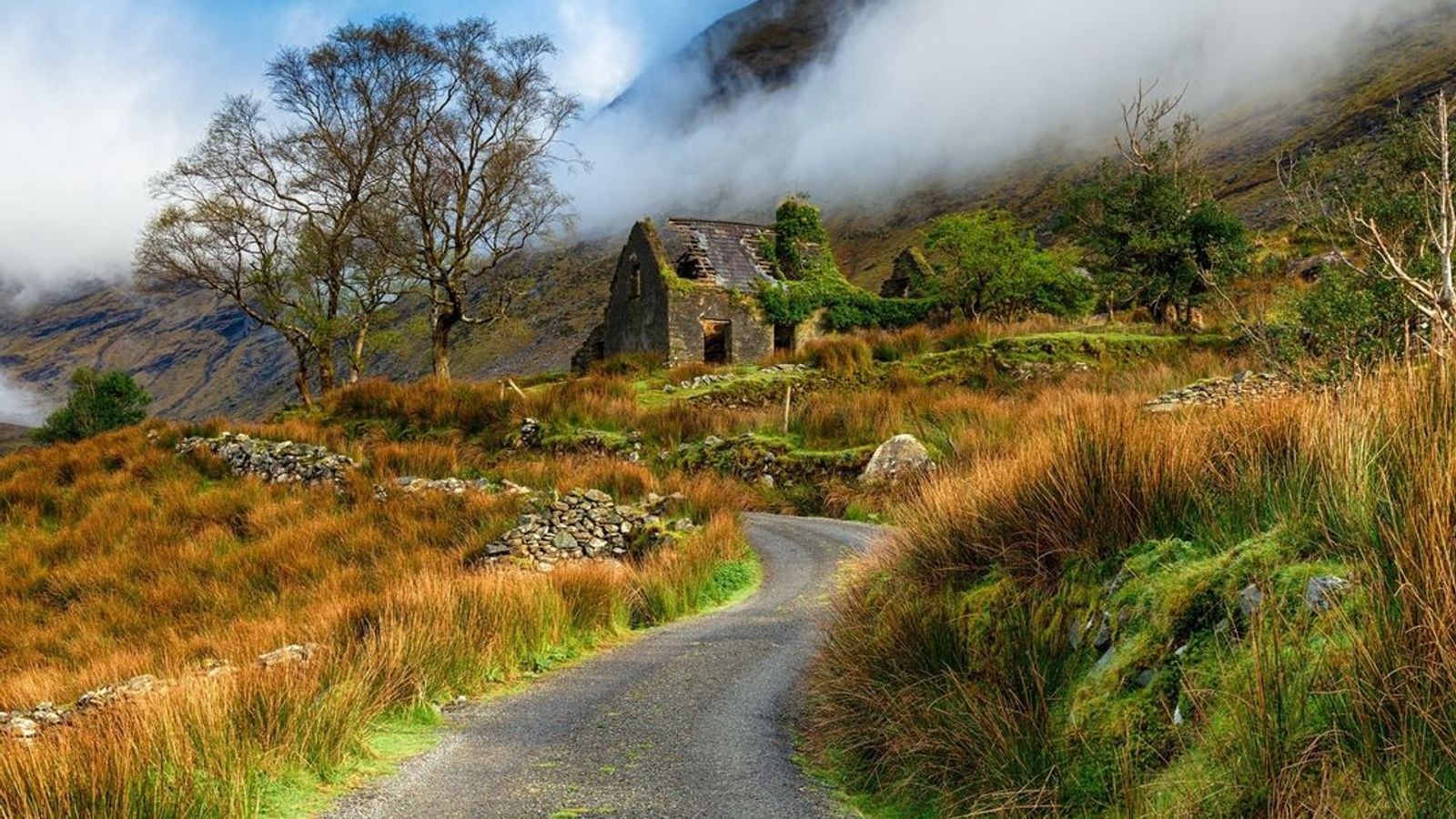
A Landscape Full of Ghosts
Ireland has more ruined cottages per square mile than almost anywhere in Europe. You’ll find them in every county — beside working farms, at the edge of Atlantic cliffs, deep in mountain valleys.
Some are barely visible, swallowed by ivy and gorse. Others stand proud in the middle of a field, roofless walls still solid after a hundred and fifty years.
These aren’t ruins from wars or disasters. Most were simply left behind.
A family walked out the door one day — with a trunk, a few belongings, and a ticket to Liverpool or Boston or New York. They pulled the door shut. And they didn’t come back.
What Happened to These Homes
The Great Famine of the 1840s is the most well-known reason. Between 1845 and 1852, Ireland’s population fell by roughly a quarter. About a million people died. Another million emigrated in those first years alone.
But the emptying didn’t stop there. Wave after wave of emigration followed throughout the late 19th and early 20th centuries. Young men and women in their teens and twenties left for industrial cities in Britain, for the mills of Massachusetts, for the steel towns of Pennsylvania. Most never came back.
Land clearances added to the losses. Landlords evicted entire townlands. Roofs were pulled down to prevent squatters. What remains today are those walls — a record carved in stone.
Reading a Ruin
There’s more information in a ruined cottage than you might expect. Locals who know the area can often tell you which family lived there, how long ago they left, and sometimes even where they went.
The walls themselves offer clues:
- Gable ends standing, side walls collapsed — the roof was likely heavy stone slabs.
- Low walls, crumbled corners — the structure was built to be light and quick, not to last.
- Hearth stone still in place — the family had time to plan their departure.
- Hearth pulled out or destroyed — sometimes signals eviction rather than emigration.
- Two rooms — a family with some means.
- A single room — extreme poverty. Some ruins in the west of Ireland are barely larger than a modern garden shed.
These clues are about individual homes. For a broader look at how entire townlands — not just single cottages — were emptied, see our guide to Ireland’s abandoned villages.
☘️ Enjoying this? 64,000+ Ireland lovers get stories like this every week. Subscribe free →
What the Diaspora Feels
For Irish-Americans, Irish-Australians, and the descendants of Irish emigrants around the world, these ruins carry a specific weight. Many travel to Ireland specifically to find the cottage their great-great-grandparents left behind.
Some find it. Many find only a townland name on an old census record and a general area to search. Some find a pile of stones that could be anything — or nothing at all. And yet standing there, in the right field, under the right mountain, seems to matter regardless.
If you want to trace your Irish roots and find where your family came from, an Irish heritage trip can help you narrow down the county and townland — and often turn up records that will surprise you.
“You feel the pull of the place,” one Irish-American visitor said, standing in a field in Kerry. “Like something’s been waiting for you. And also like you owe it something.”
The Cottage in the Black Valley
The Black Valley in County Kerry is one of the best places in Ireland to feel the weight of those departures. It’s a glacial valley surrounded by the MacGillycuddy’s Reeks, accessible only by narrow mountain roads.
It was the last place in Ireland to get electricity, in 1976. The Black Valley still feels like somewhere time hasn’t entirely caught up with. Stone ruins sit alongside working farms. The silence is total.
To get there, you pass through the famous Gap of Dunloe. If you’re planning a visit to County Kerry, the Black Valley is worth the extra hour. The ruins there are particularly well-preserved — the mountain roads kept out the developers, and so the landscape looks much as it would have a century ago.
Beyond the Black Valley, some of the best-preserved ruins in the country are at Slievemore on Achill Island, County Mayo — close to a hundred stone cottages climbing the mountainside, abandoned during and after the Famine — and at the ghost village of Port, a remote abandoned fishing settlement near Glencolmcille, County Donegal.
Some Have Come Back
Not all ruined cottages were abandoned forever. Some were left empty for decades, then quietly reclaimed.
A descendant who moved to Dublin in the 1960s returned in his seventies to rebuild the family home. A farmer’s daughter who emigrated to England in the 1950s came back with her English-born children to fix the roof and light the hearth again.
These stories don’t make the news, but they happen every generation. The Irish relationship with land — with a specific field, a specific stone wall, a specific view from the kitchen window — doesn’t dissolve easily. It just waits.
What They Are Still Saying
Every ruin represents a real life. Someone was born there, learned to walk on those stones, looked out that window at those same mountains every morning. The fact that we don’t know their names doesn’t mean the names don’t exist.
Ireland’s landscape is full of things that refuse to be forgotten. The ruined cottages are just the most visible.
If you’re planning a trip to Ireland and want to feel its full depth, these ruins aren’t something to pass by. They are one of the most honest things the country has to show you. Use our Ireland travel planning guide to build a trip that leaves time to wander off the main roads.
Standing in that silence — with the stones, the nettles, and the wide Irish sky — something shifts. Ireland doesn’t explain itself. It just waits.
☘️ You Might Also Love
☘️ Want More Hidden Ireland?
Join 64,000+ subscribers who discover Ireland’s best-kept secrets every week.
Subscribe Free — Join the Community →
Free forever · Unsubscribe anytime · No spam
📥 Free Download: Ireland Travel Planning Guide
Our most popular resource — itineraries, insider tips, and the 50 places you must not miss.
Tours & experiences you might love


Powered by Viator. Some links are affiliate links — we may earn a small commission at no extra cost to you.
Secure Your Dream Irish Experience Before It’s Gone!
Planning a trip to Ireland? Don’t let sold-out tours or packed attractions spoil your journey. Iconic experiences like visiting the Cliffs of Moher, exploring the Rock of Cashel, or enjoying a guided walk through Ireland’s ancient past often sell out quickly—especially during peak travel seasons.

Booking in advance guarantees your place and ensures you can fully immerse yourself in the rich culture and breathtaking scenery without stress or disappointment. You’ll also free up time to explore Ireland’s hidden gems and savour those authentic moments that make your trip truly special.
Make the most of your journey—start planning today and secure those must-do experiences before they’re gone!