

Every visitor to Ireland notices them sooner or later. Standing in ancient graveyards, rising from monastery ruins, and marking the ends of winding country roads — those stone crosses, each ringed with a circle of stone, seem to belong to somewhere older than time itself. But that circle? Nobody fully agrees on what it means.
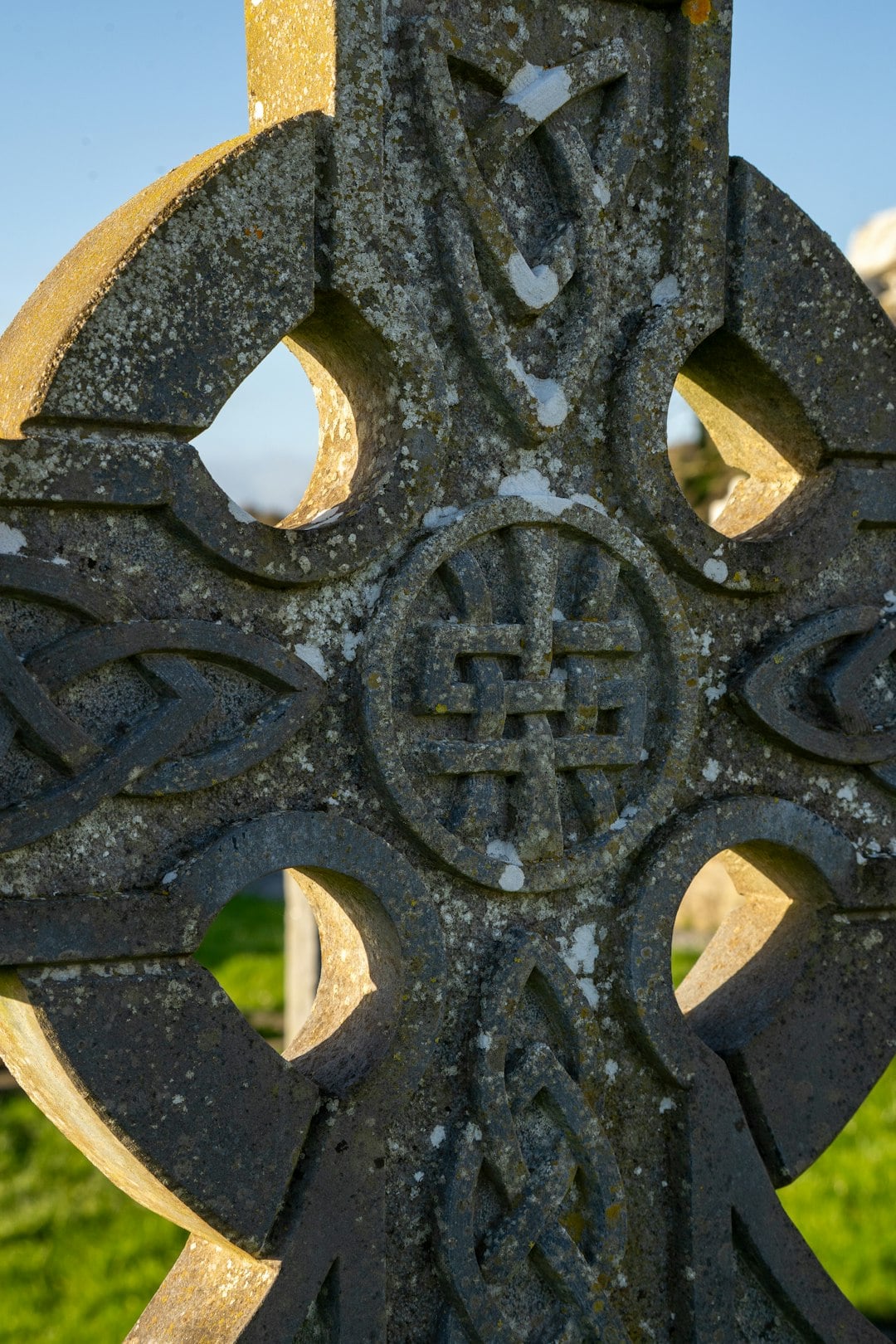
A Cross Unlike Any Other
The Celtic cross is immediately recognisable: a Latin cross, familiar from churches the world over, but with one dramatic difference. A ring of stone connects the four arms, creating a shape that feels both ancient and otherworldly.
Scholars call this ring the nimbus or halo ring, but the name tells you very little about its purpose. What it actually represents has been debated for over a thousand years — and the debate has never been settled.
No ancient inscription survives to explain it. No medieval monk left behind a clear record of the decision. What remains is the stone itself: beautiful, weather-worn, and stubbornly silent.
The Theories That Divide Scholars
The most popular explanation is practical. The ring was added as structural support — a way of holding the heavy stone arms together against the relentless Irish wind and rain. If you run your hand along a high cross, you can feel how the ring distributes the weight. It is elegant engineering as much as anything else.
But many historians reject this as too simple. The ring appears on crosses that were never tall enough to need reinforcement. Some were carved in shallow relief and never bore any structural load at all.
A second theory reaches further back, into the pre-Christian past. The circle may represent the sun — a symbol sacred to the Celtic peoples long before Christianity arrived on Irish shores in the fifth century.
In this reading, the cross is a deliberate fusion: a Christian message wrapped inside a sign that ancient Irish communities already understood and revered. This was a tactic used across the early Church. New beliefs were planted inside familiar forms. The sun wheel, a recurring motif in Celtic art, may have been repurposed rather than erased — turned into something that felt both new and deeply known.
A third theory suggests the ring echoes the laurel wreaths of Roman victory monuments, carried into Ireland through the traditions of early Christianity on the Continent. Others argue it is simply decorative — a frame, nothing more, chosen because it was beautiful.
The High Crosses That Still Stand
The finest surviving Celtic crosses are breathtaking, even in ruin. The Cross of Muiredach at Monasterboice in County Louth is carved with intricate biblical scenes — the Last Judgement, the arrest of Christ, the adoration of the Magi — each panel telling a story in stone. It dates to the tenth century and still stands over five metres tall.
At Glendalough in County Wicklow, the ruins of an early Christian monastery include one of Ireland’s most iconic landscapes: round tower, stone crosses, and mountains rising together in a valley that feels removed from the modern world entirely.
The Ahenny Crosses in County Tipperary are older still. Their surfaces are covered almost entirely in abstract swirling patterns — Celtic knotwork rather than Christian narrative. They stand alone in a small country graveyard that most tourists never find.
If you want to visit these ancient sites and experience the full depth of Irish heritage first-hand, the Ireland travel planning guide will help you build your itinerary around the places that matter most.
Why the Symbol Never Fades
For many Irish people, the Celtic cross is simply home. It appears on family gravestones, on jewellery worn close to the skin, on the badges of county GAA clubs. It is a symbol that carries grief and pride and identity all at once.
For the Irish diaspora, it carries something specific about belonging. The sight of a Celtic cross in a graveyard in Boston, Melbourne, or Buenos Aires is a quiet thread connecting generations separated by ocean.
It sits alongside other remarkable Irish symbols in a tradition that stretches back thousands of years. You can explore more of that tradition in our article on lesser-known Irish Celtic symbols — where some of the country’s most overlooked carvings and signs are brought to life.
The Symbol That Keeps Asking a Question
Perhaps what makes the Celtic cross so enduring is precisely its ambiguity. A symbol that answers every question neatly tends to be forgotten. A symbol that keeps asking a question stays alive.
Is the ring the sun, or engineering, or something else entirely? Is it a bridge between two beliefs, or simply the practical solution of an anonymous stonemason who needed the arms to hold? The cross does not say.
What it does say is this: someone stood where you are standing now, over a thousand years ago, and shaped something permanent from stone. They wanted it to mean something. Whatever they intended, it still does — and it will, long after the last question has been asked.
The next time you find yourself in Ireland, look for the Celtic crosses wherever you travel: in ancient graveyards, beside round towers, along rural laneways. Stand quietly for a moment. Let the stone do what stone does best: hold time still, just for a breath. And if it stirs something in you that you cannot quite name, you are not alone. That, too, may be exactly the point.
For another ancient Irish symbol with remarkable staying power, read the story of the St Brigid’s Cross — a simple rush cross that has protected Irish homes for over 1,500 years and still does today.
☘️ You Might Also Love
☘️ Want More Hidden Ireland?
Join 64,000+ subscribers who discover Ireland’s best-kept secrets every week.
Subscribe Free — Join the Community →
Free forever · Unsubscribe anytime · No spam
📥 Free Download: Ireland Travel Planning Guide
Our most popular resource — itineraries, insider tips, and the 50 places you must not miss.
Tours & experiences you might love


Powered by Viator. Some links are affiliate links — we may earn a small commission at no extra cost to you.
Secure Your Dream Irish Experience Before It’s Gone!
Planning a trip to Ireland? Don’t let sold-out tours or packed attractions spoil your journey. Iconic experiences like visiting the Cliffs of Moher, exploring the Rock of Cashel, or enjoying a guided walk through Ireland’s ancient past often sell out quickly—especially during peak travel seasons.

Booking in advance guarantees your place and ensures you can fully immerse yourself in the rich culture and breathtaking scenery without stress or disappointment. You’ll also free up time to explore Ireland’s hidden gems and savour those authentic moments that make your trip truly special.
Make the most of your journey—start planning today and secure those must-do experiences before they’re gone!