

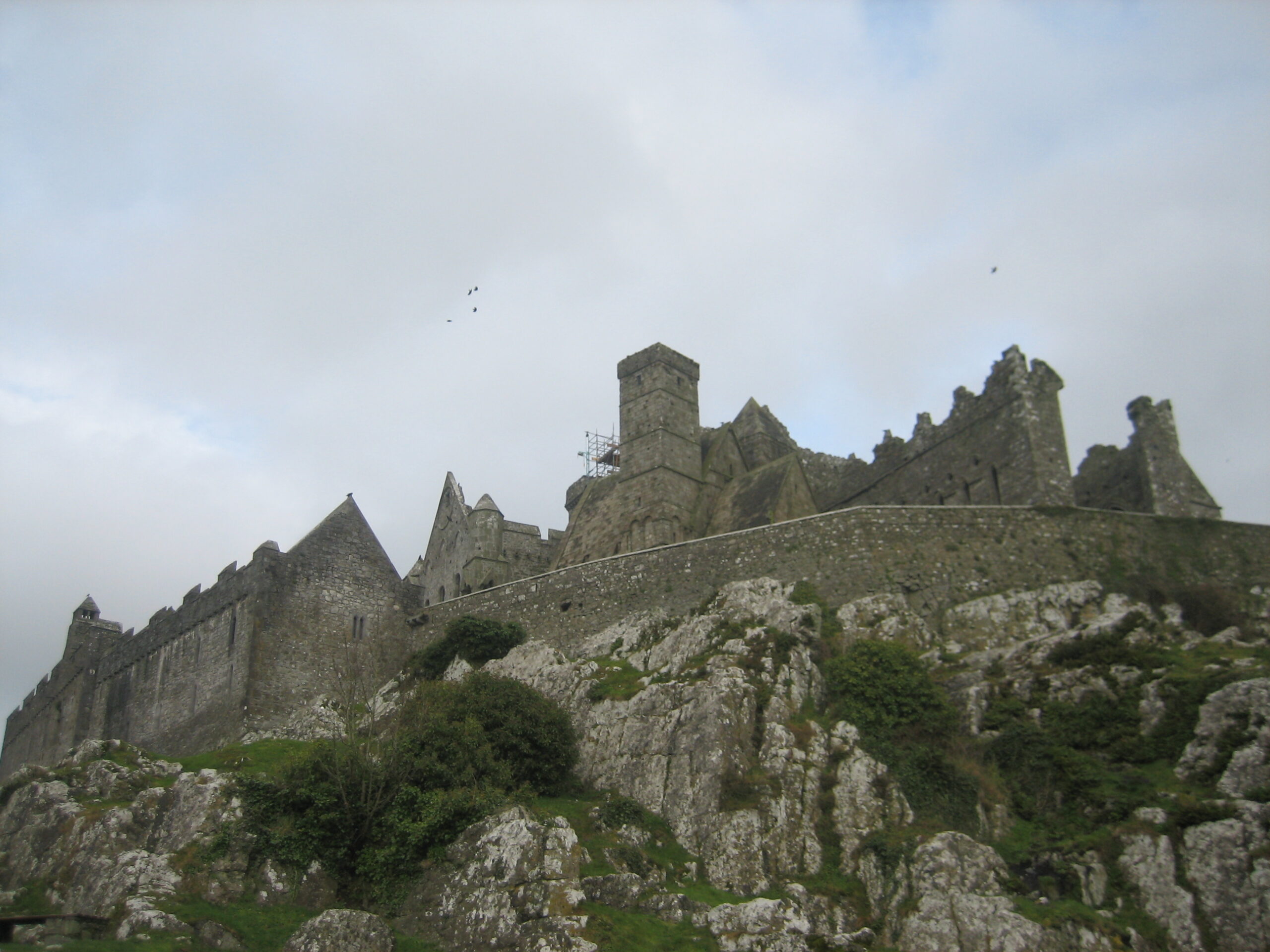
Drive into Cashel from any direction and you will see it before you are ready. A cathedral on a rock, rising out of flat farmland with nothing around it to explain why it exists. The Rock of Cashel is one of the most arresting sights in Ireland. And for centuries, the local answer to why it’s there has had nothing to do with geology.
The Mountain That Lost a Piece
North Tipperary has a mountain called Devil’s Bit. Look at it from the right angle and you can see the problem — there is a notch cut out of the skyline, a gap that looks like something took a bite and left.
According to the oldest version of the legend, that is exactly what happened.
The Devil was crossing Ireland one day and tried to bite clean through the mountain to save time. He failed. The chunk came loose in his jaw, and he spat it out rather than carry it further. It landed in the middle of the Tipperary plain, some miles to the south. And that is the Rock of Cashel.
A Place People Were Drawn to Long Before Christianity
The rock is a limestone outcrop rising around sixty metres (200 feet) above the surrounding farmland. It would have been visible for miles in every direction long before anyone built on it.
The kings of Munster claimed it as their seat. For six centuries this was the power centre of the south of Ireland — the place where alliances were made, kings were crowned, and enemies were received with either warmth or steel.
Ireland has more historic fortifications and castle sites per head of population than almost anywhere else in Europe, and even among those, Cashel stands apart. Ireland’s remarkable castle heritage is something visitors often discover only when they leave the main roads.
The Visit That Left a Mark on the King
The most famous story attached to Cashel involves St Patrick, who arrived here around 450 AD to baptise Aengus, the King of Munster.
The ceremony proceeded. Patrick used his crozier — his walking staff — to mark the ritual. And somewhere in the process, he drove it straight through the king’s foot.
Aengus did not move. He did not flinch. He did not say a word. Patrick only noticed when he looked down. Horrified, he asked why the king had said nothing. Aengus replied that he had assumed the pain was part of the process — if this was what it cost to become a Christian, he was willing to bear it.
The story has no tidy moral. It just lives on, which says something about what the Irish find worth keeping.
☘️ Enjoying this? 64,000+ Ireland lovers get stories like this every week. Subscribe free →
What the Normans Built and Why It Still Stands
The cathedral complex you see today was built mostly between the 12th and 15th centuries. Cormac’s Chapel, completed in 1134, is one of the finest examples of Romanesque architecture in Ireland — carved stone arches and blind arcading that survived when everything else around it did not.
The building is remarkable partly because it is so old and partly because so much of it remains. If you are planning your trip to Ireland, Cashel is worth the detour off the main road south.
A Roof Removed by Appointment
The cathedral’s roofless state is not entirely the result of war. In 1749, the Church of Ireland Archbishop of Cashel, Arthur Price, had the cathedral’s lead roof stripped after worship had already moved to a new cathedral built in the town below — historians still argue over whether the roof tax, the value of the lead, or a wish to see the old Catholic site fall into disuse was the real motive. The decision was made with paperwork, not siege engines.
Before that, the complex had already seen its share of violence. During the wars of the 1640s, Cashel was attacked and hundreds of people sheltering there were killed. The rock that had been a symbol of kingship and faith became something harder to name.
And yet it endures. The same instinct that keeps Irish people from touching ancient sites in their fields seems to extend to the Rock of Cashel too. Something about it discourages interference.
What You See When You Look Up
There is a walk around the outside of the rock that gives you a full circuit of the walls and grounds. Most visitors come for the view from the top — the Tipperary plain stretching out in every direction, flat and green and quiet.
Some, if they know the story, look north towards Devil’s Bit Mountain. On a clear day you might just see the notch in the skyline where something came loose all those centuries ago.
Two landmarks, one legend, many miles apart. It is not history. But it is the kind of story that stays with you long after the drive home, which is perhaps the better thing to be.
☘️ You Might Also Love
☘️ Join 64,000+ Ireland Lovers
Every Friday, get Ireland’s hidden gems, local secrets, and travel inspiration — the kind you won’t find in any guidebook.
Free forever · · Unsubscribe anytime
Tours & experiences you might love


Powered by Viator. Some links are affiliate links — we may earn a small commission at no extra cost to you.
Secure Your Dream Irish Experience Before It’s Gone!
Planning a trip to Ireland? Don’t let sold-out tours or packed attractions spoil your journey. Iconic experiences like visiting the Cliffs of Moher, exploring the Rock of Cashel, or enjoying a guided walk through Ireland’s ancient past often sell out quickly—especially during peak travel seasons.

Booking in advance guarantees your place and ensures you can fully immerse yourself in the rich culture and breathtaking scenery without stress or disappointment. You’ll also free up time to explore Ireland’s hidden gems and savour those authentic moments that make your trip truly special.
Make the most of your journey—start planning today and secure those must-do experiences before they’re gone!