

You have seen the Celtic knot thousands of times. On jewellery. On gravestones. In the margins of illuminated manuscripts. Tattooed on the wrists and shoulders of people who have never set foot in Ireland but feel its pull regardless. Most people, if asked, could not tell you what it actually means.
A Pattern That Did Not Begin in Ireland
Celtic knotwork as we recognise it today did not originate on this island. It arrived during the early medieval period, carried along trade and pilgrimage routes connecting Ireland to North Africa and the Near East.
Coptic Christian manuscripts produced in Egypt and the Levant centuries before the pattern reached Irish shores used interlace designs remarkably similar to what later appeared in Irish stone and vellum. Irish monks travelling as pilgrims and scholars across Europe brought these patterns home.
When the pattern arrived in Irish monasteries, something changed. The monks of Iona, Durrow, and Kells did not copy what they had seen. They pushed the interlace further, layering it to extraordinary complexity, filling every margin and initial letter until the designs became almost mathematical in their precision. They made it their own.
The Monks Who Perfected It
The golden age of Celtic knotwork ran from roughly the seventh century through the ninth. Its greatest achievement is the Book of Kells, produced around 800 AD. Scholars who have attempted to recreate individual knotwork panels from the manuscript describe the process as almost impossibly exacting. Some panels contain hundreds of interlocking strands, each passing consistently over or under the next, with no errors visible to the naked eye.
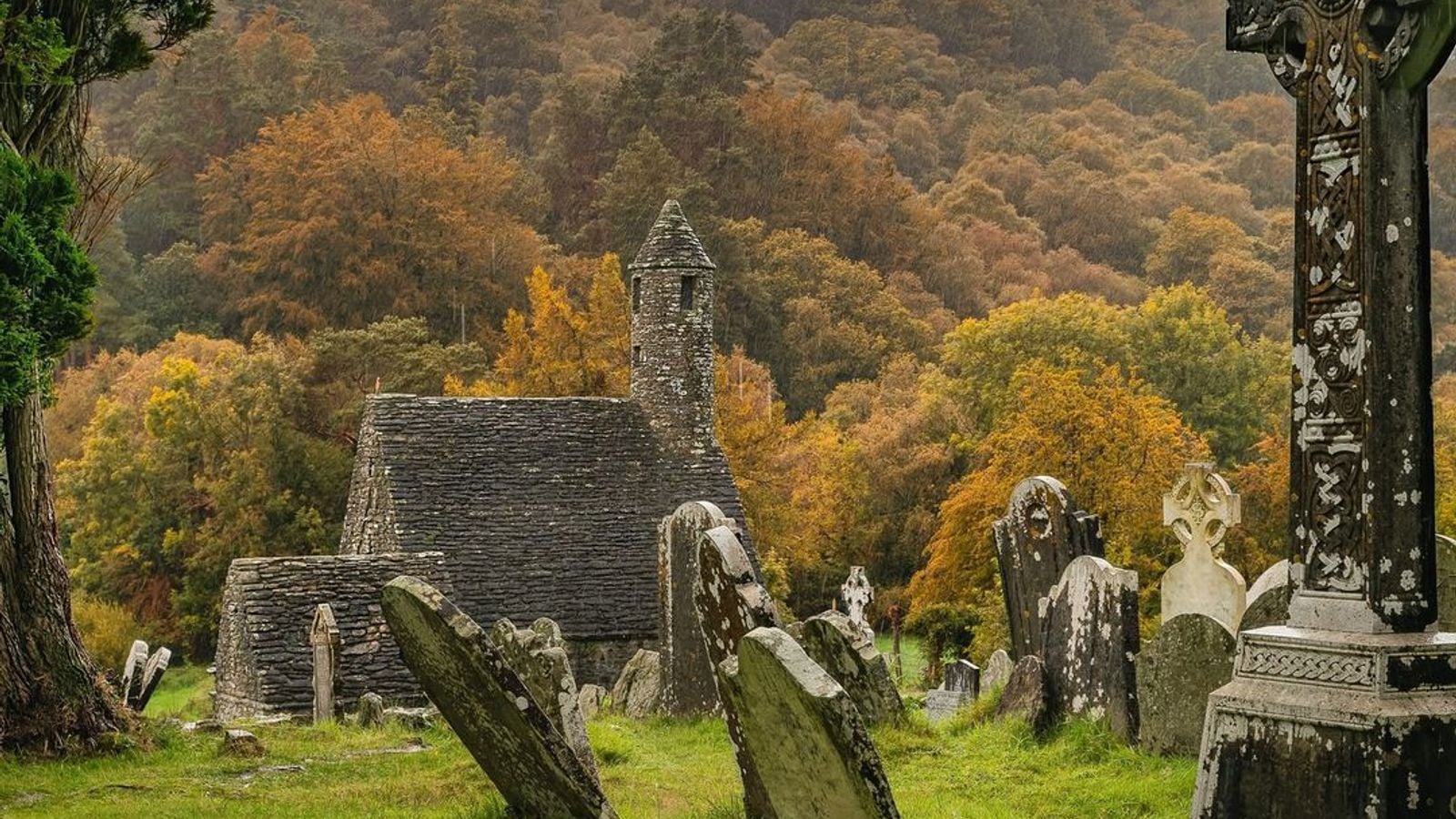
The knotwork spread from manuscripts to stone. High crosses across Ireland bear the same interlace patterns, carved by hands trained in the same monastic tradition. The pattern worked in any material. The meaning remained unchanged.
The defining feature of every true Celtic knot is this: follow any strand with your finger and it loops back on itself without stopping. Over, under, through, and back again. No beginning. No end. This was not a technical accident. It was a deliberate, considered statement.
What the Endless Line Was Saying
In early Irish thought and in the Christian theology that shaped monastic Ireland, an unbroken line represented eternity. Something without a starting point cannot logically have an ending point. The monks who carved these patterns into stone were making an argument in geometry rather than words.
Life continues beyond death. The soul weaves through existence without cessation. Time folds back on itself rather than arriving at a full stop. The knotwork was not decoration added to a sacred object. It was the meaning of the object, expressed in the only form that could hold it.
☘️ Enjoying this? 64,000+ Ireland lovers get stories like this every week. Subscribe free →
The Names We Give to Different Knots
Over the centuries, specific Celtic knot patterns acquired specific associations.
The Trinity Knot — three interlocking arcs forming a continuous triangle — became the most widely recognised. It predates Christianity on this island but was adopted into Christian symbolism to represent the three-in-one. You will find it on eighth-century stone crosses and on jewellery in every craft shop in the country.
The Shield Knot, a four-cornered interlace design, was associated with protection. It was placed near the beds of children and carried by those facing difficulty.
The Dara Knot resembles the root system of an oak tree. Its name comes from the Irish doire, meaning oak grove. It signified inner strength: the invisible foundation that holds a life upright even when the surface is battered.
Why You See It on Gravestones
Across Ireland’s oldest churchyards, high crosses and headstones carry knotwork carvings. This is not coincidence. The knot on a gravestone was a message to every person who stopped to read it: the life below this stone has not ended.
The unbroken line said what words could not. If you want to understand the Irish relationship with death — which is to say, the Irish relationship with continuity — look at the knotwork on those stones. It will tell you more than any epitaph.
If you are planning to visit Ireland’s ancient monastic sites and high crosses, this planning guide covers everything from Glendalough to Clonmacnoise. And the Celtic cross itself holds its own mysteries — the ring around the intersection has been debated by scholars for generations.
Why It Still Travels
Celtic knotwork has followed Irish people to every country they settled. It appears on wedding rings, christening gifts, and memorial plaques. People three generations removed from County Clare or County Donegal still choose the Trinity Knot for a tattoo. People who have never seen the Book of Kells wear its patterns on their hands.
The design keeps moving because the idea at its centre keeps speaking. Continuity. Connection. The things that do not stop when we do.
The next time you notice a Celtic knot — on a gate in Galway, in a jeweller’s window in Killarney, on a gravestone in a country churchyard — try to find where the line begins. You will not find it. That was always the point.
☘️ You Might Also Love
Tours & experiences you might love


Powered by Viator. Some links are affiliate links — we may earn a small commission at no extra cost to you.
Secure Your Dream Irish Experience Before It’s Gone!
Planning a trip to Ireland? Don’t let sold-out tours or packed attractions spoil your journey. Iconic experiences like visiting the Cliffs of Moher, exploring the Rock of Cashel, or enjoying a guided walk through Ireland’s ancient past often sell out quickly—especially during peak travel seasons.

Booking in advance guarantees your place and ensures you can fully immerse yourself in the rich culture and breathtaking scenery without stress or disappointment. You’ll also free up time to explore Ireland’s hidden gems and savour those authentic moments that make your trip truly special.
Make the most of your journey—start planning today and secure those must-do experiences before they’re gone!