

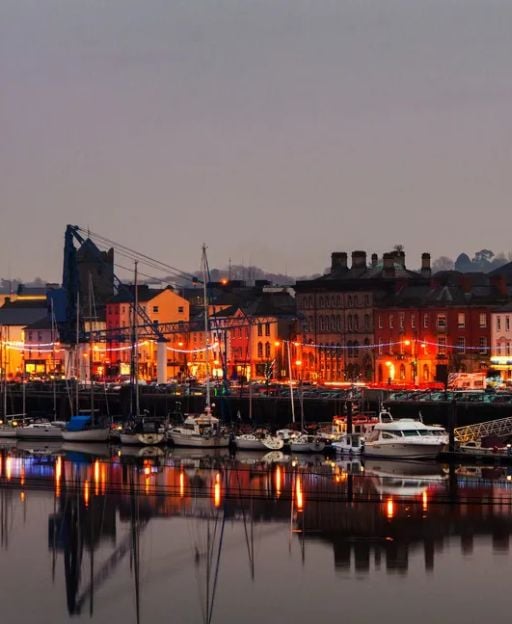
If your family name is Power, Phelan, Foley, or Walsh, there is a good chance your people once called County Waterford home. The Irish surnames from Waterford carry a history unlike any other county in Ireland. This is where the Vikings founded Ireland’s oldest city in 914 AD. It is where the Normans first came ashore in force after 1169. And it is one of the most significant emigration counties in Irish history — the port from which hundreds of thousands left for a new world they would never forget.
Try our free Irish ancestry tools ☘️
Have an Irish surname? Find your ancestral Irish county — type your surname and we’ll trace it back to the county where it originated, with a short note on the family’s history.
Curious about your first name in Irish too? Your Irish Name translates first names to their Gaelic equivalent — with the meaning and the pronunciation.
Waterford is not a county that shouts. It is a county that remembers. Its surnames remember Norman knights who became more Irish than the Irish themselves. They remember Gaelic princes who ruled these river valleys long before any invader arrived. They remember the men and women who stood on the quays of Waterford city and looked one last time at the hills of the Comeragh Mountains before boarding ships to Newfoundland, New York, and Philadelphia. If your roots are here, understanding these names is the first step toward coming home.
Watch: Do You Qualify for an Irish Passport?
Tracing your Irish family? If one of your grandparents was born in Ireland, you may be able to become an Irish citizen. This 14-minute guide explains who qualifies, what it costs and how long it takes. Thinking of making the move? Get the free Moving to Ireland checklist.
Ireland’s Oldest City and Its Ancient Names
Waterford was founded in 914 AD by Norse Vikings, who called their settlement Vedrarfjordr — meaning “windy fjord.” It is the oldest city in Ireland, and its history is layered in ways that shaped its surnames profoundly. Before the Vikings, before the Normans, and before the English, the people of this land were the Déisi (also spelled Déise) — an ancient tribal grouping whose name means “vassals.” Their territory, the Decies, covers much of what is modern County Waterford.
The Déisi produced some of the oldest Irish surnames associated with this land: Phelan, Foley, and Curran all trace their roots to this pre-Viking, pre-Norman world. Then the Normans arrived, bringing surnames like Power, Walsh, Tobin, Aylward, and Butler. Over centuries, many Norman families became Gaelicised — adopting the Irish language, Irish customs, and in some cases Irish-language versions of their Norman names. The result is one of the richest surname landscapes in Ireland.
Before diving into individual surnames, it helps to understand the county’s place in Irish genealogical records. Tracing your Irish ancestry for County Waterford is well supported: the Griffith’s Valuation (1847-1864) provides townland-level records, Catholic parish registers dating from the 1700s are held at the National Library of Ireland, and the Waterford Heritage Genealogical Centre at RootsIreland.ie holds over 18,500 civil marriage records and baptismal records across the Diocese of Waterford and Lismore.
Power (de Paor) — The Norman Lords of the Decies
No surname is more associated with County Waterford than Power. The name is so dominant here that it is sometimes called the “Waterford name.” Its origin is Norman: the family descends from Robert le Poer, an Anglo-Norman knight who was granted the City of Waterford and much of the county by King Henry II in 1177. The name itself likely derives from the Old French povre (an oath of poverty) or from a place in Picardy, France.
The Irish-language form, de Paor, is a Gaelicised adaptation of the Norman “le Poer.” Over centuries, the Powers became one of the most fully Gaelicised of all Norman families in Ireland — Catholic in faith, Irish in culture, and deeply embedded in the life of the county. In 1535, Sir Richard le Poer was created Baron of Curraghmore, and Curraghmore House and Gardens near Portlaw remains the historic seat of the de la Poer (Power) family to this day. Ireland’s largest private estate, it has been associated with this family for over 800 years.
Power remains among the fifty most common surnames in Ireland, and genealogical research shows it concentrated most strongly in Waterford and neighbouring counties. If Power is in your family tree, Curraghmore and the Waterford Heritage Centre should be on your itinerary.
Phelan (Ó Faoláin) — Princes of the Decies
If Power is the county’s great Norman name, Phelan is its great native Irish name. The Gaelic form is Ó Faoláin, from the personal name Faolán, meaning “little wolf.” The Ó Faoláin sept were princes of the Decies — the rulers of ancient County Waterford — and their chieftainship is recorded as far back as 966 AD.
When the Anglo-Normans invaded in the 1170s, it was an Ó Faoláin chieftain who was among the first Irish leaders to fall in resistance. That fact alone tells you something about how deeply rooted this family was in Waterford’s identity. After the conquest, some of the sept remained in Waterford while a branch moved into south-west Kilkenny. The anglicised forms — Phelan and Whelan — remain concentrated in Waterford and Kilkenny to this day.
In America, Phelans and Whelans settled primarily in New York, Pennsylvania, and the Boston area, forming part of the large south-east Irish communities in those cities. If you carry this name, your roots are very likely in the ancient Decies territory — the heart of County Waterford.
Foley (Ó Foghladha) — An Ancient Waterford Name
The Foley family is one of the oldest native Irish families in County Waterford. The Gaelic form, Ó Foghladha (modernised as Ó Foghlú), comes from the personal name Foghladha, meaning “plunderer” or “raider” — likely a warrior epithet from the early medieval period.
The Ó Foghladha sept held the Lord of the Decies title in early records, placing them among the ruling families of ancient Waterford. Over time, the sept spread outward from Waterford through Munster, extending into Cork and Kerry. A 12th-century Bishop of Cashel, Máel Íosa Ó Foghladha, is recorded — evidence of the family’s standing in the church as well as in politics.
By the 18th century, the various Gaelic spellings had largely merged into the anglicised “Foley.” In County Kerry, the older form “Foulue” survived alongside Foley until around 1850. Irish-American Foleys are found in large numbers in New York, Massachusetts, and Connecticut — tracing back to Famine emigration from Waterford and Cork. If Foley is your name, the Dungarvan area and West Waterford are the ancestral heartland.
☘️ Enjoying this? 64,000 Ireland lovers get stories like this every week. Subscribe free →
Walsh (Breathnach) — The Welsh Arrivals
Walsh is one of the most common surnames in all of Ireland, but in County Waterford it has a particularly deep presence. The Gaelic form, Breathnach, literally means “Welsh person.” The name was applied by native Irish speakers to those of Welsh origin who came to Ireland with the Anglo-Norman invasion of 1172.
The Walshs in Waterford descend primarily from Philip the Welshman and his brother David, who arrived with the Norman forces and received land grants in Kilkenny and Waterford. Over the centuries, Walsh became one of the most widespread surnames in the south-east, and it remains among the top five Irish surnames in the United States. The Munster Express newspaper, founded in Waterford in 1860 by the Walsh family, is still published today — a living link to this surname’s deep roots in the county.
For context on how Walsh compares to other Norman-Irish surnames in adjacent counties, our guides to Irish surnames from Cork and Irish surnames from Kerry trace the same families as they spread through Munster.
McGrath (Mac Craith) — The Poets of Munster
The name McGrath comes from the Gaelic Mac Craith — “son of Craith,” where the personal name Craith means “good fortune” or “grace.” The earliest recorded Mac Craith was a Chief Poet of the Province of Munster, serving the O’Brien dynasty in 1086 AD — an exceptional lineage for a family name.
The Waterford McGraths — sometimes recorded as McCragh — were located on the eastern slopes of the Knockmealdown Mountains, in the border territory between Waterford and Tipperary. These families were associated with the broader Fitzgerald (Earl of Desmond) power structure. Following the Cromwellian dispossessions of the 17th century and the collapse of the Catholic Gaelic order, many McGraths settled more firmly in counties Waterford and Tipperary. Today, the name is found concentrated in this region, with strong Irish-American communities in New York, Massachusetts, Connecticut, and New Jersey.
For comparison, our guide to Irish surnames from County Tipperary covers the overlapping Tipperary McGrath connection in more detail.
Tobin (Tóibín) — From Normandy to County Waterford
Tobin is one of the more unusual Norman names to have taken deep root in Waterford. The Gaelic form, Tóibín, is a rendering of the Norman place-name Saint-Aubin (from Saint Albinus, a 6th-century French bishop). The original family name was d’Angulo or Saint Aubin.
The Tobins established themselves in south Tipperary and Kilkenny after the Norman invasion, with a strong presence extending into County Waterford. By the 1440s, three major Tobin clans were documented in south-east Tipperary. The 14th-century chronicler John Clyn described them as “a turbulent sept more dreaded by the English settlers than the native Irish” — which, for a Norman family originally allied with the English crown, is a remarkable thing to record.
The most famous bearer of this name in modern times is the novelist Colm Tóibín, whose very spelling of the surname preserves the Gaelicised form distinctive to the Waterford-Tipperary region. Tobins from the south-east settled in New York and Boston during the Famine, and the name is found throughout the northeastern United States.
Aylward — Eight Centuries at Faithlegg
The Aylward family has one of the most specific and documented origins in County Waterford. According to tradition, a Bristol merchant named Aylward supported Henry II’s fleet during the 1171 campaign and was rewarded with a grant of approximately 7,000 acres at Faithlegg, near the head of Waterford Harbour — where the Rivers Nore, Barrow, and Suir meet.
The name itself derives from the Anglo-Saxon Æthelweard, meaning “noble protector.” The Aylwards became a major Catholic Waterford family. Members of the family served repeatedly as Mayors of Waterford city. During the Cromwellian Siege of Waterford in 1650, John Aylward of Faithlegg served as Mayor — a final act of civic leadership before the estate was confiscated and the family transplanted to Connacht. It was never restored to them.
Today, Faithlegg House Hotel occupies the estate where the Aylwards received their grant in 1177. The original castle ruins and a 13th-century church remain on the grounds. For Aylward families researching their heritage, Faithlegg is as close to a homecoming as any visit to Ireland can offer.
Curran, Butler, and More Waterford Names
Curran (Ó Corráin)
The name Ó Corráin derives from the personal name Corraidhín, from corradh, meaning “spear.” There are several Ó Corráin septs across Ireland; the Waterford branch originated in County Cork and by the 16th and 17th centuries was concentrated in counties Waterford and Tipperary. The 1659 census of Waterford lists Currans as frequent residents, and the family produced distinguished ecclesiastics in the medieval period. Currans from Waterford are documented in Famine-era records arriving in New York and Boston.
Butler (Buitléir)
The Butler family name comes from the hereditary title “Butler of Ireland” (cupbearer) — an office granted to Theobald Fitzwalter when he landed at Waterford city in 1185 with Prince John. This makes Waterford the literal point of origin for one of the greatest Norman dynasties in Irish history. The Butlers’ core territory became the Suir valley and counties Tipperary and Kilkenny, with the river boundary touching northern Waterford throughout. The 7th Earl of Ormond, Thomas Butler, was the great-grandfather of Anne Boleyn. Our guide to Irish surnames from Limerick covers the Butler connection to the wider Munster region.
Barron
The Barron family is Cambro-Norman in origin — a cadet branch of the Fitzgerald dynasty. They established themselves in counties Waterford and Kilkenny following the Norman invasion and were active in Waterford civic life for centuries. A Barron baronetcy was created for County Waterford in the 18th century. The name remains associated with the south-east to this day.
From Waterford Quay: Two Great Migrations
County Waterford has two distinct emigration stories, and both are remarkable.
The Waterford-Newfoundland Trade Route
Beginning around 1675, English ships called into Waterford to collect provisions and workers for the Newfoundland cod fishery. By the late 18th century, Waterford city was one of the major provisioning ports for the transatlantic trade, with more than 100 ships and 5,000 men per season clearing south-coast Irish ports for Newfoundland. The vast majority of these migrants came from Waterford city and its hinterland — covering counties Waterford, south Kilkenny, south Tipperary, and south-east Cork.
After 1780, seasonal workers increasingly stayed permanently, and the surnames Power, Walsh, Foley, and Phelan became embedded in Newfoundland in large numbers. Families born in Newfoundland of Waterford parents sometimes returned to St Patrick’s Church in Waterford city for baptisms. This is one of the most specific and distinctive county-level emigration stories in all of Irish history.
The Great Famine (1845–1852)
Waterford was one of the main embarkation ports during the Famine. Ships left from Waterford quay directly for New York, Philadelphia, and Quebec. Most emigrants could not afford to travel inland and settled in the port cities where they arrived: Manhattan’s Lower East Side, Boston’s South Boston district, Philadelphia’s Southwark neighbourhood. In later generations, Waterford-origin families moved into the coal-mining regions of Pennsylvania and the industrial towns of Connecticut and New Jersey.
The Lismore Estate Emigration Record Database (1815–1905) specifically documents emigration from the Lismore Castle Estate, covering lands in counties Waterford and Cork. It is an exceptional resource for families from this part of the county.
Tracing Your Waterford Ancestry: Where to Start
Waterford is well served for genealogical research, both online and in person.
The Waterford Heritage Genealogical Centre, accessible through RootsIreland.ie, holds Catholic Church records, civil registration records, and burial transcriptions for the Diocese of Waterford and Lismore — covering the full county including Dungarvan, Lismore, Cappoquin, Tallow, Kilmacthomas, and Portlaw. Many of the records are not yet fully digitised and are only accessible through the centre.
For broader research strategy — covering civil records from 1864, parish registers, Griffith’s Valuation, and the records lost in the 1922 Public Record Office fire — see our full guide to tracing your Irish ancestry. If you are planning to visit Waterford in person, our guide to planning an Irish heritage trip covers the archives, local guides, and townland research in detail.
Heritage Sites in County Waterford
- Waterford Treasures (Viking Triangle): Three museums in Waterford city covering Viking, medieval, and Georgian history — including Reginald’s Tower, the oldest civic building in Ireland
- Curraghmore House and Gardens: The 800-year seat of the Power (de la Poer) family near Portlaw — essential for any Power ancestry visitor
- Faithlegg House Hotel: Built on the original Aylward estate, near the confluence of the Nore, Barrow, and Suir — the 13th-century church on the grounds is one of the oldest standing structures in the county
- The Copper Coast UNESCO Global Geopark: 25 km of coastline between Tramore and Dungarvan, containing Neolithic dolmens, Iron Age forts, Ogham stones, and medieval churches — ancestral landscape for many Waterford families
- Ardmore: One of the oldest Christian settlements in Ireland, associated with St. Declan and the Déisi people — the ancestral community of Phelan, Foley, and Curran families
For a structured approach to combining genealogical research with travel, our 7-day Irish ancestry itinerary provides a proven framework adaptable to any county, including Waterford. And for context on neighbouring counties with overlapping surname histories, see our guides to Irish surnames from Galway and Irish surnames from Tipperary.
Frequently Asked Questions About Irish Surnames from Waterford
What is the most common Irish surname from County Waterford?
Power is the surname most strongly associated with County Waterford. It derives from the Anglo-Norman family le Poer, who were granted the city and much of the county in 1177. Over centuries they became one of the most fully Gaelicised Norman families in Ireland. Power remains among the fifty most common surnames in Ireland and is concentrated most heavily in Waterford and the surrounding counties.
Are Phelan and Whelan the same name?
Yes. Both Phelan and Whelan are anglicised forms of the Gaelic Ó Faoláin, meaning “descendant of the little wolf.” The same Gaelic name was written differently depending on the region and the phonetic conventions of whoever recorded it. Both forms trace to the Ó Faoláin sept, the native Irish princes of the Decies — the ancient ruling family of County Waterford. If your family name is Whelan, your probable ancestral county is Waterford or south Kilkenny.
Why do so many Irish surnames from Waterford have Norman origins?
Because Waterford was the Normans’ primary landing point in Ireland. When Strongbow (Richard de Clare) took the city in 1170, and when King Henry II landed there in 1171, they brought with them Norman families who received land grants across the county. Names like Power, Walsh, Tobin, Aylward, Butler, and Barron all trace their Irish origins to this specific moment and this specific place. Over the following centuries, many of these Norman families became as Irish as the Gaelic families they had displaced — speaking Irish, marrying into Gaelic families, and adopting Irish customs and beliefs.
Where did Waterford families emigrate to in America?
Waterford had two major emigration patterns. From the 1670s onward, large numbers of Waterford men and families emigrated to Newfoundland via the transatlantic cod trade — creating Irish communities in Newfoundland that persist to this day. During the Great Famine (1845–1852), the main destinations were New York, Philadelphia, and Boston. In later generations, Waterford-origin families moved into the coal-mining regions of Pennsylvania and the industrial towns of Connecticut and New Jersey. The Waterford-Newfoundland connection is particularly distinctive — surnames like Power, Walsh, Phelan, and Foley remain common in Newfoundland today as a direct result.
How do I research my Waterford ancestry before visiting Ireland?
Begin with free online resources: IrishGenealogy.ie holds civil registration records from 1864 and Catholic parish registers for many Waterford parishes. The National Library of Ireland website holds digitised parish registers. Griffith’s Valuation (1847-1864), available free at AskAboutIreland.ie, records every Irish household at townland level and is essential for pre-Famine research. For professional support before your visit, contact the Waterford Heritage Genealogical Centre via RootsIreland.ie. Our full guide to finding your Irish ancestry walks you through every step of the research process.
☘️ You Might Also Love
☘️ Join 64,000+ Ireland Lovers
Every Friday, get Ireland’s hidden gems, local secrets, and travel inspiration — the kind you won’t find in any guidebook.
Or subscribe free — enter your email below:
Free forever · · Unsubscribe anytime
Tours & experiences you might love


Powered by Viator. Some links are affiliate links — we may earn a small commission at no extra cost to you.
Secure Your Dream Irish Experience Before It’s Gone!
Planning a trip to Ireland? Don’t let sold-out tours or packed attractions spoil your journey. Iconic experiences like visiting the Cliffs of Moher, exploring the Rock of Cashel, or enjoying a guided walk through Ireland’s ancient past often sell out quickly—especially during peak travel seasons.

Booking in advance guarantees your place and ensures you can fully immerse yourself in the rich culture and breathtaking scenery without stress or disappointment. You’ll also free up time to explore Ireland’s hidden gems and savour those authentic moments that make your trip truly special.
Make the most of your journey—start planning today and secure those must-do experiences before they’re gone!
Subscribe Free