

Irish surnames from Laois carry the weight of ancient kingdoms and lost lordships. County Laois sits at the heart of Leinster, home to the Fitzpatricks, the Dunnes, and the Lalors — families who shaped this county and this island for centuries. The Rock of Dunamase has watched over this land since the Middle Ages. Fitzpatrick, Dunne, Lalor, Phelan, Delaney — these names trace back to kings, rebels, and warriors who held their ground long after the world changed around them. If your family carries a Laois name, you carry a very old story.
Free Irish ancestry tool ☘️
Have an Irish surname? Find your ancestral Irish county — we’ll trace your name to where the family originated, with a short note on its history.
Irish Surnames from Laois: A County of Ancient Kingdoms
County Laois was the heart of the ancient kingdom of Ossory. In Irish, the county is called Laois, pronounced “Leash”. It sits south of the Slieve Bloom Mountains, bordered by seven other counties. For centuries, Gaelic families ruled this land on their own terms.
The Fitzpatricks held the eastern territories as Lords of Upper Ossory. The Dunnes ruled the north as Lords of Iregan. The Lalors, the Phelans, and the Delaneys held smaller but fiercely defended territories across the county.
English power arrived here earlier than in most of Ireland. The Plantation of Laois and Offaly began in the 1550s. The English Crown renamed the county “Queen’s County” in honour of Queen Mary. Portlaoise became “Maryborough”. The old Gaelic names were written over, but the families stayed on.
Many lost their land in the plantation. They became tenants on land they had once owned outright. Their surnames survived even when their estates did not.
If you are tracing your roots, our guide to tracing your Irish ancestry covers every archive and database you need.
Fitzpatrick – Mac Giolla Phádraig: Lords of Upper Ossory
Fitzpatrick is the most powerful name in County Laois. The Gaelic form is Mac Giolla Phádraig — son of the servant of Patrick. The name honours Saint Patrick, Ireland’s patron saint. The Fitzpatricks were devoted to his memory from the earliest Christian centuries.
Fitzpatrick holds a unique place in Irish naming history. It is the only major Gaelic family name in Ireland that kept its “Mac” prefix after the Norman conquest. Most other families dropped their prefix when English officials Anglicised their names. The Fitzpatricks held onto theirs.
They ruled Upper Ossory for generations. Their territory covered eastern County Laois, around Durrow and Castletown. They held this land through conquest, alliance, and sheer determination from early medieval times until the seventeenth century.
The Fitzpatricks built Castle Durrow in the heart of their territory. They were patrons of the Church and supporters of early monasteries in the region. Their power declined after the Plantation of Laois, but their descendants never left the county entirely.
Today Fitzpatrick is one of the most common surnames in County Laois and across Ireland. Large communities settled in New York, Boston, and Chicago after the Famine. The name is well established in Irish-American communities across the United States.
Dunne – Ó Duinn: Lords of Iregan
Dunne is one of the most distinctly Laois surnames in Ireland. The Gaelic form is Ó Duinn — descendant of Donn. The name Donn meant brown or dark. Some historians link it to the Irish word for a fort, dún. Either meaning points to strength and solidity.
The Dunne sept ruled Iregan. This territory covered the northern part of County Laois, around Tinnahinch and Stradbally. They held this land from early Christian times as one of the dominant Gaelic families in the province of Leinster.
The Dunnes resisted the Plantation fiercely. They fought to hold their territory for decades after English settlers arrived. They lost most of their land in the seventeenth century, as did most Gaelic families across the county.
Today Dunne is one of the most common surnames in County Laois and across Leinster. You will find it throughout the midlands and across the Irish diaspora in America and Australia. It is spelled Dunne, Dunn, or O’Dunne depending on the branch.
Lalor – Ó Leathlobhair: Land Warriors and Rebels
Lalor is one of Ireland’s most politically charged surnames. The Gaelic form is Ó Leathlobhair — descendant of Leathlobhar. The meaning of the name is debated. Some scholars believe it comes from the Irish words meaning “grey” and “speaker”. Others link it to older terms for a leader or judge.
The Lalor family held land in County Laois around Tinakill in the south of the county. They were a proud sept with deep roots in the land. Like most Laois families, they faced dispossession during the Plantation of Laois and Offaly.
The most famous bearer of the name was James Fintan Lalor. Born in 1807 in Tinnakill, County Laois, he became one of Ireland’s great political thinkers. Lalor argued that Irish people owned the land and had the right to take it back. His ideas on land reform shaped the Land League movement of the 1870s and 1880s. He died in 1849 during the Famine years, but his thinking outlived him by generations.
Today the Lalor name appears as Lalor, Lawlor, and Lawler across Ireland and in Irish communities worldwide. It is most common in County Laois and County Kildare.
☘️ Enjoying this? 65,000 Ireland lovers get stories like this every week.
Thinking about it for retirement?
If you’ve started thinking seriously about retiring there, our complete our full Retire in Ireland guide covers the visa, healthcare, cost-of-living, and the regions worth shortlisting.
Subscribe free →
Phelan – Ó Faoláin: Kings of Ossory
Phelan is one of the oldest surnames in this part of Ireland. The Gaelic form is Ó Faoláin — descendant of Faolán. The name Faolán came from the Irish word for wolf. It described a person with the wolf’s qualities — fierce, loyal, and fast.
The Phelan sept was one of the royal families of Ossory, the ancient kingdom that covered modern Counties Laois and Kilkenny. They held their power here from early Christian times. The Phelans were among the kings of Ossory in the medieval period.
The Norman conquest and later the Plantation pushed the Phelans south and east. Many settled in County Waterford and County Kilkenny. Others held on in Laois as best they could. The name spread across Leinster over the centuries.
Today the name appears as Phelan, Whelan, and Ó Faoláin across Ireland. It is one of the most common surnames in County Wexford and County Waterford, where many Phelan families resettled after losing their Laois lands.
Delaney – Ó Dubhshláine: A Name of the Dark Waters
Delaney carries an evocative meaning. The Gaelic form is Ó Dubhshláine — descendant of Dubhshláine. The name combines two Irish words. Dubh means dark or black. Sláine refers to the River Slaney, which rises in the Wicklow Mountains and flows south through Leinster. The name may mean “dark Slaney” — referring to the black waters of the river at certain times of year.
The Delaney family held land in County Laois and County Kilkenny. They were a native Gaelic sept with strong roots in the Ossory region. The Plantation of Laois displaced many Delaney families from their ancestral lands in the sixteenth and seventeenth centuries.
Today the name is most common in counties Laois, Kilkenny, and Tipperary. Large Delaney communities settled in New York and Boston after the Famine. The name is well known in Irish-American communities across the eastern United States.
How Laois Surnames Crossed the Atlantic
County Laois sits in the midlands, far from the main emigration ports. But its people left in large numbers, especially during the Great Famine of 1845 to 1852.
Most left through Dublin or Waterford. They crossed to Liverpool and boarded ships for New York, Boston, or Philadelphia. Fitzpatrick, Dunne, Lalor, and Phelan families appear in early records of Irish communities in American cities.
An earlier wave left after the Plantation of Laois in the 1550s and again after the Williamite Wars at the end of the seventeenth century. Laois Catholic families joined the Flight of the Wild Geese. They served as soldiers in France, Spain, and Austria. Several Laois officers rose to senior rank in European armies.
The Pennsylvania coalfields drew many midland Irish families in the nineteenth century. Laois surnames appear in the mining towns of eastern Pennsylvania alongside families from Tipperary, Kilkenny, and Offaly.
Their descendants now number in the hundreds of thousands. Laois is a small county. But its surnames reach across the English-speaking world.
Our Irish heritage trip planning guide explains how to visit your ancestral county in person.
How to Trace Your Laois Ancestry
Laois Heritage Society
Laois Heritage Society is based in Portlaoise. They hold genealogical records for County Laois. Their database connects to the national network at rootsireland.ie. It is the best starting point for anyone researching a Laois family.
County Laois Archives
The County Laois Archives in Portlaoise holds estate papers, land records, and local government documents. This is the place to look for families from the tenant farmer class who lost land during the Plantation era. Records of the old Queen’s County administration are held here.
Griffith’s Valuation and Census Records
Griffith’s Valuation listed every landholder in Queen’s County in the 1850s. You can search it free at askaboutireland.ie. The 1901 and 1911 census returns are fully searchable at census.nationalarchives.ie. These are the best starting points for Famine-era research.
For a full step-by-step guide, see our guide to tracing your Irish ancestry.
Where to Visit in Laois to Connect with Your Heritage
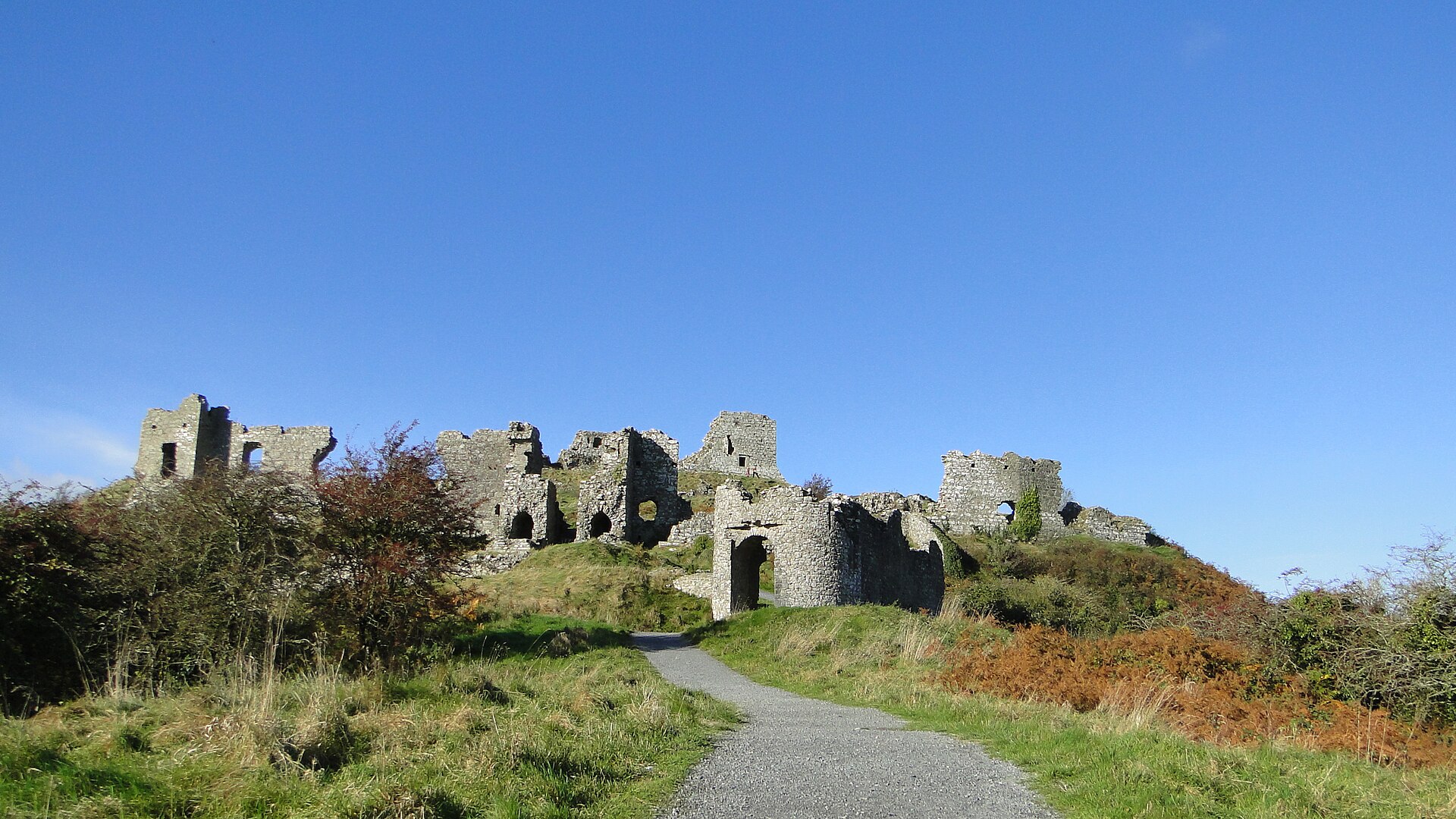
Rock of Dunamase, near Portlaoise. The Rock of Dunamase is the most dramatic heritage site in County Laois. It sits on a high rocky outcrop above the Leinster plain. A medieval castle once stood here, held at various times by Gaelic lords and Norman invaders. The Fitzpatricks and their allies knew this fortress well. Walking the ruins, you stand where the lords of ancient Laois once held watch over their land.
Timahoe Round Tower, Timahoe. Timahoe Round Tower is one of the finest early Christian monuments in Leinster. It dates to the twelfth century and stands over 29 metres high. The round tower was part of a monastic site founded by Saint Mochua in the seventh century. It survives in excellent condition. The surrounding village is quiet and unchanged from a much earlier Ireland.
Emo Court, near Portarlington. Emo Court is a neoclassical mansion set in beautiful grounds. It was built in the eighteenth century by the Gardiner family, later Earls of Portarlington. The house and grounds are now in the care of the state and open to visitors. The wider Portarlington area has strong connections to French Huguenot settlers who arrived after the 1690s. This adds a layer of heritage history that reaches beyond the native Irish families.
Stradbally Hall, Stradbally. Stradbally Hall is a large estate that has been in the same family for generations. The village of Stradbally hosts the National Steam Rally each August, drawing thousands to the county. The estate grounds contain the ruins of an earlier medieval settlement. The surrounding countryside is typical midland Ireland — quiet, green, and unhurried.
Our 7-day Irish ancestry itinerary gives a full framework for visiting heritage sites across Ireland. Our guide to Irish surnames from Offaly covers the county to the north. Our guide to Irish surnames from Westmeath covers another midland county with deep Gaelic roots.
Frequently Asked Questions About Laois Surnames
What are the most common Irish surnames from County Laois?
The most historically significant surnames from County Laois include Fitzpatrick (Mac Giolla Phádraig), Dunne (Ó Duinn), Lalor (Ó Leathlobhair), Phelan (Ó Faoláin), and Delaney (Ó Dubhshláine). Fitzpatrick was the dominant Gaelic dynasty, ruling as Lords of Upper Ossory. Dunne were the Lords of Iregan in the north of the county. Lalor produced James Fintan Lalor, one of Ireland’s most influential political thinkers.
What does Fitzpatrick mean in Irish?
Fitzpatrick comes from the Gaelic Mac Giolla Phádraig, meaning son of the servant of Patrick. The name honours Saint Patrick. The Fitzpatricks were Lords of Upper Ossory in County Laois. They are the only major Gaelic Irish family that kept its “Mac” prefix after the Norman conquest, making Fitzpatrick unique in Irish naming history.
Who were the Dunnes of County Laois?
The Dunnes (Ó Duinn) were the Gaelic lords of Iregan, a territory in northern County Laois around Tinnahinch and Stradbally. They were one of the dominant families in Leinster for centuries. Their name comes from Donn, meaning dark or brown. The name today appears as Dunne, Dunn, and O’Dunne across Ireland and the diaspora.
Who was James Fintan Lalor?
James Fintan Lalor (1807–1849) was a County Laois-born Irish nationalist and political thinker. Born in Tinnakill, he argued that Irish people had the right to own their land. His ideas on land reform shaped the Land League movement of the 1870s and 1880s. He died in 1849 during the Famine years but his thinking influenced Irish politics for generations. The Lalor family were a native Laois sept with roots in the south of the county.
Where can I trace my County Laois ancestry?
Start with Laois Heritage Society in Portlaoise, which holds Laois church records linked to the rootsireland.ie database. Use askaboutireland.ie for Griffith’s Valuation from the 1850s. Search the 1901 and 1911 census at census.nationalarchives.ie. The County Laois Archives in Portlaoise holds estate papers and local records for the old Queen’s County.
Your Laois Roots Are Waiting
County Laois does not pull the same crowds as Kerry or Galway. But it holds deep history. The Fitzpatrick lords ruled Upper Ossory for centuries. The Dunnes held their northern territory through conquest and alliance for generations. James Fintan Lalor shaped Irish political thought from a farm in the south of the county.
If your surname is Fitzpatrick, Dunne, Lalor, Phelan, or Delaney, your family was part of that story. Stand at the Rock of Dunamase and you stand where the lords of ancient Ossory once watched over their land. Walk through Timahoe and you walk past a tower that has been standing since the twelfth century.
That name is yours now. Follow it home.
Explore more of our Irish surnames series — covering Cork, Galway, Kerry, Dublin, Clare, Mayo, Donegal, Tipperary, Limerick, Waterford, Wexford, Kilkenny, Sligo, Roscommon, Antrim, Down, Tyrone, Derry, Armagh, Fermanagh, Cavan, Monaghan, Leitrim, Longford, Westmeath, Offaly, and more.
☘️ Join 65,000+ Ireland Lovers
Every Friday, get Ireland’s hidden gems, local secrets, and travel inspiration — the kind you won’t find in any guidebook.
Subscribe free — enter your email:
📲 Know someone who’d love this? Share on WhatsApp →
Free forever · One email per week · Unsubscribe anytime
Tours & experiences you might love


Powered by Viator. Some links are affiliate links — we may earn a small commission at no extra cost to you.
Secure Your Dream Irish Experience Before It’s Gone!
Planning a trip to Ireland? Don’t let sold-out tours or packed attractions spoil your journey. Iconic experiences like visiting the Cliffs of Moher, exploring the Rock of Cashel, or enjoying a guided walk through Ireland’s ancient past often sell out quickly—especially during peak travel seasons.

Booking in advance guarantees your place and ensures you can fully immerse yourself in the rich culture and breathtaking scenery without stress or disappointment. You’ll also free up time to explore Ireland’s hidden gems and savour those authentic moments that make your trip truly special.
Make the most of your journey—start planning today and secure those must-do experiences before they’re gone!
Subscribe Free