

Walk into an Irish pub mid-session and something shifts. The music doesn’t stop. Nobody turns around. But if you say the wrong thing, ask the wrong question, or stand too close to the circle — you’ll know. The musicians won’t say a word. They won’t need to.
It’s Not a Performance
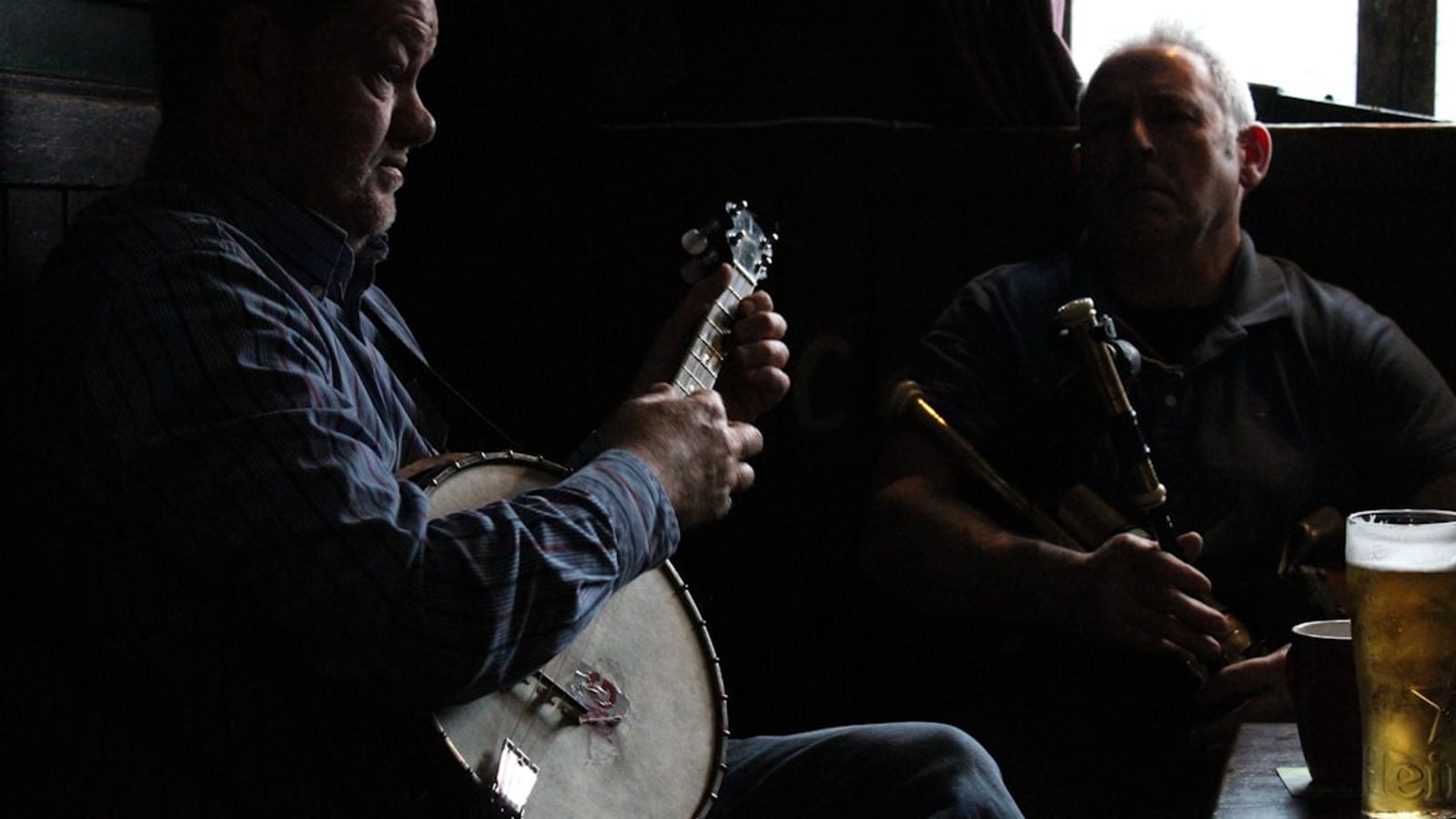
The first thing visitors misunderstand is the most important. A trad session is not a gig. There is no stage, no set list, and no audience in the traditional sense.
The musicians are playing for themselves and for each other. If you happen to be watching, you’re welcome — but you’re not the point.
This changes everything about how the session works. There’s no applause between tunes. There’s no announcement of what’s coming next. One tune bleeds into another, and if you’re not listening closely, you might not notice the shift. That’s by design.
Sessions happen in ordinary pub corners, often on a weeknight, with pints resting on the floor beside the players’ feet. There’s nothing polished about it. That’s exactly why it matters.
The Circle Has a Leader — Even If Nobody Says So
☘️ Discover the Ireland most visitors never find
Join 64,000 people who love Ireland as much as you do. Get our free guide to 25 hidden gems — the places, traditions, and stories that most people miss. Free when you subscribe.
Read with 64,000 Ireland Lovers →Every session has a lead musician, but they’ll never introduce themselves as such. It’s usually the most experienced player in the room, or the one who started the night. They call the tunes, set the tempo, and decide when to move on.
Watch carefully and you’ll see it. A slight nod. A glance around the circle. A few bars played solo before the rest join in. The others follow without comment.
If you’re a musician hoping to join, you wait, listen, and learn the tune before adding your voice to it. Joining uninvited with the wrong tune at the wrong tempo is one of the fastest ways to become unwelcome. The signal, when it comes, is polite but unmistakeable — the circle simply doesn’t accommodate you.
The Bodhrán Problem
No instrument divides opinion in trad circles quite like the bodhrán. It’s the drum that became the heartbeat of Irish traditional music — but it’s also the instrument most misused by enthusiastic beginners.
You can read about the bodhrán’s fascinating and disputed history, but the short version is this: it arrived in formal sessions relatively recently, and some traditionalists still argue it doesn’t belong.
Whether or not that view is fair, a poorly played bodhrán can drown out every other instrument at the table. The unwritten rule? If you haven’t been playing for years, leave it at home. Or at least ask before you take it out.
☘️ Enjoying this? 64,000+ Ireland lovers get stories like this every week. Subscribe free →
Never Request a Song
This is the rule most visitors break within the first five minutes. You’re sitting close to the musicians, you’ve had a Guinness, and you want to hear a famous Irish ballad. So you ask.
Don’t.
Requests are for cover bands. A trad session is spontaneous, collaborative, and shaped entirely by the mood of the players. Asking for a specific tune — especially one associated with the tourist version of Irish music — signals that you’ve misread the room. A polite smile will be the response. The tune will not follow.
This is not rudeness. It’s protection of something fragile. The session belongs to the musicians. Your job as a listener is to receive what they give, gratefully.
What the Uilleann Pipes Teach You About Respect
When a uilleann piper settles in to play, the room adjusts. These instruments are extraordinarily difficult to play and require absolute concentration. They carry in a different register to a fiddle or flute — quieter, richer, more demanding of the room.
The uilleann pipes nearly vanished from Irish life within living memory. The fact that they survived and now appear regularly in sessions across the country is something players take seriously. When the piper starts, the conversation at nearby tables drops. Not because anyone asks. Because it’s understood.
This is the deeper lesson of a trad session: the music exists in a web of unspoken respect. You don’t need to know all the rules to feel them. You just need to pay attention.
Where to Find a Real Session
The sessions worth finding are not listed on tourist websites. They happen on Tuesday nights in County Clare villages, on Sunday afternoons in Connemara, in west Kerry pubs with no menu and no wi-fi.
Doolin in County Clare has a strong session culture and is accessible to visitors — but the sessions in smaller surrounding towns are less polished and more alive. If you’re planning a trip around real trad music, it’s worth building your itinerary around the west coast.
The rule of thumb: if a sign outside advertises “live traditional music”, it’s a performance. If you found out about it from a local who mentioned it in passing — that’s a session.
There’s something that happens when you sit in the corner of a small Irish pub on a cold evening, watching musicians who have known each other for thirty years play tunes that are three hundred years old. You feel, without being able to fully explain it, that you’re briefly part of something larger than tourism.
Something that existed long before you arrived. Something that will continue long after you leave.
You don’t need to earn that feeling. You just need to show up quietly, listen properly, and let it find you.
☘️ You Might Also Love
☘️ Join 64,000+ Ireland Lovers
Every Friday, get Ireland’s hidden gems, local secrets, and travel inspiration — the kind you won’t find in any guidebook.
Love more? Join 43,000 Scotland lovers → · Join 30,000 Italy lovers → · Join 7,000 France lovers →
Free forever · · Unsubscribe anytime
Tours & experiences you might love


Powered by Viator. Some links are affiliate links — we may earn a small commission at no extra cost to you.
Secure Your Dream Irish Experience Before It’s Gone!
Planning a trip to Ireland? Don’t let sold-out tours or packed attractions spoil your journey. Iconic experiences like visiting the Cliffs of Moher, exploring the Rock of Cashel, or enjoying a guided walk through Ireland’s ancient past often sell out quickly—especially during peak travel seasons.

Booking in advance guarantees your place and ensures you can fully immerse yourself in the rich culture and breathtaking scenery without stress or disappointment. You’ll also free up time to explore Ireland’s hidden gems and savour those authentic moments that make your trip truly special.
Make the most of your journey—start planning today and secure those must-do experiences before they’re gone!
Subscribe Free