

Pull up to a village in Connemara on a misty morning and something will feel different before you’ve even stepped out of the car. The signs are in a language you don’t quite recognise. The man behind the petrol station counter greets you in it. You’re not lost. You’ve simply arrived somewhere English never entirely conquered.
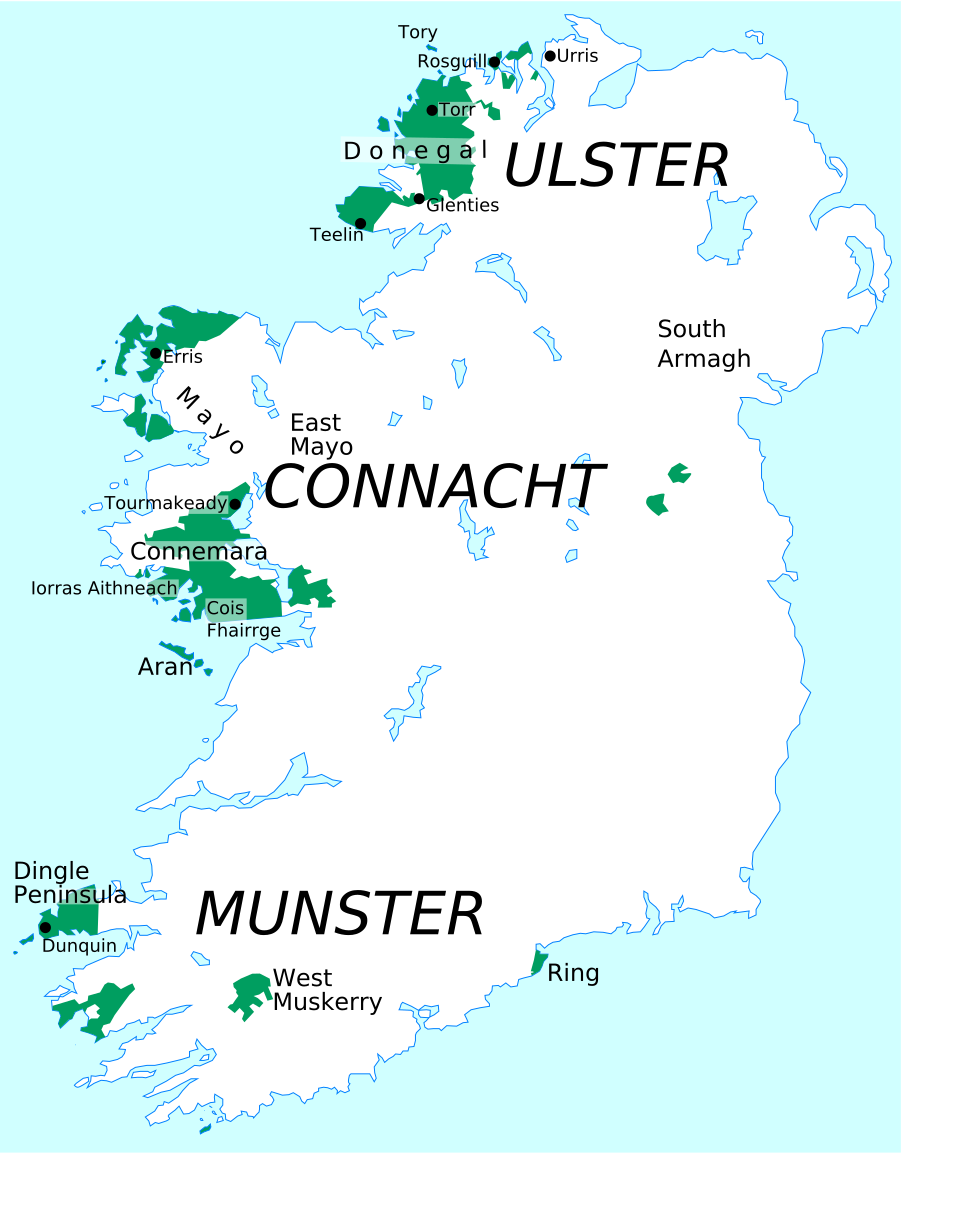
What Is the Gaeltacht?
The word means, simply, “Irish-speaking territory.” These are the coastal and rural stretches of western Ireland where the Irish language — Gaeilge — never gave way to English. Not entirely, not ever.
Officially designated in 1956, the Gaeltacht regions cling to the wild edges of the island: the Connemara coast in County Galway, the Gweedore peninsula in Donegal, the Dingle Peninsula in Kerry, the Aran Islands off the Atlantic shore, and scattered pockets in Mayo, Cork, and Waterford.
Roughly 96,000 people live within these officially designated areas. Somewhere between 20,000 and 25,000 reach for Irish first — at home, at Mass, in the queue at the post office.
Where the Road Signs Change
There’s a visible moment when you cross into a Gaeltacht. The road signs stop offering English beneath the Irish. In some areas, they never offered it in the first place.
An Daingean, not Dingle. Gaoth Dobhair, not Gweedore. Cill Rónáin on the Aran Islands, where the traditional ways of the islanders have outlasted centuries of change.
Visitors often find themselves quietly disoriented. Locals find this, privately, rather satisfying.
The Language at the Kitchen Table
For Gaeltacht families, Irish isn’t a preserved relic or a school exercise. It’s the language of argument and affection — of bedtime stories, birthday toasts, and shouting at the television during a GAA final.
Children grow up dreaming in it. The local shop, the GAA pitch, the church: all Irish. When cousins arrive from Dublin speaking only English, the children here sometimes feel like the ones at an advantage.
Every summer, thousands of teenagers from across Ireland travel to Gaeltacht homes to spend weeks immersed in the language. They sleep in spare rooms, help in the kitchen, and attend Irish-language discos in borrowed jumpers. For many, it’s the moment Irish becomes real — not a classroom exercise, but a living, breathing thing.
Seán-Nós: The Voice Behind the Language
The Gaeltacht didn’t just preserve a language. It preserved a way of singing it.
Seán-nós — “old style” in Irish — is the ancient form of unaccompanied vocal music that has survived in pockets like Connemara, Donegal, and Kerry for centuries. It’s deeply personal: each singer ornaments the notes differently every time, as though the song belongs only to them.
You’ll hear it at late-night sessions, at the annual Oireachtas festival in November, in quiet kitchens where someone is coaxed into giving a song by the fire. It sounds unlike anything else on earth — and it exists because communities kept speaking the language it was written in.
A Language Under Quiet Pressure
The numbers are not comfortable. Young people continue to leave Gaeltacht areas for cities — for education, for work, for better connectivity. Every departure is a small silence in the language.
The Irish government funds Údarás na Gaeltachta to bring jobs and investment to these communities. TG4, the Irish-language television channel, broadcasts from the Galway Gaeltacht. RTÉ Raidió na Gaeltachta carries Irish voices to every part of the island and beyond.
But the truest protection is something no agency can fund. A grandmother who refuses to answer in English. A father who calls his children home in Irish. A community that simply insists — quietly, stubbornly — that this is who they are.
Going There
The Gaeltacht regions are also some of Ireland’s most quietly extraordinary places. The boggy stretches of Connemara with mountains behind and Atlantic ahead. The drama of the Slieve League cliffs above Donegal Bay. The Dingle Peninsula curling westward into open ocean, where traditional currach boats still put out from shore.
Visitors who venture into these areas often find something they weren’t quite expecting — a place where the map makes different sounds, where the past hasn’t been smoothed away, where an ancient language is still finding new words for the modern world.
If you’re planning a trip to Ireland, consider adding a day or two in a Gaeltacht region. The landscapes are reason enough. But you may leave with a few words of Irish and a feeling that you’ve touched something quietly rare.
To spend time in a Gaeltacht is to be reminded that cultures don’t die easily when the people who carry them simply refuse to let go. Ireland’s ancient language is alive, shaped by Atlantic air and stubborn love — waiting at the end of a misty road, for anyone willing to follow it.
☘️ You Might Also Love
☘️ Want More Hidden Ireland?
Join 64,000+ subscribers who discover Ireland’s best-kept secrets every week.
Subscribe Free — Join the Community →
Free forever · Unsubscribe anytime · No spam
📥 Free Download: Ireland Travel Planning Guide
Our most popular resource — itineraries, insider tips, and the 50 places you must not miss.
Tours & experiences you might love


Powered by Viator. Some links are affiliate links — we may earn a small commission at no extra cost to you.
Secure Your Dream Irish Experience Before It’s Gone!
Planning a trip to Ireland? Don’t let sold-out tours or packed attractions spoil your journey. Iconic experiences like visiting the Cliffs of Moher, exploring the Rock of Cashel, or enjoying a guided walk through Ireland’s ancient past often sell out quickly—especially during peak travel seasons.

Booking in advance guarantees your place and ensures you can fully immerse yourself in the rich culture and breathtaking scenery without stress or disappointment. You’ll also free up time to explore Ireland’s hidden gems and savour those authentic moments that make your trip truly special.
Make the most of your journey—start planning today and secure those must-do experiences before they’re gone!