

Every year, more than 400,000 people climb a narrow spiral staircase to the top of a medieval tower in County Cork, lie on their back over a stone parapet, and lower their head towards a chunk of limestone embedded in a castle wall ninety feet above the ground.
They do it to gain the power of eloquent speech.
They do it because, five centuries ago, an Irish lord talked himself out of surrendering his castle to Queen Elizabeth I — and she was furious about it.
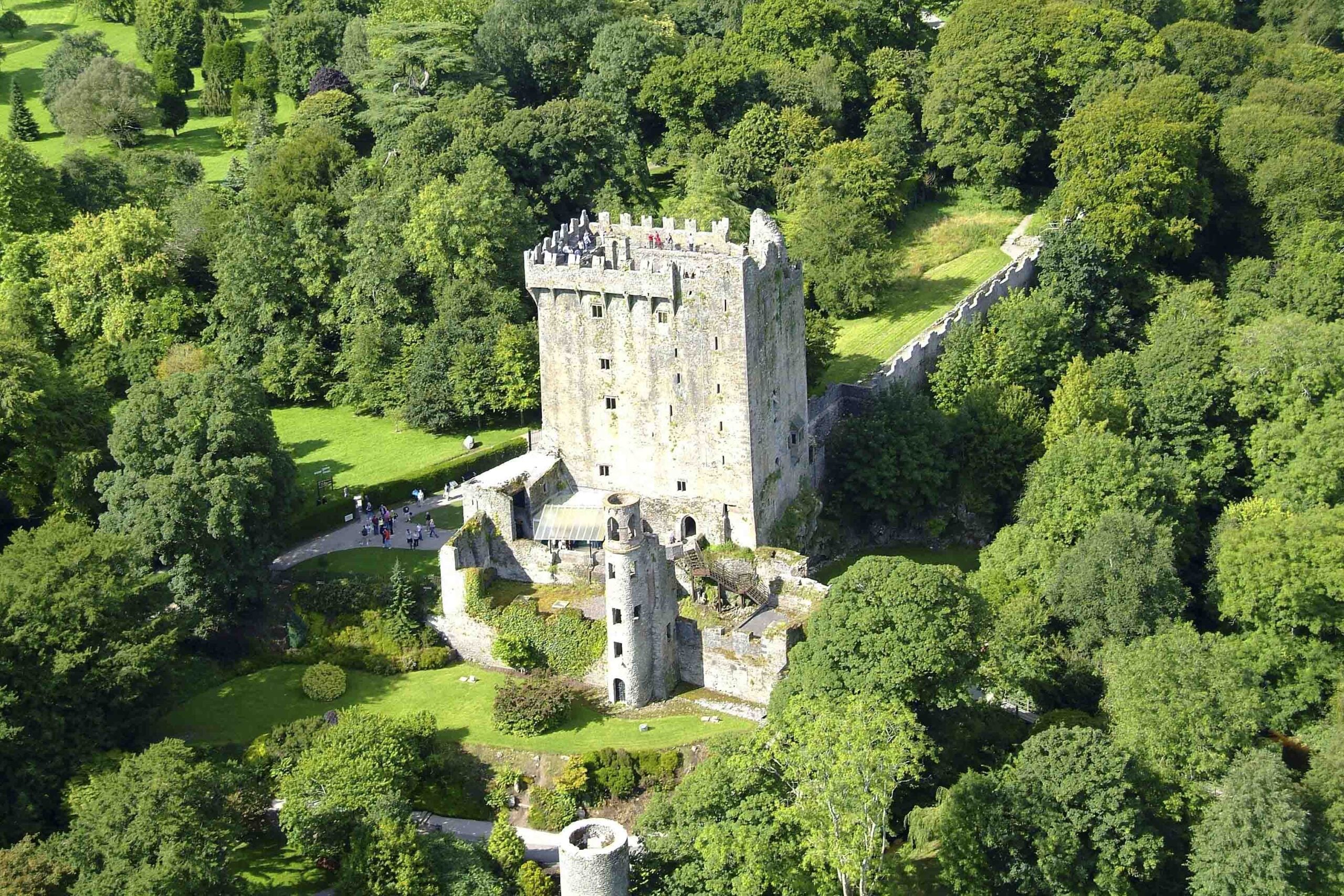
The Stone at the Top of the World
Blarney Castle stands five miles north-west of Cork city, a squat and powerful tower house that has dominated its hilltop since 1446.
Built by Cormac Laidir MacCarthy, the castle was for centuries one of the most significant fortresses in Munster. Its walls are nearly four metres thick. Its tower rises eighteen metres above the surrounding woodland.
But it is not the battles fought here that draw the crowds today. It is a single piece of bluestone set below the battlements at the very top of the tower — and the extraordinary promise of what kissing it will do for you.
How the Word “Blarney” Entered the English Language
In the late sixteenth century, a MacCarthy lord was required to surrender his castle and lands to Queen Elizabeth I as part of England’s tightening grip on Ireland.
He agreed. He wrote letters. He promised. He flattered the Queen with extraordinary warmth and explained, at considerable length, precisely why the moment was not quite right to hand over his home.
The letters kept coming. The castle remained in Irish hands. Elizabeth reportedly grew so exasperated at his endless smooth-talking that she declared: “This is all Blarney — what he says he never means.”
From that moment, the word entered English as a synonym for charming, persuasive speech that is not entirely to be trusted. The Irish were delighted. It seemed to them a perfectly reasonable accusation.
What the Legend Actually Promises
Kiss the Blarney Stone, and you will receive the gift of the gab — the Irish phrase for a natural talent at eloquent, witty, and persuasive speech.
You will never be lost for words. You will talk your way into rooms and out of trouble. You will find the exact phrase that makes a difficult situation dissolve into laughter.
The tradition of kissing the stone became widespread in the eighteenth century, though legends around its magical properties are far older. Some trace the power to a witch saved from drowning who enchanted the stone in gratitude. Others claim it is half of the Stone of Scone, brought to Ireland by Robert the Bruce after the Battle of Bannockburn.
Nobody agrees on the true origin — which feels, somehow, entirely appropriate for a stone whose whole reputation is built on telling a good story.
The Climb
Getting to the stone is not for the faint-hearted.
Visitors climb 127 steep stone steps through the dark interior of the tower. The staircase winds tightly upward in the spiralling tradition of Irish castle design, worn smooth by centuries of feet. At the top, you emerge into the wind.
Then comes the ritual itself. You lie on your back at the edge of the battlements, grip two iron rails above your head, and lean backwards and downwards until your lips find the stone.
An attendant holds your waist. The Castle grounds stretch out far below. The Munster hills roll away on every horizon.
For a moment — and visitors report this consistently — all the noise of ordinary life goes quiet. There is just you, the stone, and five hundred years of Irish history pressing up through the cold limestone.
Who Has Kissed It
The list is long and distinguished.
Winston Churchill made the journey to Blarney. Mick Jagger kissed it. US senators and Nobel laureates have paid their respects. Irish emigrants returning home for the first time in decades have made it a first stop.
It has been kissed by confirmed sceptics who left oddly moved, by children on school tours who shrieked with terror at the height, and by elderly visitors who climbed those 127 steps slowly and deliberately because this was something they had promised themselves for forty years.
What unites them all is the gesture itself — the willingness to be slightly ridiculous in the hope of something wonderful. The Irish have always understood this impulse. It is, in its own way, the definition of blarney.
Beyond the Stone
Blarney Castle is far more than its famous stone. The grounds contain one of Ireland’s great walled gardens, the eerie Witch’s Kitchen, the Druid’s Cave, and a stretch of ancient woodland that feels genuinely enchanted.
The Rock Close — a landscaped garden of dolmens, standing stones, and ancient yew trees — has stood here since before the castle itself. Botanical gardens planted in the nineteenth century wind along the banks of the River Martin.
Visitors who want to explore Ireland’s most legendary castles will find Blarney sits at the top of almost every list — and those planning a broader Irish trip will find it fits easily within a day out from Cork city. If you are still putting your itinerary together, the Ireland trip planning hub is a good place to start.
Why People Keep Coming
There is no scientific evidence that the stone works. Plenty of people have kissed it and remained stubbornly lost for words.
But the Irish have always understood something about the power of a good story — that what a thing promises is sometimes as important as what it delivers. The Blarney Stone does not offer eloquence so much as it offers permission: permission to believe, for a moment, that words have power, that wit matters, and that the right phrase at the right moment can change everything.
Stand at the top of that tower on a clear day with all of County Cork laid out below you, and it is entirely possible to believe that someone, somewhere, found exactly the words they were looking for.
☘️ You Might Also Love
64,000 Ireland lovers can’t be wrong.
Every week, our free newsletter delivers hidden gems, seasonal guides, local stories, and practical travel tips — straight to your inbox. Join the community that loves Ireland as much as you do.
☘️ Join 64,000+ Ireland Lovers
Every Friday, get Ireland’s hidden gems, local secrets, and travel inspiration — the kind you won’t find in any guidebook.
Subscribe free — enter your email:
📲 Know someone who’d love this? Share on WhatsApp →
Free forever · · Unsubscribe anytime
📥 Free Download: Ireland Travel Planning Guide
Our most popular resource — itineraries, insider tips, and the 50 places you must not miss.
Tours & experiences you might love


Powered by Viator. Some links are affiliate links — we may earn a small commission at no extra cost to you.
Secure Your Dream Irish Experience Before It’s Gone!
Planning a trip to Ireland? Don’t let sold-out tours or packed attractions spoil your journey. Iconic experiences like visiting the Cliffs of Moher, exploring the Rock of Cashel, or enjoying a guided walk through Ireland’s ancient past often sell out quickly—especially during peak travel seasons.

Booking in advance guarantees your place and ensures you can fully immerse yourself in the rich culture and breathtaking scenery without stress or disappointment. You’ll also free up time to explore Ireland’s hidden gems and savour those authentic moments that make your trip truly special.
Make the most of your journey—start planning today and secure those must-do experiences before they’re gone!