

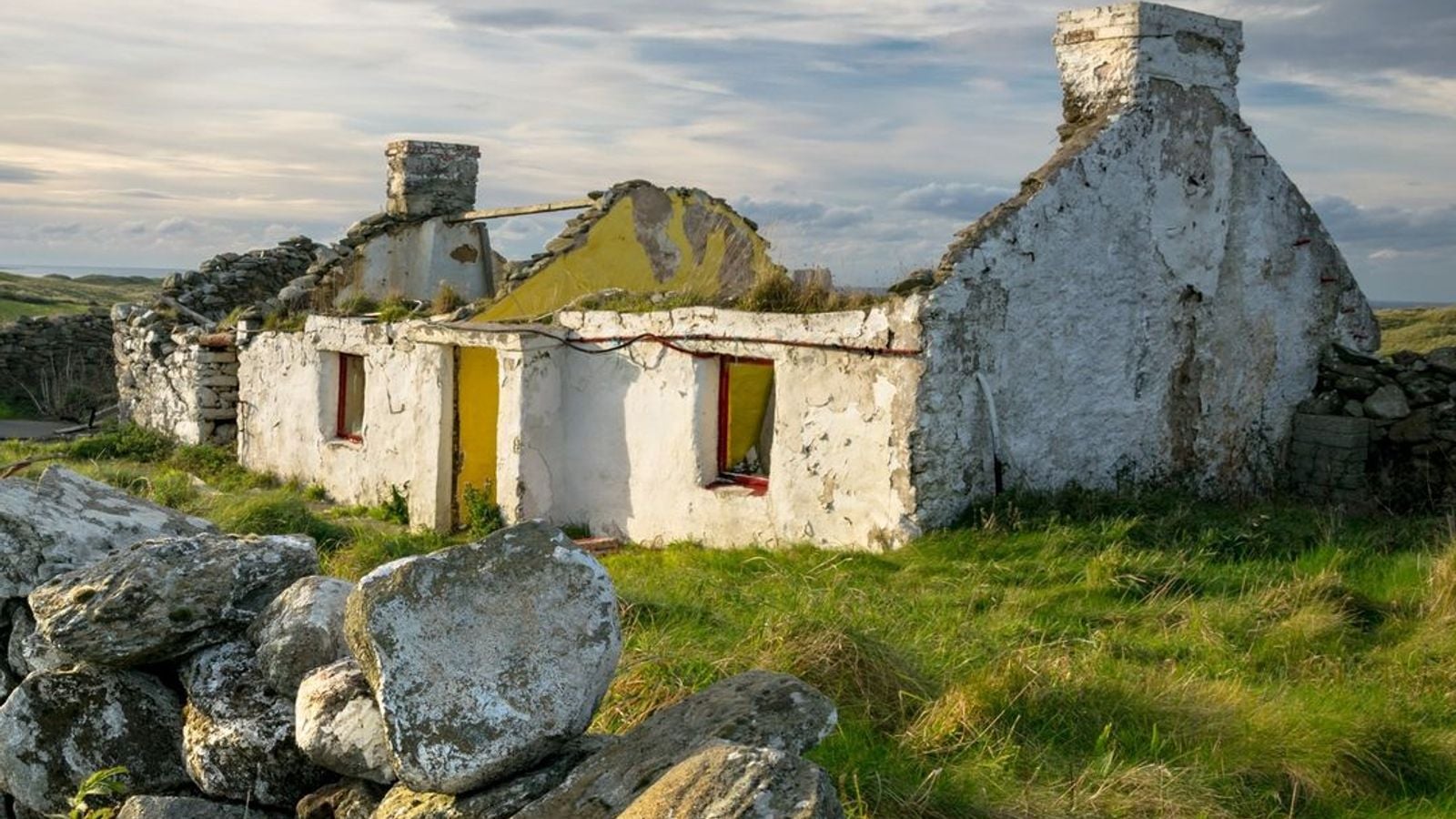
Pause on any hillside in Ireland — Kerry, Mayo, Donegal, anywhere along the western seaboard — and look beyond the bracken. Stone walls trail through the grass. A doorway stands without a door. A chimney rises with no roof. These are not random relics. They were homes. Many of them were abandoned in a single generation and never reoccupied.
Ireland has thousands of abandoned settlements. Most visitors never notice them.
The Villages That Emptied in a Generation
In the years between 1845 and 1852, Ireland lost roughly a quarter of its population. One million people died from starvation and disease. Another million emigrated during those seven years, with millions more to follow.
The communities they left behind didn’t disappear gradually. A townland that housed 80 or 90 people could be cleared — through death, eviction, or emigration — inside a single decade. Entire clusters of families simply vanished.
The walls stayed. The doors rotted. The thatched roofs collapsed. But the stone frames remained, on hillsides, down boithrins, in the middle of fields. You can walk through the doorway of a cottage abandoned 175 years ago and the walls are still chest-high.
What a Townland Once Meant
Ireland is divided into roughly 61,000 townlands — small parcels of land, each with its own name and history. A townland wasn’t simply an address. It was a community: families working shared ground, lending tools, gathering for weddings and wakes, raising children who knew every stone.
Each townland name carries meaning. Baile (settlement), Cill (church), Dun (fort), Gleann (valley). The names are still on the maps today, even when the people are long gone.
Standing in one, you are standing inside someone’s entire world. There are no entrance fees, no interpretive signs, no rope barriers. Just the walls and the wind.
Ireland’s Most Haunting Ghost Villages
The best-known is Slievemore on Achill Island in Co. Mayo. More than 100 stone cottages stretch in rows up the mountain slope, intact enough to trace every room. The village was mostly abandoned during the Famine years and never resettled.
A trip to County Mayo will bring you within reach of Slievemore — and the silence up that slope is unlike anywhere else in Ireland.
There are others across every province. Ruined settlements along the Beara Peninsula in Cork. The deserted village at Glencolmcille in Donegal. The scattered stone remains along the Ox Mountains in Sligo. Most carry no signposts. They are simply there.
Enjoying this? 64,000+ Ireland lovers get stories like this every week. Subscribe free
Why the Walls Still Stand
Irish dry stone walls — no mortar, just carefully chosen and balanced stone — can last for centuries without repair. The technique locks each stone against its neighbours through weight and friction. Properly built, the wall moves slightly in frost and holds.
This is why ruins from 200 or 300 years ago remain structurally legible. You can trace the floorplan of a cottage, identify the kitchen hearth, see where a bed might have stood. The walls become a kind of map of a life once lived.
There is also a quiet tradition in rural Ireland: you do not take stones from a ruined home. The house is someone’s, still. Removing the stones would be a form of erasure that feels wrong to many locals. So the walls stay, slowly greening over with moss and ivy.
The Hearth at the Centre
In any abandoned Irish cottage, the fireplace is usually the last element standing. The thatch goes first. The wooden fittings rot. The window frames disappear. But the hearth — the only masonry element with real mass — tends to hold.
This matters because that hearth fire was central to everything in an Irish home. It heated the house, cooked the food, dried the clothes. In many homes it was kept burning for generations, never fully extinguished.
Standing in a roofless ruin before a cold hearth open to the sky is one of the most unexpectedly affecting experiences in Ireland. No theatrical staging required. The space does the work.
How to Find Them
The ruins are everywhere across the western half of Ireland. The Deserted Village trail on Achill Island is a marked walk through Slievemore. The Dingle Peninsula has several ruins visible from the road. The Beara Way long-distance walk passes former settlements on both sides of the peninsula.
If you are planning a trip to Ireland, build in time to slow down. Some of the most powerful moments in the country do not happen at heritage sites. They happen on hillsides, when you stop and look carefully at what has been standing there all along.
There is something quietly devastating about a roofless Irish cottage. The doorway is exactly human height. The hearth is exactly where a family would have gathered. Someone built this with their hands. Someone left it knowing they would not return.
When you find one on an Irish hillside, stop for a moment. That silence has a name. It is written on every OS map. It is still there, waiting to be read.
☘️ You Might Also Love
Join 64,000+ Ireland Lovers
Every Friday, get Ireland’s hidden gems, local secrets, and travel inspiration — the kind you won’t find in any guidebook.
Free forever – – Unsubscribe anytime
Tours & experiences you might love


Powered by Viator. Some links are affiliate links — we may earn a small commission at no extra cost to you.
Secure Your Dream Irish Experience Before It’s Gone!
Planning a trip to Ireland? Don’t let sold-out tours or packed attractions spoil your journey. Iconic experiences like visiting the Cliffs of Moher, exploring the Rock of Cashel, or enjoying a guided walk through Ireland’s ancient past often sell out quickly—especially during peak travel seasons.

Booking in advance guarantees your place and ensures you can fully immerse yourself in the rich culture and breathtaking scenery without stress or disappointment. You’ll also free up time to explore Ireland’s hidden gems and savour those authentic moments that make your trip truly special.
Make the most of your journey—start planning today and secure those must-do experiences before they’re gone!