

Twelve kilometres off the coast of Kerry, a jagged rock rises from the Atlantic. It has no shelter. No trees. No fresh water worth speaking of. And for 600 years, Irish monks called it home.
A Rock at the Edge of the Known World
Sceilig Mhichíl — Skellig Michael — sits at Ireland’s furthest Atlantic edge. Its name means Michael’s Rock, after the Archangel Michael, who in early Christian tradition stood guard at the threshold between worlds.
Irish monks arrived here sometime in the 6th century, led by St Fionán. Nobody knows the exact year. Nobody knows exactly what drew them to this particular rock above all others along the Kerry coast.
But in early Christian Ireland, remoteness was not a hardship. It was the point. The further a monk could get from the noise of the world, the closer he believed he could get to God. And Skellig Michael, with open ocean on every side, was about as far as you could go.
What They Built Without Mortar
Reaching the monastery means climbing 618 stone steps cut directly into the cliff face. They wind upwards, steep and narrow, from the landing platform to a small plateau near the summit — 218 metres above the sea.
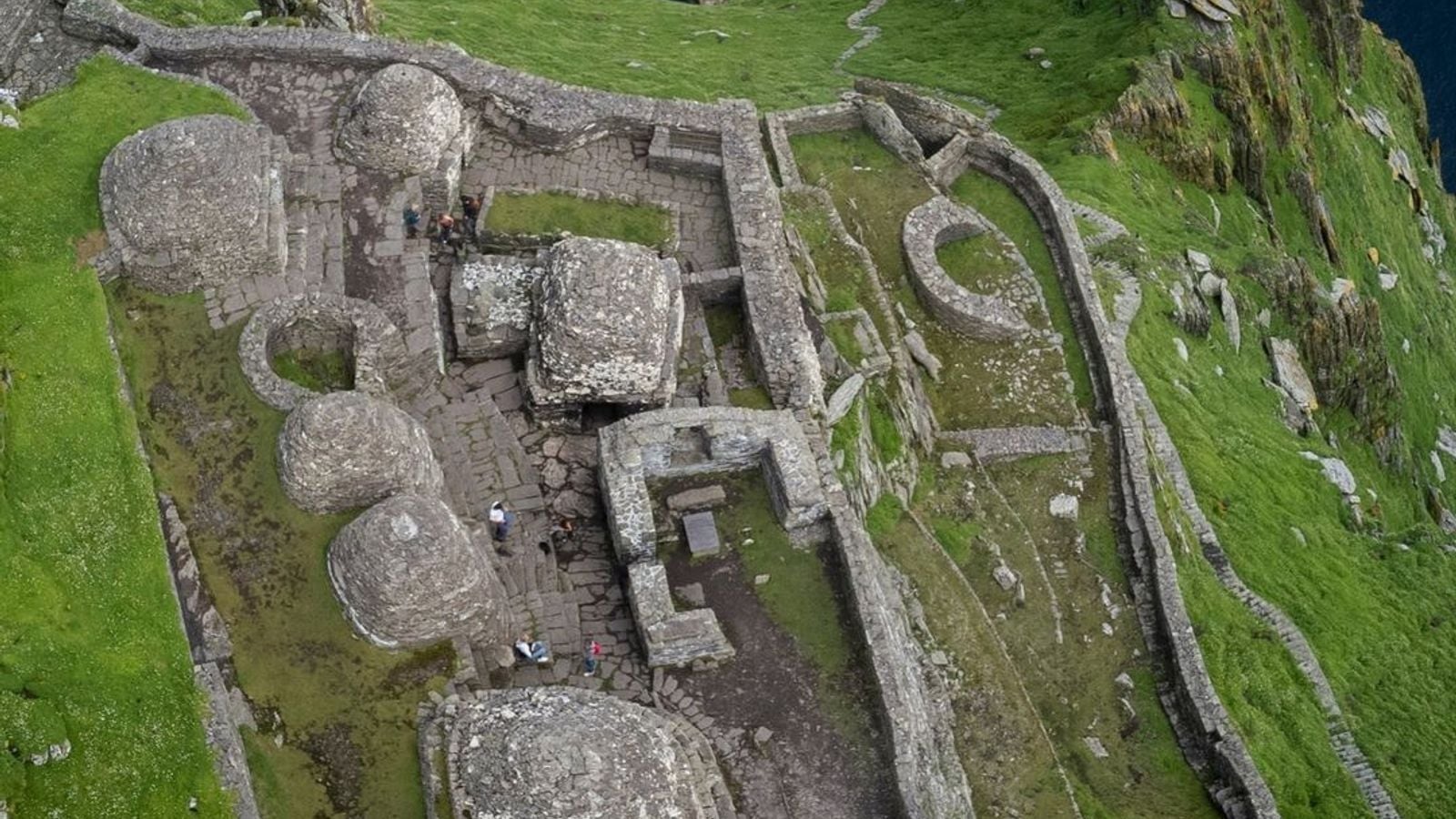
At the top: six dry-stone beehive huts known as clocháns. Two small oratories. A graveyard. All of it built without a single drop of mortar — each stone locked into place by weight, angle, and precision alone.
These buildings have stood for over 1,400 years. They remain watertight. They have survived Atlantic gales, centuries of abandonment, and the kind of winters that would flatten most modern structures. Engineers who have studied them still cannot fully explain how the monks achieved this.
Ireland is full of evidence of its ancient builders. Ireland’s mysterious round towers were built by the same monastic tradition — and experts still debate what they were truly built for.
A Life of Radical Simplicity
The community on the Skellig was small — probably no more than twelve or thirteen monks at any time.
They fished. They kept small garden terraces on the rock’s slopes. They collected eggs from the seabirds that nested in thousands along the cliffs. They prayed at fixed hours through the day and night. They copied manuscripts. And in the long, dark winters, with the Atlantic crashing against the base of the rock far below, they stayed.
There was no leaving when the weather turned. For weeks at a time in winter, no boat could make the 12-kilometre crossing from the mainland. Skellig Michael in January is a different world entirely from the island that summer visitors see.
☘️ Enjoying this? 64,000+ Ireland lovers get stories like this every weekday morning. Subscribe free →
The Vikings Came — and the Monks Stayed
Ireland in the 9th century was not a peaceful place. Norse raiders struck the coastline repeatedly, taking treasure, livestock, and people.
Skellig Michael was attacked more than once. In 812 AD, Abbot Étgal was seized and died in captivity. The monastery was struck again in 823 AD. The monks who survived had every reason to leave permanently.
They came back. They continued their life on this exposed rock for another three centuries after those raids — praying, fishing, enduring whatever the Atlantic threw at them.
By around 1100 to 1200 AD, the community finally moved to a new monastery at Ballinskelligs on the Kerry mainland. The climate may have worsened. The sea crossing may have become too dangerous for regular supply. Whatever the reason, they went. But Skellig Michael did not cease to be a place of pilgrimage. Medieval visitors continued to make the crossing long after the monks were gone.
What Skellig Michael Is Like Today
Skellig Michael has been a UNESCO World Heritage Site since 1996. Access is strictly controlled. A small number of licensed boats make the crossing from Portmagee or Ballinskelligs Pier between roughly May and early October, all subject to weather.
Some days, no boats go. The Atlantic decides.
Those who land face the 618 steps on foot. There are no handrails for much of the ascent. The path is ancient and uneven. At the top, something happens to almost everyone who makes it.
The silence is different up there. The ocean stretches in every direction to the horizon. Thousands of Atlantic puffins nest in burrows along the cliff edge — vivid, unhurried, and completely unbothered by visitors picking their way carefully past.
The beehive huts stand exactly as the monks left them. You can walk inside. You can crouch in the low doorway and look out across the same ocean those men looked out across every single day of their adult lives.
Modern visitors may also recognise the island from Star Wars: The Force Awakens (2015) and The Last Jedi (2017), where its beehive huts became Luke Skywalker’s remote hideaway — a detail that still surprises people who come for the monastic history and leave talking about Jedi training.
Skellig Michael sits off the Iveragh Peninsula, south-west of Killarney. If you are planning a trip to Kerry, the complete guide to Killarney is the best starting point. For a broader Ireland trip, the Ireland travel planning hub covers everything you need. For the fuller picture of the island — its UNESCO status, the climb, and practical visiting details — see our complete Skellig Michael guide.
There are places in Ireland that simply stop you. Skellig Michael is one of them.
Thirteen centuries of silence, stone, and salt wind. No café at the top. No queue. No phone signal. Just the monks’ world, left exactly as they left it — and the endless Atlantic beyond.
☘️ You Might Also Love
☘️ Join 64,000+ Ireland Lovers
Every Friday, get Ireland’s hidden gems, local secrets, and travel inspiration — the kind you won’t find in any guidebook.
Free forever · Unsubscribe anytime
Tours & experiences you might love


Powered by Viator. Some links are affiliate links — we may earn a small commission at no extra cost to you.
Secure Your Dream Irish Experience Before It’s Gone!
Planning a trip to Ireland? Don’t let sold-out tours or packed attractions spoil your journey. Iconic experiences like visiting the Cliffs of Moher, exploring the Rock of Cashel, or enjoying a guided walk through Ireland’s ancient past often sell out quickly—especially during peak travel seasons.

Booking in advance guarantees your place and ensures you can fully immerse yourself in the rich culture and breathtaking scenery without stress or disappointment. You’ll also free up time to explore Ireland’s hidden gems and savour those authentic moments that make your trip truly special.
Make the most of your journey—start planning today and secure those must-do experiences before they’re gone!