

There is an old saying in Ireland: it takes 21 years to learn the uilleann pipes. Seven years to learn the instrument, seven to practise it, and seven to play it. Most musicians hear this and laugh. Then they try to pick one up.
Not the Pipes You Are Thinking Of
If you have ever heard Highland bagpipes at a Scottish wedding or festival, the uilleann pipes will catch you completely off guard.
They do not wail. They murmur.
Where Highland pipes project sound across an open hillside, uilleann pipes were made for smaller, warmer spaces — a firelit kitchen, a back room in a pub, a hushed gathering after dark. The name comes from the Irish word uillinn, meaning elbow. The air does not come from the lungs. It comes from a small bellows pumped by the right forearm, pushing air into a bag tucked under the left arm.
You never run out of breath. You can keep playing — and talking, and smiling — for as long as your arm holds out.
One Instrument, Three Voices
What makes the uilleann pipes genuinely extraordinary is not just the chanter — the melody pipe every set of bagpipes has. It is what surrounds it.
Alongside the chanter run three drones: long pipes that produce a constant, resonant bass note beneath the melody. That low hum is the sound most people recognise from recordings — a deep, ancient pulse under the tune.
Below the drones lie the regulators. These are keyed pipes that a skilled player taps with the wrist and heel of the right hand to produce chords, all while the melody plays at the same time.
Chanter. Drones. Regulators. Three separate musical systems, played simultaneously, by one person, sitting down. It is unlike anything else in Irish music.
Why Sitting Down Matters
The uilleann pipes are always played seated — and this is not coincidence. It is engineering.
The bottom of the chanter rests against the player’s knee. Pressing it closed changes the sound of the lowest note, enabling a technique called closed fingering that gives pipers precise control over how each note begins and ends. The result is a melodic flexibility that lets players ornament a tune in ways that even fiddle players quietly envy.
That expressiveness gives uilleann pipe music its particular quality — a gentleness that can still carry enormous weight. A slow air does not fill a room; it fills the air inside it.
If you are planning a trip to Ireland, hearing the pipes live at a traditional session is one of the most unforgettable experiences you can have.
☘️ Enjoying this? 64,000+ Ireland lovers get stories like this every week. Subscribe free →
The 21 Years
The old saying is not a discouragement. It is a description of what learning the uilleann pipes actually looks like.
The first years are spent on the chanter alone — finding the notes, controlling the air pressure, navigating a scale that can jump an octave depending on how firmly the bellows is squeezed. Drones are added later, once the chanter is steady. Regulators come last, when the hands have learned to work independently enough that one can play melody while the other taps chord keys.
Even experienced musicians from other traditions — fiddle players, flute players, even bodhrán players — describe starting the pipes as beginning again from nothing. The coordination required is simply different from anything else.
How the Pipes Nearly Vanished — and Were Saved
By the early 20th century, the number of active uilleann pipers had fallen to a handful of elderly men, mostly in Munster and Connacht. The instrument was on the edge of disappearing entirely.
What saved it was people who cared too much to let it go.
Leo Rowsome, a Dublin pipemaker and teacher, trained a new generation in the 1930s and 40s. Willie Clancy — a Clare man of extraordinary talent — brought the music to a wider audience. When he died in 1973, the annual Willie Clancy Summer School was founded in his hometown of Miltown Malbay. Every July, thousands of musicians gather there for a week that has become one of the finest traditional music events in the world.
Na Píobairí Uilleann, the pipers’ association founded in Dublin in 1968, has been teaching, archiving, and promoting the instrument ever since. Today there are more active uilleann pipers than at any point in recorded history — in Ireland, in America, in Australia, in Japan.
The instrument that once nearly went silent has never sounded louder.
Where to Hear the Uilleann Pipes
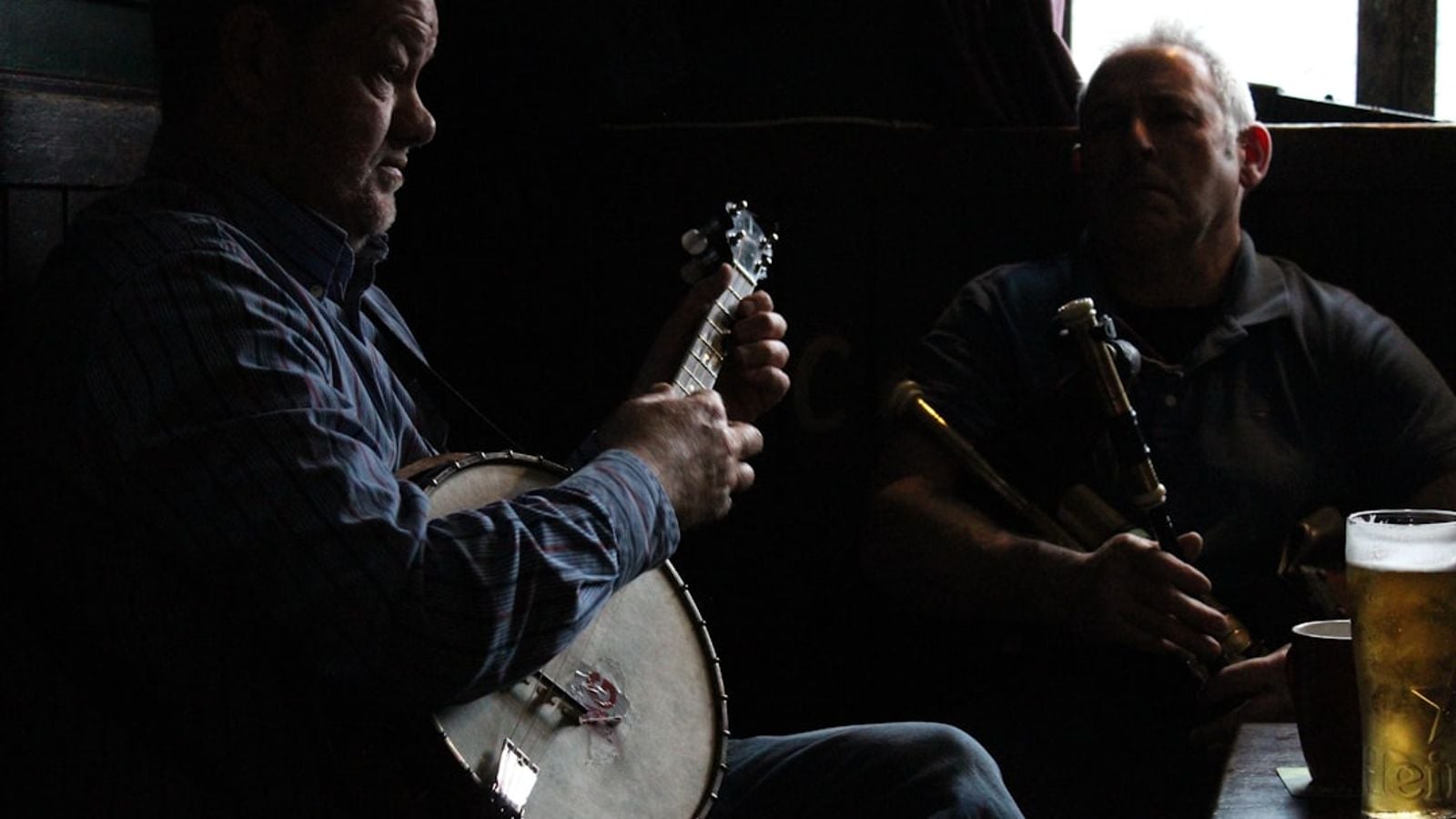
The best place to hear them is a traditional session at a small Irish pub. County Clare is a particularly good region — it has been a heartland of pipe music for generations, and the instrument turns up regularly in pubs around Miltown Malbay, Kilfenora, and Ennistymon.
The Willie Clancy Summer School (held each July in Miltown Malbay) draws some of the finest players alive. Na Píobairí Uilleann in Dublin runs workshops, concerts, and open sessions throughout the year for anyone who wants to get closer to the music.
If you do hear them live — in a small room, on a dark evening, with the drones settling into that low, resonant hum — you will understand why nobody who has ever loved the uilleann pipes has ever been able to leave them entirely alone.
Watch the player’s hands. Left hand on the chanter, right wrist hovering over the regulators, elbow working the bellows below. It looks calm. It looks almost effortless.
It took 21 years to get there.
☘️ You Might Also Love
Frequently Asked Questions
Why is this tradition still relevant in Ireland today?
The uilleann pipes remain central to Irish traditional music today. Na Píobairí Uilleann, the pipers’ association founded in Dublin in 1968, has spent decades teaching, archiving, and promoting the instrument, and there are more active uilleann pipers now than at any point in recorded history — playing everywhere from small pub sessions in County Clare to concert stages worldwide.
How far back does this Irish tradition or practice date?
The uilleann pipes have deep roots in Irish music, but by the early 20th century the tradition had nearly died out, with only a handful of pipers still playing. Dublin pipemaker and teacher Leo Rowsome trained a new generation through the 1930s and 40s, and Clare piper Willie Clancy helped bring the music to a wider audience before his death in 1973, the same year the Willie Clancy Summer School was founded in Miltown Malbay in his honour.
Where can visitors experience authentic Irish culture and traditions?
The best place to hear the uilleann pipes live is a traditional session in a small Irish pub. County Clare — especially around Miltown Malbay, Kilfenora, and Ennistymon — has been a heartland of pipe music for generations. The Willie Clancy Summer School, held every July in Miltown Malbay, draws some of the finest players alive, and Na Píobairí Uilleann in Dublin runs workshops, concerts, and open sessions throughout the year.
Do Irish diaspora communities around the world still practice these traditions?
Yes — the uilleann pipes are played well beyond Ireland today, with active pipers in Ireland, America, Australia, and Japan. Na Píobairí Uilleann and community piping groups support learners internationally, and the instrument now has more players worldwide than at any point in its recorded history.
☘️ Join 64,000+ Ireland Lovers
Every Friday, get Ireland’s hidden gems, local secrets, and travel inspiration — the kind you won’t find in any guidebook.
Subscribe free — enter your email:
Free forever · · Unsubscribe anytime
Tours & experiences you might love


Powered by Viator. Some links are affiliate links — we may earn a small commission at no extra cost to you.
Secure Your Dream Irish Experience Before It’s Gone!
Planning a trip to Ireland? Don’t let sold-out tours or packed attractions spoil your journey. Iconic experiences like visiting the Cliffs of Moher, exploring the Rock of Cashel, or enjoying a guided walk through Ireland’s ancient past often sell out quickly—especially during peak travel seasons.

Booking in advance guarantees your place and ensures you can fully immerse yourself in the rich culture and breathtaking scenery without stress or disappointment. You’ll also free up time to explore Ireland’s hidden gems and savour those authentic moments that make your trip truly special.
Make the most of your journey—start planning today and secure those must-do experiences before they’re gone!
Subscribe Free