

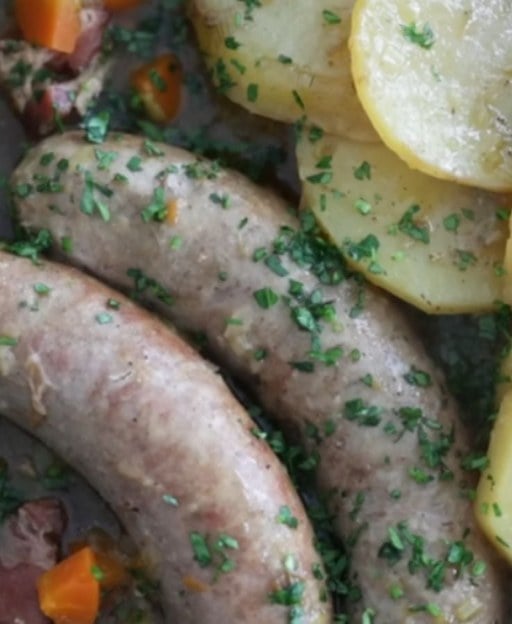
If there is one dish that belongs entirely and unapologetically to Dublin, it is coddle. While Ireland has no shortage of beloved comfort foods, Dublin Coddle holds a particular place in the city’s heart — a humble, nourishing pot of sausages, back rashers, potatoes and onions, slow-cooked together until everything melds into something far greater than the sum of its parts. It is a dish born of thrift and practicality, a way of stretching whatever was left in the larder towards the end of the week, and it has been feeding Dubliners in tenements, terraced houses and family kitchens for more than two centuries.
Coddle is generally traced to the 18th century, when it became deeply woven into the fabric of working-class Dublin life. It was particularly associated with Saturday nights, a way of using up the week’s leftover rashers and sausages. The dish is also reputedly a favourite of some of Dublin’s best-known literary figures: Jonathan Swift is said to have been fond of it, Seán O’Casey is said to have referred to it, and it appears in references to Dublin in James Joyce’s writing. That kind of cultural staying power tells you everything you need to know about how seriously Dubliners take their coddle.
What makes coddle distinctive — and what occasionally surprises visitors — is that it is not browned or roasted. Everything is layered and gently simmered together in water or stock, producing a pale, brothily savoury pot rather than a richly coloured stew. That simplicity is the whole point. The starch from the potatoes thickens the liquor, the fat from the sausages and rashers seasons it, and the long, slow cook does the rest. Every family has their own version — some add a splash of stout, some add barley — but the recipe below is as traditional and unfussy as it gets.
Ingredients
Serves 4
- 8 good-quality pork sausages (about 450g / 1lb)
- 200g (7oz) smoked back rashers (bacon), roughly chopped
- 900g (2lb) floury potatoes, such as Roosters or Kerr’s Pinks, peeled and thickly sliced
- 3 medium onions, peeled and thickly sliced
- 500ml (18fl oz) good chicken or ham stock (or water)
- A generous handful of fresh flat-leaf parsley, roughly chopped
- Salt and freshly ground black pepper
- Crusty white bread, to serve
Method
- Preheat your oven to 160°C / 140°C fan / Gas Mark 3 (325°F).
- Place the sausages and chopped rashers into a large saucepan and cover with cold water. Bring to the boil over a medium-high heat and blanch for 3–4 minutes. Drain and set aside. This step removes excess fat and keeps the final broth clean and well-seasoned rather than greasy.
- In a large, heavy-based casserole dish or oven-safe pot with a lid, begin layering your ingredients. Start with half the sliced onions on the bottom, followed by half the potatoes, then the blanched sausages and rashers. Add the remaining onions and finish with the remaining potatoes on top.
- Season each layer generously with salt and freshly ground black pepper as you go, and scatter over most of the parsley, reserving a little for serving.
- Pour over the stock, ensuring the liquid comes roughly three-quarters of the way up the pot — you want the top layer of potatoes to sit just above the liquid so they steam and become fluffy rather than waterlogged.
- Place a piece of greaseproof paper directly on top of the contents before fitting the lid. This helps retain moisture and keeps everything cooking evenly.
- Transfer the covered pot to the preheated oven and cook for 1 hour 30 minutes to 2 hours, until the potatoes are completely tender and the broth is lightly thickened and deeply savoury. Check once or twice during cooking and add a splash more stock or water if needed.
- Ladle into deep bowls, scatter over the reserved fresh parsley, and serve immediately with thick slices of crusty white bread to mop up the wonderful broth.
Tips
- Choose floury potatoes. Waxy varieties will hold their shape but won’t break down into the broth the way a floury potato will, and it is that gentle thickening that makes coddle so satisfying.
- Don’t skip the blanching step. It takes only a few minutes but makes a real difference to the clarity and flavour of the finished broth.
- Quality sausages matter. Use the best butcher’s pork sausages you can find — good fat content and seasoning will carry the whole dish.
- Leftovers are even better. Like many slow-cooked dishes, coddle improves overnight as the flavours deepen. Reheat gently with a splash of water to loosen.
- Some Dubliners add stout. A splash of Guinness in the stock is not traditional to every household, but if you fancy it, replace about 100ml of stock with stout for a slightly richer, more complex broth.
Further Reading on Dublin Coddle
Want the story behind the pot? Read why Dublin workers left a pot on the stove every Saturday night, or find out where you can still find coddle in Dublin. For the literary connections, see the Saturday-night dish and its literary fans, and for the pub tradition, the forgotten pub food that disappeared from Irish bars. Looking for another take on the same dish? Our traditional Dublin coddle recipe covers the same ground.
There is something genuinely moving about sitting down to a bowl of Dublin Coddle on a cold evening — knowing that for generations, Dubliners have done exactly the same thing, in the same city, with the same simple, honest ingredients. It is not a dish that tries to impress; it simply nourishes, comforts, and satisfies in the way that only the most deeply rooted recipes ever do. Make it once, and you will completely understand why this city has never needed anything fancier.
Tours & experiences you might love


Powered by Viator. Some links are affiliate links — we may earn a small commission at no extra cost to you.
Secure Your Dream Irish Experience Before It’s Gone!
Planning a trip to Ireland? Don’t let sold-out tours or packed attractions spoil your journey. Iconic experiences like visiting the Cliffs of Moher, exploring the Rock of Cashel, or enjoying a guided walk through Ireland’s ancient past often sell out quickly—especially during peak travel seasons.

Booking in advance guarantees your place and ensures you can fully immerse yourself in the rich culture and breathtaking scenery without stress or disappointment. You’ll also free up time to explore Ireland’s hidden gems and savour those authentic moments that make your trip truly special.
Make the most of your journey—start planning today and secure those must-do experiences before they’re gone!