

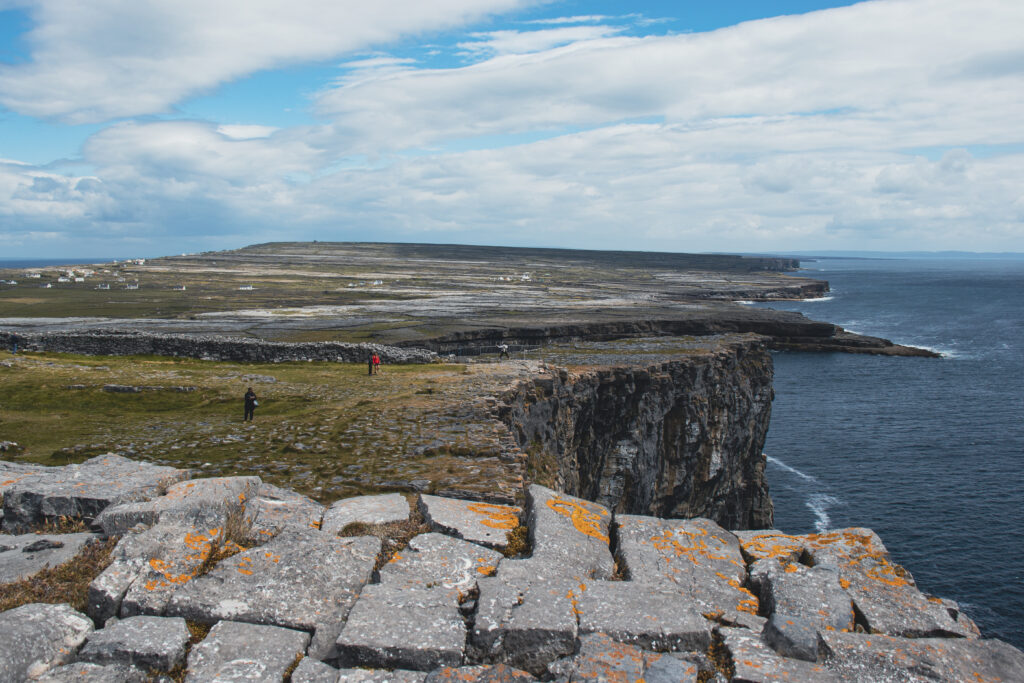
Stand at the edge of Dún Aonghasa and the Atlantic opens beneath you — a 100-metre drop, straight down. Three thousand years ago, someone built a massive stone fortress right here on Inis Mór. They built three walls. But they left one side completely open to the cliff.
Nobody has ever fully explained why.
What Is Dún Aonghasa?
Dún Aonghasa (pronounced “doon ENG-uh-shuh”) sits on the south-western tip of Inis Mór, the largest of the Aran Islands off the coast of County Galway. Archaeologists date it to around 1100 BC, placing its origins firmly in the Bronze Age.
It is one of the oldest stone forts in Europe. Three concentric D-shaped walls wrap around a central enclosure roughly 50 metres wide. The innermost wall stands four metres high in places and required an extraordinary communal effort to build.
But the sea-facing side has no wall at all. The fort simply ends — at the edge of a sheer cliff.
The Wall That Isn’t There
The obvious question is whether the missing wall fell into the sea over three millennia. Geologists have examined the cliffs. They found no evidence of collapse on the scale needed to explain a missing fortification. The cliff edge shows no signs of major displacement.
The current thinking among archaeologists is that the open cliff side was deliberate. The sheer drop was the wall. A 100-metre vertical cliff needs no masonry to keep enemies out.
But that raises a deeper question. Why build here at all — on the windiest, most exposed point of an island already surrounded by the Atlantic?
The Iron Spikes Around It
What makes Dún Aonghasa stranger still is what surrounds the outer wall. A band of pointed limestone pillars stands upright in the ground, set close together and angled outward. Archaeologists call this a chevaux-de-frise — a defensive barrier designed to slow or stop any ground assault.
You can walk through these stones today. They stretch for dozens of metres in each direction. The effort involved in placing each one suggests this was no casual outpost. Someone was very determined to defend this place.
Yet no human remains from a battle have ever been found inside. No weapons. No signs of a siege or violent occupation.
☘️ Enjoying this? 64,000+ Ireland lovers get stories like this every week. Subscribe free →
What Archaeologists Think — and Don’t Know
The honest answer is: no one is certain what Dún Aonghasa was for. A fortress is the obvious reading, but some researchers argue it was a ritual site. The placement at the cliff’s edge — dramatic, liminal, between land and ocean — fits the pattern of sacred spaces in early Irish culture.
Others believe it could have been both. Early Irish societies did not always separate the sacred from the defensive. A place that kept enemies out might also be where you communed with what lay beyond the horizon.
The Aran Islands held deep significance in early Christian Ireland. Enda of Aran founded a monastery on Inis Mór in the 5th century, and the island became a centre of pilgrimage. Whether Dún Aonghasa carried spiritual weight long before that, we can only speculate.
How to Visit Dún Aonghasa
Inis Mór is reached by ferry from Rossaveal in County Galway or from Doolin in County Clare. The crossing takes between 30 and 45 minutes. Ferries run year-round, though schedules reduce in winter.
From the main village of Kilronan, it is a 40-minute cycle or a short minibus ride to the base of the fort. A paved path then climbs steeply to the entrance. There is no railing at the cliff edge. You can stand right at the lip if you choose, though most visitors sit back and take it in from a safer distance.
If you are planning a wider Irish trip, the Free Ireland Travel Planner covers the best ways to include the Aran Islands in your itinerary. While you are on Inis Mór, look for Aran jumpers in the village — the patterns stitched into each one carry centuries of meaning that most visitors never notice.
There is no other place in Ireland quite like this. You stand on the same stones that Bronze Age people shaped by hand, looking out at the same ocean they faced. Three thousand years of Atlantic weather have done almost nothing to it.
Whoever built Dún Aonghasa left the sea wall out. Perhaps they understood that some things — the Atlantic, time, mystery — cannot be kept out no matter how high you build.
☘️ You Might Also Love
☘️ Join 64,000+ Ireland Lovers
Every Friday, get Ireland’s hidden gems, local secrets, and travel inspiration — the kind you won’t find in any guidebook.
Love more? Join 43,000 Scotland lovers → · Join 30,000 Italy lovers → · Join 7,000 France lovers →
Free forever · · Unsubscribe anytime
Tours & experiences you might love


Powered by Viator. Some links are affiliate links — we may earn a small commission at no extra cost to you.
Secure Your Dream Irish Experience Before It’s Gone!
Planning a trip to Ireland? Don’t let sold-out tours or packed attractions spoil your journey. Iconic experiences like visiting the Cliffs of Moher, exploring the Rock of Cashel, or enjoying a guided walk through Ireland’s ancient past often sell out quickly—especially during peak travel seasons.

Booking in advance guarantees your place and ensures you can fully immerse yourself in the rich culture and breathtaking scenery without stress or disappointment. You’ll also free up time to explore Ireland’s hidden gems and savour those authentic moments that make your trip truly special.
Make the most of your journey—start planning today and secure those must-do experiences before they’re gone!