

Step through the arched gateway at Jerpoint and you step out of the modern world entirely. The roofless nave stretches ahead of you. The sky fills the space where a ceiling once hung. And all around the cloister, carved from grey stone, the monks are still there — watching. They have been watching for eight hundred years.
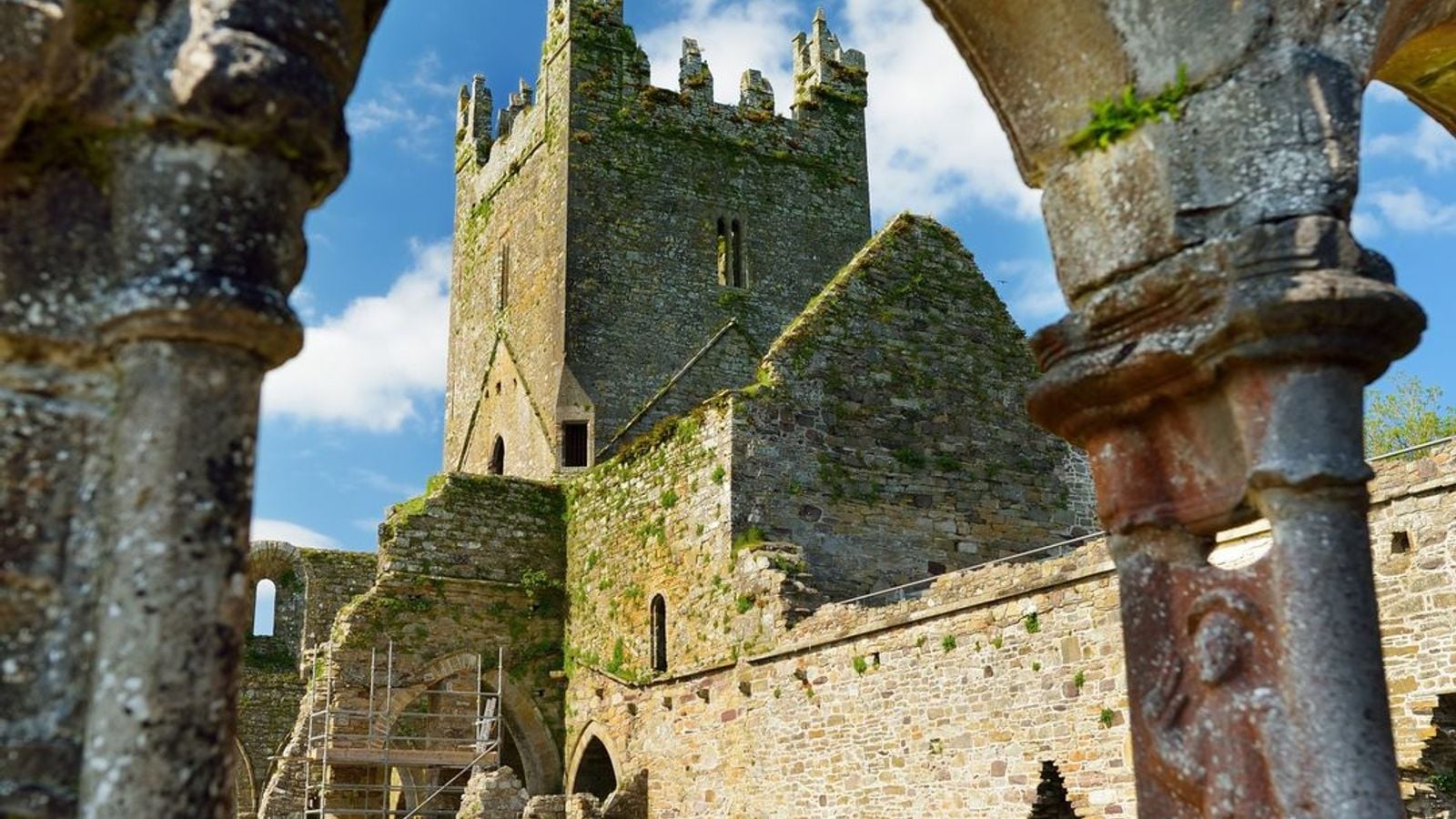
Jerpoint Abbey in County Kilkenny is one of Ireland’s finest medieval ruins. But it is not the kind of ruin that simply stands there looking old. Something about it demands attention. The carved figures on the cloister arcade are unlike anything else in Ireland — bishops clutching their staffs, knights with raised hands, serpents coiling around columns. Their makers are unknown. Their meaning is debated. But nobody who sees them forgets them.
The Kingdom That Built a Monastery
In 1160, the King of Ossory — a small Irish kingdom covering what is now County Kilkenny — made a decision that would shape this landscape for a thousand years. Donal Mac Gilla Pátraic gave a tract of land along the River Nore to a community of Benedictine monks from Kilkenny town.
By 1180, those monks had been replaced by Cistercians, brought from Baltinglass in County Wicklow. The Cistercians were the great builders of medieval Europe — disciplined, skilled in construction, and known for choosing river valleys for their abbeys.
They set to work immediately. Over the following century, the church, the square tower, the cloister, and the chapter house rose from the riverbank. Jerpoint became one of the most important religious houses in Leinster — a place of learning, prayer, and burial for the powerful families of the region.
The great Norman dynasty of Kilkenny, the Butlers, are buried here. So are bishops, abbots, and knights. Some of the finest medieval craftsmanship in Ireland was created within these walls, by hands that left no names behind.
The Carvings That Refuse to Be Explained
Walk around the cloister arcade and you find yourself in conversation with people who have been dead for five centuries. The carved figures decorating the columns at Jerpoint were created sometime in the 1400s, most likely by craftsmen from the nearby town of Callan. They are known today as the Callan School of sculpture, and they worked in a style entirely their own.
What they carved is extraordinary. Apostles with weathered faces. A bishop clutching his staff with an expression that looks almost irritated. A knight in full armour, one hand raised as if about to speak. Dragons and serpents twisted around the column shafts, their bodies knotted in elaborate patterns.
Unlike the abstract carvings found at most Irish medieval sites, these figures are intensely human. They have posture, personality, gesture. Each one is different. And because there are no written records identifying who carved them or why, they carry a mystery that no guidebook can quite dissolve.
Standing among them on a quiet morning, with river sounds drifting over the walls, it is easy to understand why some visitors find the place unsettling. The cloister at Jerpoint does not feel abandoned. It feels like something is still happening here, just beyond what the eye can catch.
A Knight Carved in Stone
The most striking object at Jerpoint is not in the cloister at all. It stands in the north transept of the ruined church: a seven-foot effigy of a Norman knight known as the Cantwell Fada — the “tall Cantwell” — carved in grey limestone, lying at full length with a small dog curled at his feet.
The Cantwells were a Norman family who arrived in Ireland after the twelfth-century invasion. The knight depicted is probably Thomas de Cantwell, who died sometime in the 1300s. His armour is carved in careful detail — the chain mail, the triangular shield, the great sword at his side.
The dog at his feet was a medieval symbol of loyalty. It is small and alert, as though still waiting for its master to rise.
There is also the tomb of Felix O’Dulany, Bishop of Ossory, dating to around 1202. His effigy is more worn, but the sense of individual presence remains. These are not generic medieval carvings. They are portraits of specific people, made when the memory of those people was still very much alive.
☘️ Enjoying this? 64,000+ Ireland lovers get stories like this every week. Subscribe free →
The Day the Monks Were Told to Leave
For nearly four hundred years, Jerpoint Abbey functioned exactly as intended — a place of prayer, scholarship, and community. Grain was grown in the surrounding fields. Pilgrims came to visit the famous shrine. The great families of Kilkenny continued to bring their dead here to be buried in the church.
Then, in 1540, the monastery was dissolved.
Henry VIII’s campaign to seize church properties across Ireland reached Jerpoint in that year. The monks were expelled. The buildings, lands, and revenues were handed to the Crown, and eventually passed to the Butler family of Ormond — the same dynasty whose ancestors lay buried in the church beside them.
The Butlers used the abbey as a private burial chapel for a few more decades. But without its monastic community, the buildings fell slowly silent. The roof was stripped. The windows emptied. The carved faces in the cloister watched over an abandoned courtyard.
What saved Jerpoint was neglect. Unlike many Irish abbeys that were deliberately torn down or turned into farm buildings, this one was largely left alone. Nobody stripped its stones. Nobody built houses over its graves. The carvings that the Callan craftsmen made were protected by chance, and they survived.
Visiting Jerpoint Abbey Today
Jerpoint Abbey is managed by the Office of Public Works and is open to visitors from spring through autumn. It sits just outside the village of Thomastown in County Kilkenny, about ninety minutes from Dublin and well within reach of a day trip from Kilkenny city.
The experience is quiet in a way that larger heritage sites rarely manage. There are no crowds pressing around you. The site guides know their subject well and are worth talking to — particularly about the cloister figures, which have more going on than they first appear.
Walk the full cloister arcade slowly. Give each carved figure time. Look at the expressions, the gestures, the details — the worn fingers, the angle of a bishop’s foot, the knotted tail of a serpent. These were made with intention, by skilled hands working for specific reasons, and some of those reasons are still being worked out by historians today.
County Kilkenny has more to offer than most visitors realise. From the medieval streets of Kilkenny city to the many castles scattered across the county’s farmland, this is a region that rewards slow travel. You’ll find a full guide in our County Kilkenny guide. And if you’re still in the early stages of planning your trip, our planning hub is the best place to start.
The carved monks of Jerpoint have been watching over the dead for eight hundred years. They have seen the last abbot walk away. They have seen the seasons turn and the stones darken with rain and moss and time.
They are still watching. And if you give them long enough, you’ll feel it — that something remarkable happened here, and that it hasn’t entirely ended.
☘️ You Might Also Love
☘️ Join 64,000+ Ireland Lovers
Every Friday, get Ireland’s hidden gems, local secrets, and travel inspiration — the kind you won’t find in any guidebook.
Love more? Join 43,000 Scotland lovers → · Join 30,000 Italy lovers → · Join 7,000 France lovers →
Free forever · · Unsubscribe anytime
☘️ Want More Hidden Ireland?
Join 64,000+ subscribers who discover Ireland’s best-kept secrets every week.
Subscribe Free — Join the Community →
Free forever · Unsubscribe anytime · No spam
📥 Free Download: Ireland Travel Planning Guide
Our most popular resource — itineraries, insider tips, and the 50 places you must not miss.
Tours & experiences you might love


Powered by Viator. Some links are affiliate links — we may earn a small commission at no extra cost to you.
Secure Your Dream Irish Experience Before It’s Gone!
Planning a trip to Ireland? Don’t let sold-out tours or packed attractions spoil your journey. Iconic experiences like visiting the Cliffs of Moher, exploring the Rock of Cashel, or enjoying a guided walk through Ireland’s ancient past often sell out quickly—especially during peak travel seasons.

Booking in advance guarantees your place and ensures you can fully immerse yourself in the rich culture and breathtaking scenery without stress or disappointment. You’ll also free up time to explore Ireland’s hidden gems and savour those authentic moments that make your trip truly special.
Make the most of your journey—start planning today and secure those must-do experiences before they’re gone!