

Every spring in old Ireland, something remarkable happened in local newspapers across Kerry, Clare, and Cork. A list appeared. And if your name was on it, everyone in the parish knew your business before Sunday Mass.
The Skellig List was one of the most unusual traditions in Irish folk culture — funny, cutting, and entirely made up. But that never stopped anyone from printing it, reading it, or finding their own name somewhere near the bottom of the page.
What Was the Skellig List?
During Lent, Catholic tradition in Ireland forbade weddings. Shrove Tuesday — the day before Ash Wednesday — was the last chance to marry until Easter, six long weeks away. Most engaged couples raced to beat that deadline. But every year, some didn’t make it in time, and their neighbours noticed.
Each spring, newspapers across the south and west of Ireland published the Skellig List — a mock register naming every unmarried man and woman who had missed the Shrove Tuesday deadline, supposedly bound for Skellig Michael, a remote island seven miles off the Kerry coast, for one last chance at a wedding.
The reason for sailing there? Skellig Michael was said to run on the Old Julian calendar rather than the Gregorian calendar the rest of Ireland adopted in 1752 — which meant Lent supposedly began there nearly two weeks later than on the mainland. In theory, a couple who’d missed the mainland deadline could still slip in a wedding on the island before its own Lent began.
In practice, the Atlantic in early spring is not a place for romantic boat trips. No one was actually going anywhere. The whole enterprise was a joke — and the joke was always at the expense of whichever bachelors and spinsters appeared on the list that year.
Why Skellig Michael?
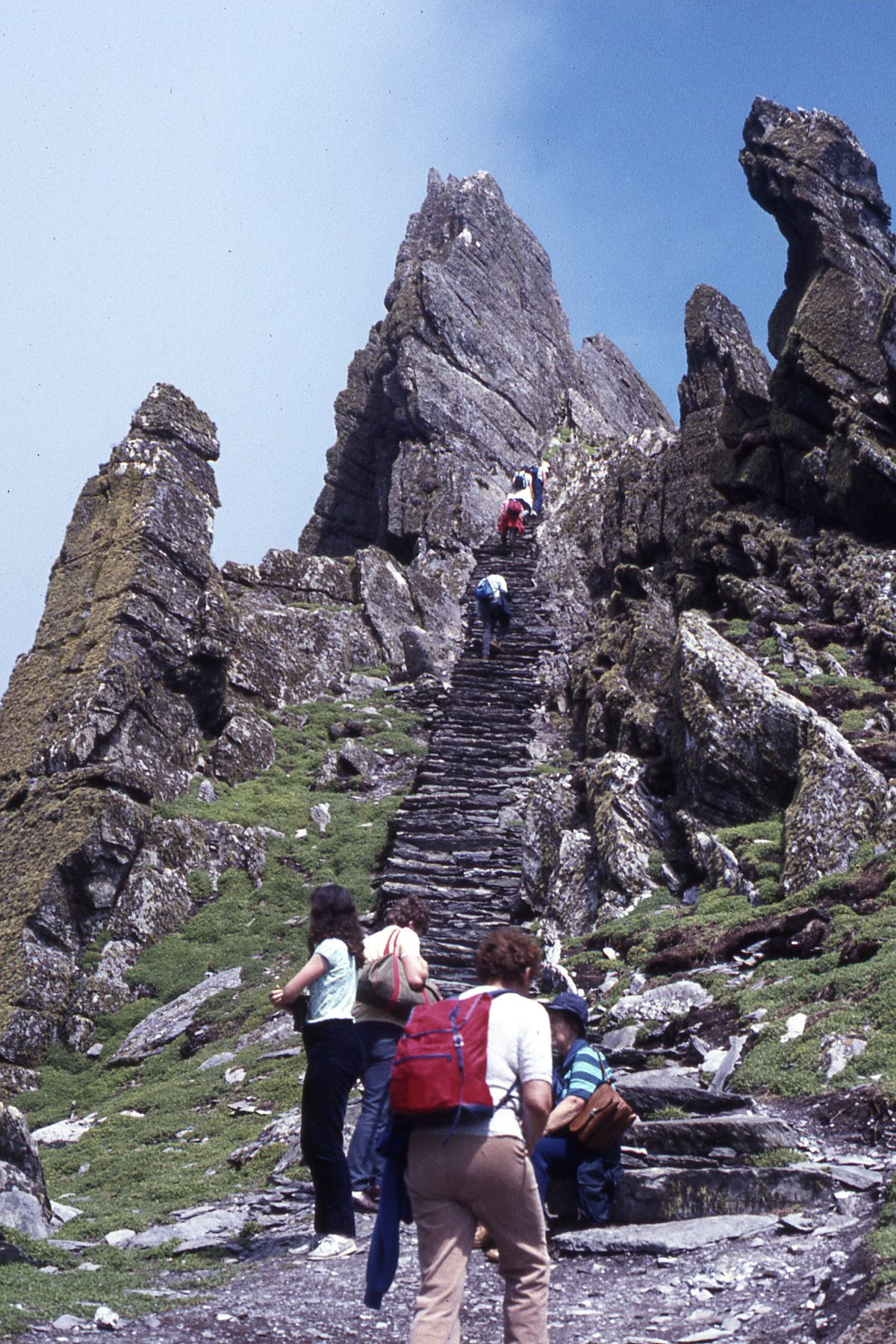
Skellig Michael is not a place that lends itself to comedy at first glance. The island rises 218 metres straight out of the ocean, its twin peaks visible from the Kerry mainland on clear days. Sixth-century monks built a monastery up there and lived in stone beehive huts for six hundred years. The wind never stops. The waves reach heights that make the crossing genuinely dangerous even in summer.
That impossibility was precisely the point. To say someone was ‘sailing to Skellig’ was to say they were so far behind on getting married that they’d have to brave winter Atlantic swells, seasickness, and sheer vertical rock face for one last chance at a wedding. The exaggeration was the humour — and so was the implied insult.
Skellig Michael’s ancient spiritual reputation gave the joke its edge. This was no ordinary island — it was one of the most sacred sites in early Irish Christianity, a place of fasting, prayer, and isolation. The idea of overdue couples storming its shores to find a priest willing to perform a wedding was absurd in the most delicious way possible.
For those curious about the island’s real history, the story of Skellig Michael’s monks is one of the most extraordinary chapters in Irish heritage — a community that survived at the edge of the known world for generations.
How the Lists Were Made
The mechanics of the Skellig List were loose, which was part of its appeal. Anyone with a pen and a bit of mischief could contribute. In some areas, the lists were published in local newspapers. In others, they were handwritten broadsheets pinned to the church gate or the door of the public house. In small townlands, they were simply read aloud at the crossroads for the entertainment of whoever happened to be standing there.
The format was always the same: couples listed in pairs, with a note that they were bound for Skellig that evening, or that morning, or at first light. Some lists were short and pointed — ten names, maybe twelve, all of them local. Others ran to dozens of entries and included couples from the next parish who had no idea they’d been nominated.
Some names on the list were genuinely unmarried people who had simply run out of time before Shrove Tuesday. Others were people who had barely exchanged a word, paired up by a neighbour with a sense of humour and an eye for gossip. Either way, appearing on the Skellig List meant everyone in a ten-mile radius now considered your love life open for discussion. (For the deadline that made the joke possible, see our deep dive on why every unmarried Irish person dreaded being named on the Skellig List.)
☘️ Enjoying this? 64,000+ Ireland lovers get stories like this every week. Subscribe free →
The Community Behind the Joke
What made the Skellig List work was not cruelty but intimacy. Rural Irish communities in the nineteenth and early twentieth centuries were small enough that everyone truly did know everyone else’s business. A young man who had been visiting the same farmhouse rather too often was not going unnoticed. A girl who had been seen at the crossroads dances three weeks running with the same partner was the subject of conversation long before her name appeared in print.
The Skellig List gave those observations a public, comic shape. It was mockery wrapped in tradition, and the Irish were very good at both. Couples who took it in good spirit were cheered. Those who bristled were teased a little louder. The best response — and everyone knew it — was to laugh along and say you’d have to check the tide tables.
Irish wedding traditions have always carried a note of community performance, from the straw boys who crashed weddings uninvited to the rituals that followed couples into their new lives. The Skellig List was simply the teasing that came before the wedding — the community’s way of saying it had noticed, and approved, and was already invested in what came next.
When the Lists Disappeared
The Skellig List tradition began to fade in the early decades of the twentieth century. Ireland was changing — becoming more urban, more self-conscious, more careful about how its customs looked from the outside. The idea of publicly mocking Lenten observance, even in jest, felt less comfortable as the decades passed.
By the 1950s, the lists had largely vanished from print. A few local papers in Kerry and Clare kept the practice alive into the 1960s, but the entries grew shorter each year. By the time the next generation came of age, many had never heard of the tradition at all.
What survived was memory and affection. Old-timers in the parishes where the lists had been most active could still recall names that had appeared generation after generation — the same family surnames cropping up on the Skellig List just as their parents’ had before them. There was no shame in being remembered that way. If anything, it was a kind of local fame.
What the Skellig List Says About Ireland
In a culture that could be deeply serious about faith, land, and family, the Skellig List stood apart as something rare: a tradition that was entirely, unashamedly playful. It did not mock love. It celebrated the inconvenience of it. The people on the list were not figures of disgrace — they were neighbours whose unmarried state was well-known enough for someone to poke fun at.
There is something worth holding on to in that. The Skellig List asked nothing of the people it named except the ability to laugh at themselves. And in rural Ireland, that was never in short supply. The Claddagh ring with its famous motto of love, loyalty, and friendship might be the most enduring symbol of Irish romance — but the Skellig List, with its satirical newspaper columns and its imaginary Atlantic crossings, might be the most honest.
It said: we see you. We see what you feel. And we think it’s worth writing down.
The lists are gone now. But every year around Shrove Tuesday, someone in Ireland still makes a joke about a still-single friend that travels precisely the same road. The humour is the same. The kindness behind it is the same.
Some traditions don’t need to survive in print to keep living.
☘️ You Might Also Love
☘️ Want More Hidden Ireland?
Join 64,000+ subscribers who discover Ireland’s best-kept secrets every week.
Subscribe Free — Join the Community →
Free forever · Unsubscribe anytime · No spam
📥 Free Download: Ireland Travel Planning Guide
Our most popular resource — itineraries, insider tips, and the 50 places you must not miss.
Tours & experiences you might love


Powered by Viator. Some links are affiliate links — we may earn a small commission at no extra cost to you.
Secure Your Dream Irish Experience Before It’s Gone!
Planning a trip to Ireland? Don’t let sold-out tours or packed attractions spoil your journey. Iconic experiences like visiting the Cliffs of Moher, exploring the Rock of Cashel, or enjoying a guided walk through Ireland’s ancient past often sell out quickly—especially during peak travel seasons.

Booking in advance guarantees your place and ensures you can fully immerse yourself in the rich culture and breathtaking scenery without stress or disappointment. You’ll also free up time to explore Ireland’s hidden gems and savour those authentic moments that make your trip truly special.
Make the most of your journey—start planning today and secure those must-do experiences before they’re gone!